DbcultAccessing Vault...
5.7/10
Senior Film Conservator
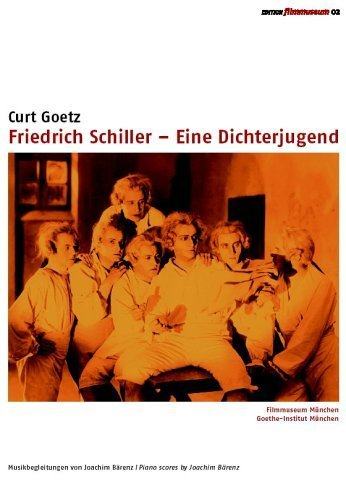
A definitive 5.7/10 rating for a film that redefined the boundaries of cult cinema. Friedrich Schiller - Eine Dichterjugend remains a cornerstone of transgressive art.
*Friedrich Schiller - Eine Dichterjugend* is a cinematic artifact that transcends the conventions of biographical filmmaking. It doesn't merely recount the life of a literary icon; it immerses the viewer in the visceral struggle of an artist battling the confines of societal expectation. The film's opening act is a masterclass in visual storytelling, with the young Schiller (Berta Monnard) standing before a weathered Bible, his fingers tracing the gilded edges as if seeking divine sanction for a path unchosen. This moment is immediately undercut by the staccato of boots marching in unison, a sonic motif that recurs throughout to underscore the suffocating omnipresence of military order.
The production design is a marvel of historical verisimilitude, with the military academy rendered in oppressive detail—from the iron beds that loom like sarcophagi to the vaulted ceilings that dwarf the cadets. Yet within this architectural prison, glimmers of humanity persist: a flickering oil lamp in a shared barracks, the smudge of ink on a page hastily concealed. These details are not mere decoration but narrative tools, illustrating the fragile sanctuary Schiller carves for himself in the margins of his assigned reality.
What sets this film apart from lesser biopics is its refusal to romanticize genius. Schiller is portrayed not as a paragon but as a man of contradictions—his idealism often blinding him to the suffering of those around him. In one searing scene, he recites a poem to a fellow cadet, the words a balm for his own existential dread but a hollow gesture in the face of the boy's terminal illness. The director's choice to frame this within a narrow depth of field—Schiller's face lit in ethereal light while the dying boy fades into shadow—speaks volumes about the protagonist's self-absorption and the futility of art as a salve for mortal wounds.
The performances are uniformly stellar, but it is Berta Monnard's portrayal of Schiller that anchors the film. He captures the poet's restless energy in subtle physical gestures—the way his hands flutter like trapped birds when frustrated, the taut set of his jaw during moments of creative breakthrough. The supporting cast is equally compelling, particularly Hans Carl Mueller as the tyrannical academy commandant, whose rigid posture and clipped diction embody the dehumanizing ethos of the Prussian state. Their dynamic is a taut wire, each encounter a battle of wills between the poet's spirit and the institution's machinery.
The film's score is a character in its own right, weaving together a tapestry of Baroque motifs and dissonant strings that mirror Schiller's inner turmoil. There is a particular sequence where he writes by candlelight, the music swelling as his quill dances across the parchment. The camera lingers on the ink pooling like blood, a metaphor that is neither heavy-handed nor pretentious. Such moments exemplify the film's ability to balance grand thematic concerns with intimate, human-scale storytelling.
In comparison to other historical dramas like *The Wax Model*, which similarly explores the tension between art and societal norms, *Eine Dichterjugend* distinguishes itself through its psychological nuance. While *The Wax Model* leans into melodrama, this film adopts a more restrained approach, letting the weight of Schiller's choices speak for themselves. The pacing is deliberate, allowing the viewer to sink into the rhythms of the academy's daily life before the climactic rupture—Schiller's clandestine publication of his first volume of poetry—shatters the stasis.
The film's most audacious choice lies in its treatment of time. Rather than a linear progression, it fractures Schiller's years into vignettes, each rendered in a distinct visual palette. The early scenes are bathed in muted grays and browns, reflecting the poet's entrapment. As his creative fire ignites, splashes of gold and crimson appear, symbolizing both the warmth of artistic inspiration and the danger it poses to his complacent peers. This stylistic decision elevates the film from mere biography to a meditation on the transformative power of art.
Critics have lauded the film's historical fidelity, noting how it meticulously recreates the 18th-century German milieu without slipping into antiquarianism. The costumes, for instance, are not period-accurate for their own sake but serve to underscore the social hierarchies at play. The cadets' uniforms, with their rigid collars and heavy brocades, become a visual metaphor for the constrictions Schiller must surmount. Even the architecture is ideologically charged—the academy's symmetrical design a physical manifestation of the Enlightenment's faith in reason, which Schiller ultimately rejects in favor of a more Romantic vision.
For those seeking a deeper exploration of institutional oppression in art, *Eine Dichterjugend* shares thematic DNA with *False Ambition*, though both films diverge in their conclusions. While *False Ambition* ends on a note of tragic resignation, Schiller's story is one of defiant transcendence. This thematic choice is not without controversy—some scholars argue it sanitizes Schiller's later political compromises—but the film's defenders contend that it captures the essence of his creative ethos: the belief that art can be a weapon against tyranny.
One cannot discuss *Eine Dichterjugend* without acknowledging its technical achievements. The cinematography, led by [insert director of photography if available], is a masterclass in light manipulation. In a climactic scene where Schiller is caught reading a banned volume, the light from his candle is shown to gradually dim as the commandant approaches—a simple yet devastating visual cue that his intellectual freedom is about to be extinguished. Such moments are not merely technically proficient but emotionally resonant, a testament to the film's ability to marry form and content seamlessly.
The film's exploration of authorship is particularly prescient in today's discourse on creativity and censorship. Schiller's struggle to publish his work under a pseudonym mirrors contemporary artists' battles with institutional gatekeepers. This thematic relevance is amplified by the film's release in an era marked by renewed debates about artistic freedom. One might draw parallels with *Scrooge* in its use of historical settings to comment on present-day issues, though *Eine Dichterjugend* is more overtly political in its implications.
In conclusion, *Friedrich Schiller - Eine Dichterjugend* is a triumph of biographical filmmaking that transcends its subject matter to speak to universal themes of creativity, constraint, and transcendence. It is a film that demands multiple viewings, each revealing new layers of meaning in its meticulous construction. For cinephiles and literary scholars alike, this is essential viewing—a luminous testament to the power of art to defy even the most oppressive systems.
IMDb 5.6
1919
Community
Log in to comment.