DbcultAccessing Vault...
Cult Review
Senior Film Conservator
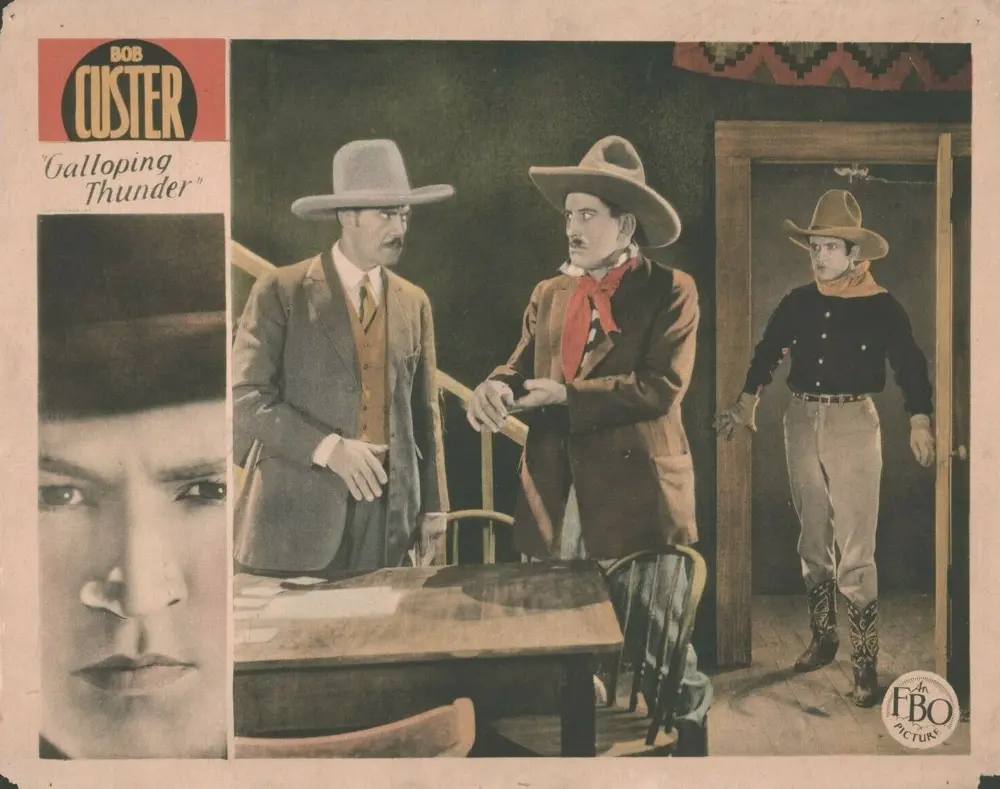
Is Galloping Thunder worth your time in the modern age? Short answer: No, unless you are a dedicated historian of the silent era or a fan of Bob Custer’s specific brand of stoicism.
This film is for the archival enthusiast who finds beauty in the grain and the mechanical rhythm of 1920s filmmaking. It is definitely not for the casual viewer who requires snappy dialogue or complex character arcs to stay engaged.
This film works because the stunt work and horse-riding sequences are genuinely dangerous and lack the safety-first polish of modern cinema.
This film fails because the narrative is a carbon copy of dozens of other 'Poverty Row' Westerns from the same period, offering zero surprises.
You should watch it if you want to see the DNA of the B-Western before it was sanitized by the Hays Code and the arrival of sound.
Bob Custer was never going to be an Oscar contender. In Galloping Thunder, his performance is as rigid as the mesas he rides past. He possesses a specific kind of physical presence that worked well in 1927, but by today's standards, his emotional range is practically non-existent.
There is a moment in the second act where Custer’s character must choose between his mission and the safety of the rancher’s daughter. His face remains a mask of indifference. It is almost comical. However, when he leaps onto a moving horse, the film transforms. He was a stuntman first and an actor second.
Compare this to the more nuanced performances in something like A Son of Erin. While that film dealt with different themes, the lead had a flicker of internal life. Custer is just a statue that can ride fast.
Director George Morgan and writer W. Bert Foster weren't interested in art. They were interested in efficiency. The cinematography in Galloping Thunder is utilitarian, yet it captures the California desert with a harsh, overexposed reality that modern digital filters can't replicate.
The saloon set is clearly a rickety construction, but the dust in the air feels real. You can almost smell the cheap whiskey and horse sweat. The lighting is flat, yet effective during the outdoor chases. The camera stays wide, allowing the viewer to see the scale of the pursuit.
This technical simplicity is a double-edged sword. It lacks the visual experimentation found in international films of the time, such as Tseka komissar Mirostsenko. Morgan wasn't trying to change the language of cinema; he was trying to fill a double bill.
In many 1920s Westerns, the horse was billed as a co-star. In Galloping Thunder, the horse arguably gives a better performance than the human cast. The titular 'Thunder' is responsible for the film’s most memorable moments, including a rescue sequence that defies logic.
The pacing of the film relies entirely on these animal-led action beats. When the horses aren't moving, the movie grinds to a halt. The dialogue cards are sparse and often redundant. We don't need a card to tell us the villain is evil; Richard Neill’s mustache-twirling does all the work.
This reliance on physical action makes it more watchable than the slower melodramas of the era, like The Stubbornness of Geraldine. It’s pure, kinetic energy trapped in a silent box.
Galloping Thunder is worth watching only if you are researching the evolution of the Western genre. It provides a clear look at the tropes that would eventually define the 1930s and 40s. For anyone else, the repetitive plot and wooden acting will be a chore to sit through.
It works. But it’s flawed. It’s a product of a factory system that prioritized volume over depth. If you want a masterpiece, look elsewhere. If you want 55 minutes of vintage horse chases, this is your film.
When placed alongside The Mutiny of the Bounty, the budget constraints of Galloping Thunder become painfully obvious. While other films were pushing for epic scale, this movie was content with a small-town skirmish.
It lacks the charm of Pals First or the comedic timing of Der müde Theodor. It sits in a strange middle ground of being too serious to be fun and too simple to be profound. It is a workhorse of a film.
Pros:
The location shooting is authentic and rugged.
The film is short, making it an easy watch for completionists.
The final chase sequence is genuinely well-edited for 1927.
Cons:
The plot is indistinguishable from other B-Westerns.
Anne Sheridan is given almost nothing to do but look worried.
The print quality of existing versions is often poor.
W. Bert Foster’s script is a checklist of clichés. You have the mysterious stranger, the corrupt businessman, and the damsel in distress. There is no subversion of these roles. In a year where cinema was beginning to experiment with films like The Eye of Envy, Galloping Thunder feels like it was written in 1915.
The pacing is lopsided. We spend twenty minutes on a subplot involving a stolen horse that doesn't actually impact the climax. It feels like padding. Even at under an hour, the movie feels long.
However, there is a brutal simplicity to it that I respect. It doesn't pretend to be more than a Saturday afternoon distraction. It is honest in its mediocrity. It doesn't reach for the stars and fail; it reaches for the dirt and succeeds.
George Morgan’s direction is invisible. This isn't necessarily a bad thing, but it means the film lacks a distinct personality. He puts the camera where the action is and lets it roll. There are no creative angles or experimental lighting choices here.
The editing is the only place where the film shows some spark. The cross-cutting during the final shootout creates a sense of tension that the script fails to provide. It’s a technique seen more effectively in My Hero!, but it works well enough here to keep you from turning it off.
One surprising observation: the film uses a lot of medium-close shots for the villains, which makes their defeat feel more personal. It’s a small touch, but it’s the only time the camera feels like it has an opinion.
Galloping Thunder is a functional piece of Western history. It isn't a hidden gem, and it won't change your life. It is a dusty, rattling wagon of a movie that manages to get to its destination without losing a wheel. If you’ve already seen the greats like Vengeance, you might find some minor enjoyment here. Otherwise, leave it in the vault.
IMDb 5.7
1918
Community
Log in to comment.