DbcultAccessing Vault...
Cult Review
Senior Film Conservator
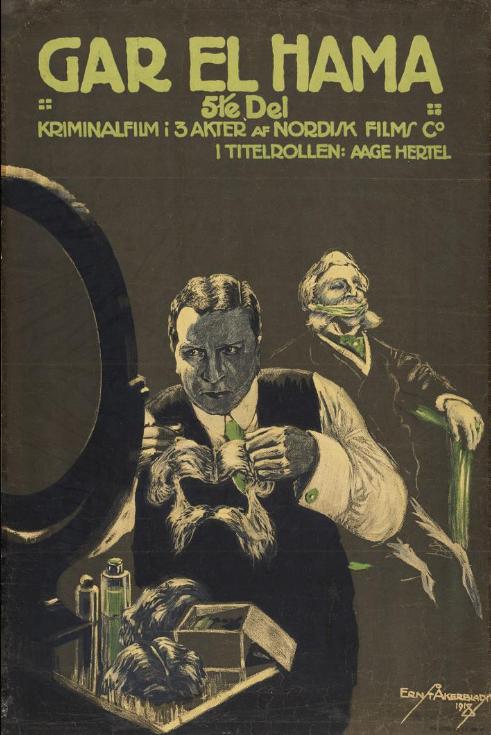
The annals of early cinema are replete with figures of audacious villainy and unwavering heroism, yet few have etched themselves into the collective consciousness with the indelible mark of Gar el Hama. In its fifth installment, Gar el Hama V, the Danish cinematic tradition of the master criminal reaches an apex of intricate plotting and psychological depth, cementing its status as a paragon of silent-era thrillers. This isn't merely a film; it's a meticulously crafted puzzle box, each frame a clue, each performance a nuanced brushstroke in a larger canvas of human guile and societal intrigue. To revisit this work is to be reminded of the sheer ingenuity that defined storytelling before the advent of synchronized sound, relying solely on visual poetry, expressive acting, and the boundless imagination of its audience.
At the heart of Gar el Hama V lies the audacious theft of the 'Eye of Ra,' a sapphire of such mythical proportions that its mere existence seems to invite transgression. Lady Eleanor, portrayed with a captivating blend of aristocratic poise and burgeoning vulnerability by Agnes Andersen, becomes the unwitting epicenter of this maelstrom. The initial scene of the gem's disappearance from her supposedly impregnable vault is a masterclass in suspense, building tension not through overt action, but through the creeping realization of an impossible feat. Peter Nielsen's script, a testament to his inventive prowess, ensures that the audience is never quite sure of the culprit's methods, only of the chilling efficacy of their execution. This is where Gar el Hama, embodied with an almost ethereal cunning by Svend Melsing, truly shines, not just as a thief, but as a performance artist of crime, each move a calculated piece in a grand, theatrical charade.
Svend Melsing's portrayal of Gar el Hama is nothing short of iconic. He imbues the character with a mesmerizing blend of aristocratic charm, intellectual arrogance, and a predatory stillness that suggests a mind always several steps ahead. Melsing’s Gar el Hama is not merely a criminal; he is a philosopher of larceny, a man who views the world's treasures as mere playthings in a larger game of wits. His disguises are not just physical alterations but complete transformations of persona, each one convincing enough to fool not only the characters within the film but often the audience itself. This chameleon-like quality is crucial to the film's narrative complexity, making it difficult to discern where the true Gar el Hama begins and the intricate web of his illusions ends. His quiet intensity, conveyed through subtle gestures and piercing gazes, speaks volumes without uttering a single word, a testament to the power of silent acting.
Opposing this formidable intellect is Inspector Sanders, brought to life with a compelling blend of tenacity and quiet exasperation by Gerhard Jessen. Jessen’s Sanders is not a caricature of the bumbling detective; rather, he is a man of keen observation and methodical deduction, constantly grappling with the elusive nature of his adversary. The dynamic between Melsing and Jessen forms the very backbone of the film, a cerebral chess match played out across the opulent drawing rooms and shadowy alleyways of Copenhagen. Sanders' frustration is palpable, his determination unwavering, as he navigates the labyrinthine clues left in Gar el Hama's wake. This cat-and-mouse game elevates Gar el Hama V beyond a simple crime story, transforming it into a study of obsession and intellectual rivalry, reminiscent of the enduring fascination with characters like Sherlock Holmes and Professor Moriarty.
The strength of Gar el Hama V is significantly bolstered by its meticulously cast supporting players, each contributing vital nuances to the overarching narrative. Agnes Andersen, as Lady Eleanor, provides the emotional anchor, her initial aristocratic composure slowly eroding under the weight of the escalating mystery and personal betrayals. Her performance subtly conveys the terror of vulnerability when one's world is shattered by unseen forces. Ingeborg Bruhn Bertelsen, as Elise, Lady Eleanor's maid, executes a remarkable turn, shifting from a figure of unassuming loyalty to a key, albeit reluctant, player in Gar el Hama's intricate scheme. Her quiet desperation and internal conflict are masterfully portrayed, adding a layer of tragic complexity to the film's moral landscape.
Aage Hertel’s Lord Ashworth, Lady Eleanor's fiancé, introduces a crucial element of human frailty and societal pressure. His secret gambling debt is not merely a plot device; it serves as a potent commentary on the hidden vices lurking beneath the veneer of high society, making him an easily manipulated pawn in the larger game. Hertel portrays Ashworth with a convincing blend of desperation and misguided loyalty, his character’s tragic arc adding a poignant dimension to the film. Furthermore, Anton de Verdier, as 'The Scorpion,' provides a formidable counterpoint to Gar el Hama. De Verdier’s portrayal is one of cold, calculating malice, devoid of Gar el Hama's theatricality, making him a truly chilling antagonist. The rivalry between these two criminal masterminds – one a showman, the other a silent predator – injects a thrilling layer of inter-criminal conflict, demonstrating that even in the underworld, power struggles are rife. This multi-faceted cast, under the astute guidance of the filmmakers, transforms a simple crime narrative into a rich tapestry of human motivations and societal critiques.
The cinematic language of Gar el Hama V is a testament to the sophisticated visual storytelling prevalent in Danish silent cinema. The film masterfully employs chiaroscuro lighting, creating deep shadows and dramatic highlights that not only enhance the mystery but also mirror the moral ambiguities of its characters. The opulent sets, from Lady Eleanor's lavish estate to the clandestine dens of the underworld, are meticulously designed, immersing the viewer in a world of stark contrasts between public grandeur and private vice. The pacing is deliberate, allowing moments of quiet tension to build before erupting into bursts of frantic action or revealing plot twists. The use of close-ups, particularly on the faces of Melsing and Jessen, effectively conveys the intense intellectual struggle between them, allowing their subtle expressions to communicate complex emotions and deductions.
One could draw parallels between its atmospheric tension and the early German Expressionist works, though Gar el Hama V retains a distinctly Danish realism amidst its dramatic flourishes. The film’s visual lexicon is less about distorted realities and more about heightening naturalistic environments to evoke a sense of unease and intrigue. The camera work, while perhaps not as overtly experimental as some contemporaries, is remarkably effective in guiding the viewer's eye, revealing information strategically and maintaining a constant state of engagement. Each frame is composed with an artist's precision, contributing to a sense of impending revelation that permeates the entire film. This commitment to visual narrative ensures that even without dialogue, the story's complexities and emotional undercurrents are conveyed with astonishing clarity.
Beyond its thrilling plot, Gar el Hama V delves into profound thematic territory, exploring the multifaceted nature of deception and the fluid boundaries of morality. Gar el Hama himself embodies the allure of the anti-hero, a figure whose transgressions are often overshadowed by his sheer brilliance and an almost artistic commitment to his craft. He challenges the rigid structures of justice, forcing Sanders and, by extension, the audience, to question the very definition of right and wrong when confronted with such sophisticated villainy. The film also cleverly dissects the facades of high society, revealing the hidden weaknesses and moral compromises that exist beneath the polished exteriors. Lord Ashworth's gambling debt and Elise's unwitting complicity serve as poignant reminders that vulnerability and ethical ambiguity are not confined to the criminal underworld but permeate all strata of society.
The film resonates with the psychological depth often found in crime dramas of its era, perhaps even more so than some of its contemporaries. One might compare its exploration of moral ambiguity to Dämon und Mensch, which similarly grappled with the internal struggles of its characters against a backdrop of societal judgment. However, Gar el Hama V grounds these themes in a more tangible, less overtly symbolic narrative. The film asks: what constitutes true power? Is it the authority of the law, or the intellectual dominance of a mind that can bend reality to its will? This nuanced approach to character motivation and societal critique elevates the film beyond mere entertainment, transforming it into a compelling piece of social commentary.
When viewed through a comparative lens, Gar el Hama V reveals its unique position within early cinematic history. Its intricate plot involving a grand jewel heist might evoke memories of films like The Great Ruby, yet Gar el Hama V distinguishes itself with a deeper exploration of psychological warfare and character complexity, rather than solely focusing on the mechanics of the crime. The serial nature of the Gar el Hama saga itself places it alongside other popular serials of the time, such as Nattens datter II, though Gar el Hama's intellectual prowess often sets him apart from more conventional villains.
The film's relentless suspense and the sense of impending doom it cultivates could be loosely associated with the tension found in The Warning, though Gar el Hama's narrative is more about the unraveling of a mystery than the anticipation of a known threat. The use of secret locations and hidden motives, particularly in the machinations of 'The Scorpion,' mirrors the intrigue found in films like Das Geheimschloss, adding layers of clandestine operations to the central narrative. Furthermore, the film's ability to portray strong, albeit conflicted, female characters like Lady Eleanor and Elise, while not as overtly central as the protagonist in The Gun Woman, nonetheless highlights the evolving roles and complexities afforded to women in cinematic narratives of the period. Even the underlying emotional currents, particularly those affecting Lady Eleanor and Lord Ashworth, touch upon themes of love and sacrifice, albeit in a darker vein than a film like Love Never Dies, proving that even within the confines of a crime thriller, the human heart finds a way to express its profound struggles.
The meticulous attention to detail in Peter Nielsen's writing, which constructs a world where every action has a consequence and every character holds a secret, gives the film a narrative density that few contemporaries could match. It’s a testament to the fact that compelling storytelling transcends technological limitations. The film's lasting impact lies not just in its thrilling plot, but in its ability to create characters that feel real, even in the exaggerated world of a master criminal. It invites repeated viewings, each time revealing new layers of its intricate design, much like a complex piece of literature. The sheer ambition of its narrative, coupled with the stellar performances, ensures its place as a truly remarkable piece of early Danish cinema, demonstrating that the pursuit of justice, or indeed, the evasion of it, can be as compelling and artistically rich as any other human endeavor.
The enduring resonance of Gar el Hama V lies in its timeless portrayal of the eternal struggle between order and chaos, intellect and instinct. It is a film that speaks to the fascination humanity has always held for the brilliant rogue, the individual who operates outside conventional norms yet commands a grudging respect. The character of Gar el Hama, as envisioned by Peter Nielsen and embodied by Svend Melsing, transcends the mere archetype of the villain; he becomes a symbol of ultimate freedom, albeit one achieved through illicit means. His actions force a re-evaluation of societal constructs, prompting viewers to consider the arbitrary nature of laws when confronted with a genius who can effortlessly circumvent them.
The film's influence can be traced through subsequent generations of crime thrillers, particularly those that prioritize cerebral plotting over brute force. Its sophisticated use of misdirection, false leads, and the psychological manipulation of its characters set a high bar for the genre. The tension between Gar el Hama and Sanders, a relationship built on mutual respect despite their opposing roles, foreshadows countless detective-criminal pairings in later cinematic and literary works. The meticulous world-building and character development also serve as a blueprint for creating immersive cinematic universes, demonstrating that even within the constraints of silent film, a rich and expansive narrative could be crafted. Gar el Hama V stands not just as a historical artifact, but as a vibrant, living piece of cinema that continues to captivate and challenge, a testament to the power of inventive storytelling and the enduring appeal of a truly formidable mind, whether on the side of angels or demons. Its legacy is etched not just in the annals of Danish cinema, but in the broader tapestry of global film history, reminding us that true artistry knows no temporal bounds.
IMDb —
1916
Community
Log in to comment.