DbcultAccessing Vault...
Cult Review
Senior Film Conservator
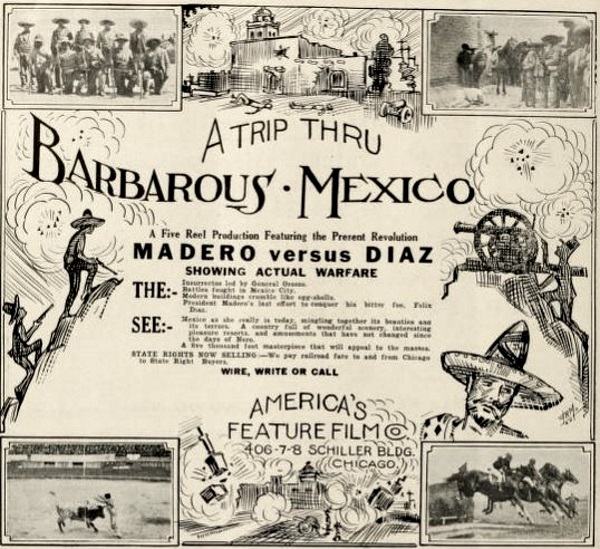
Imagine the year 1911: Europe teeters on the lip of modernism, Griffith is still tinkering with cross-cuts in Fort Lee, and out of a makeshift studio in Mexico City emerges Barbarous Mexico—a film that arrives like a live round across the sternum of polite cinema. H. Hood, an itinerant cameraman previously content to chase boxing belts and royal processions, now trains his hand-crank on a country ripping itself open. The resulting images feel less like archival curios than shrapnel you can still pluck from the national psyche.
What unfurls across seventeen jittery minutes is not the tidy, chronological lesson your history teacher promised. Instead, we get a palimpsest of violence: federales in ornate kepis charging through maguey; Zapatista horsemen swirling their serapes like matadors; women loading rifles while nursing infants—each frame soaked in a sulfuric glow that anticipates the Mexican noir of the 1940s. Hood’s camera doesn’t observe; it testifies. Every pan feels perilous, every iris-in like a moral verdict.
Scholars still bicker over whether the footage was shot in Morelos, Chihuahua, or entirely inside a repurposed bullring. Truth is, Barbarous Mexico is geography-agnostic; its true location is rupture. The edit jumps from wide shots of smoldering train tracks to claustrophobic portraits of prisoners roped like calves at a rodeo. Intertitles—hand-lettered on what looks like scavenged wrapping paper—bleat phrases like "¡Tierra y Libertad!" and "The tyrant’s throne trembles!" You can almost taste the kerosene.
Compare this mosaic to the tidy linearity of Glacier National Park or the stately tableaux of From the Manger to the Cross. Hood’s method feels closer to Eisenstein before Eisenstein: dialectical montage forged in actual gunfire. He juxtaposes a child’s broken sandal with a general’s sabre, letting the cut accuse.
Traditional revolutions are masculine pageants—moustaches, medals, machismo. Hood subverts that script by inserting a nameless soldadera as the film’s emotional spine. We first spot her lugging clay water-jars past federales; by reel two she’s cut her hair, strapped bandoliers across her rebozo, and become a scout. The camera loves her: a tight close-up lingers on her eyes—coal-bright, unblinking—until the frame itself seems to perspire. In 1911, such intimacy is radical, predating What 80 Million Women Want’s proto-feminist stance by a full presidential term.
Restored by Mexico’s Cineteca Nacional, the 4K scan reveals textures you’d swear were lost to rot: the velvet nap on a rebel’s sombrero, the amber sweat beading a horse’s flank, the cerulean haze of gunpowder mixing with dawn. These hues matter because they contradict the sepia myth we’ve been fed about early cinema. Hood’s Mexico is not a quaint diorama; it’s a bruise still ripening.
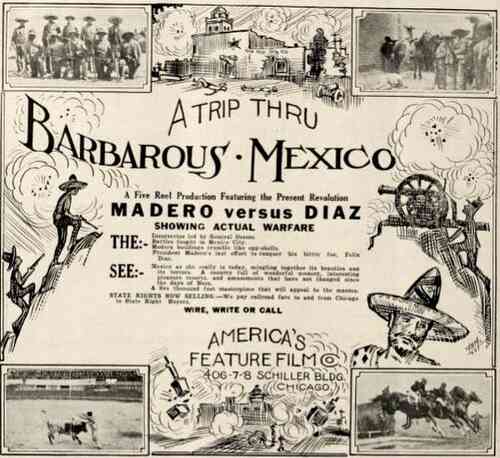
Note how the filmmaker exploits backlighting: soldiers advance against a sky so overexposed it turns the image into a silhouette of teeth and bayonets. The effect presages the expressionist horror of Dante’s Inferno and the chiaroscuro boxing in The Corbett-Fitzsimmons Fight. Yet here the stakes are national, not pugilistic.
Being a silent relic doesn’t mute Barbarous Mexico; it amplifies it. Without orchestral cushioning, each explosion—simulated by on-set dynamite—regains its original terror. When a locomotive derails into a ravine, the absence of a crash track forces you to supply the crunch of iron yourself, a synesthetic jolt that makes contemporary CGI carnage feel like cotton candy.
Hood’s politics? Slippery. One intertitle hails Madero as "apostle of democracy"; another shows his routed troops looting villages. The film refuses hagiography, preferring a polyphonic roar: landowners, anarchists, priests, foreign speculators—everyone gets a cameo, nobody exits clean. That ambiguity places the short closer to the moral murk of Les Misérables than to the patriotic certitude of The Independence of Romania.
After a hush-hush tour through Havana and Barcelona, the negative vanished for a century, surfacing in a Guadalajara flea market sandwiched between medical x-rays. Its resurrection coincided with 2020’s global protests, and clips now ricochet across social media, captioned "same fight, different century." Universities teach it as the first example of guerrilla filmmaking; cine-clubs pair it with Strike for a double shot of proletarian rage.
Stream the 4K restoration on Cineteca Canal (subtitles in 12 languages) or snag the Blu-ray from Flicker Alley complete with an essay on Hood’s transition from carnival fight films to revolutionary reportage. Warning: the enclosed booklet is addictive—vintage maps, casualty lists, even a fold-out replica of a Zapatista postage stamp.
Barbarous Mexico is not a relic; it’s a ricochet. Seventeen minutes of nitrate that manage to be origin story, autopsy, and prophecy for a nation perpetually negotiating the price of its breath. Hood didn’t just chronicle a revolution—he weaponized the very act of filming. Approach expecting staid documentary and you’ll leave with shrapnel in your soul. Approach expecting art, and you’ll find something far rarer: history still warm to the touch.

IMDb —
1920
Community
Log in to comment.