DbcultAccessing Vault...
Cult Review
Senior Film Conservator
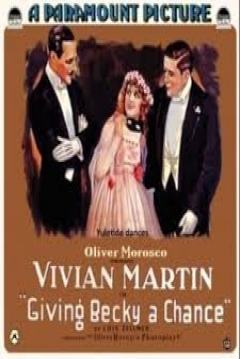
The year 1917 served as a pivotal threshold for American cinema, a time when the medium began to pivot from mere spectacle toward the nuanced psychological landscapes of the domestic drama. In the midst of this evolution, Giving Becky a Chance stands as a fascinating, if somewhat overlooked, exploration of the American Dream's more caustic edges. Directed with a keen eye for the spatial divides between the elite and the laboring class, the film utilizes the screenwriting prowess of Edith M. Kennedy and Lois Zellner to dissect the performative nature of social status. Unlike the more whimsical explorations of class found in Peggy, this narrative dives headlong into the visceral shame that often accompanies upward mobility.
Vivian Martin, an actress whose screen presence often oscillated between ingenue charm and a more grounded pathos, delivers a performance of remarkable complexity as Becky Knight. The film does not merely present her as a vain social climber; rather, it frames her deception as a survival mechanism within a rigid hierarchy. The contrast between the sterile, opulent hallways of the boarding school and the cramped, cluttered reality of her parents' shop is rendered with a chiaroscuro-like intensity. We see the parents, played with a heartbreaking stoicism, literally consuming less so that Becky can appear to have more. This theme of parental self-immolation is a recurring trope in silent-era moralities, yet here it feels particularly poignant, echoing the sentiments explored in Common Sense Brackett.
Becky’s fabrication of a wealthy lineage is not just a lie of convenience; it is an indictment of the environment that demands such credentials for entry. When she meets Dr. Tom Fielding, played by the stalwart Jack Holt, the film shifts into a more traditional romantic register, yet the underlying tension of her secret remains the primary engine of the plot. Fielding represents the 'ideal man' of the era—principled, professional, and perhaps a bit too quick to judge. His eventual discovery of Becky’s true origins occurs not through a dramatic confession, but through the harsh reality of medical necessity. The scene where he attends to her mother is a masterclass in silent film blocking, as the physical space of the humble home becomes a courtroom where Becky stands judged by her own shame.
Perhaps the most striking visual and thematic element of the film is Becky’s descent into the world of Ross Benson’s roadhouse. To save her father from the crushing weight of debt—a financial abyss that mirrors the struggles seen in The Ticket-of-Leave Man—she assumes the identity of a masked dancer. This sequence serves as a powerful metaphor for the entire narrative: Becky has been wearing a mask since the first reel, but only now, when she is literally masked, does she act with true integrity. The roadhouse, a den of vice and shadows, provides a stark contrast to the bright, artificial world of the boarding school girls. It is here that the film flirts with the 'fallen woman' genre, a territory explored with more gothic undertones in films like Moths.
The cinematography in these roadhouse scenes adopts a more frenetic energy. The mask Becky wears is not merely a costume; it is a shield against the predatory gaze of Ross Benson, played with oily menace by Jack Richardson. The struggle between Becky and Benson is the film’s emotional and physical climax. It is a moment of raw vulnerability that finally strips away the pretenses of her previous life. When Tom Fielding happens upon this scene, the film reaches its resolution not through a simple romantic reunion, but through Tom's realization that Becky’s 'deceit' was born of a desperate love, while her 'shameful' dancing was an act of profound nobility.
When examining Giving Becky a Chance alongside its contemporaries, one can see the fingerprints of a burgeoning social consciousness. For instance, the film shares a thematic DNA with The Woman in 47, particularly in its depiction of female agency under economic duress. However, where Miss Jackie of the Army might take a more patriotic or lighthearted approach to a woman’s role in society, Becky Knight’s journey is one of internal reckoning and external sacrifice. The screenplay by Kennedy and Zellner avoids the easy trap of making Becky a villain of vanity; instead, they craft a character who is a victim of the very aspirations her parents fostered.
The film also touches upon the fragility of the middle class, a theme that resonates through other works of the period like Lost in Darkness. The Knights are not the destitute poor, but the precarious 'simple shopkeepers' whose entire existence can be upended by a single illness or a bad investment. This economic anxiety provides a grounded reality to what could have been a standard melodrama. The resolution, where marriage serves as the ultimate social stabilizer, might feel conventional to modern audiences, but within the context of 1917, it represented a restoration of moral and social equilibrium.
Visually, the film utilizes the limited technology of its time to create distinct emotional atmospheres. The use of tinting—often lost in modern digital transfers—would have originally heightened the shifts between the warm, domestic scenes and the cool, dangerous nights at the roadhouse. The acting style, while still adhering to some of the theatrical gesticulations common in the 1910s, shows signs of the burgeoning 'naturalism' that would define the next decade. Vivian Martin’s ability to convey internal conflict through subtle shifts in posture and expression is particularly noteworthy. She lacks the ethereal quality of a Gish but possesses a relatable, earthbound intensity that makes Becky’s plight feel immediate.
In conclusion, Giving Becky a Chance is a vital artifact of a time when cinema was learning how to tell complex stories about the human condition. It challenges the viewer to look past the surface of social standing and to recognize the inherent dignity in sacrifice. It is a film that rewards close viewing, offering a window into the anxieties of a century ago that, surprisingly, still echo in our contemporary obsession with curated identities and social status. While it may not have the avant-garde ambitions of The Vampires: Hypnotic Eyes, its narrative core is as solid and enduring as the silent stars who brought it to life.
Recommended for fans of:

IMDb —
1931
Community
Log in to comment.