DbcultAccessing Vault...
Cult Review
Senior Film Conservator
The twentieth century’s most lethal engine was not armored but celluloid. In the spring of 1921, a khaki locomotive—number plates ripped off, red star soldered to the chimney—pounded south from Petrograd, shunting flatcars that carried neither coal nor cannons but reels of nitrate poised to explode inside peasants’ retinas. Dziga Vertov, gaunt in a leather trench coat, crouched between the buffers, winding his Debrie Parvo with the same crank rhythm as the wheels, thereby fusing kinetics with cognition: every turn of the handle advanced both train and argument. The resulting artifact, Agit-Train of the Central Committee, is less a film than a peripatetic synapse in the brain of a newborn state, a movie whose projector requires 750 kilometers of track for its screen.
Traditional synopsis feels absurd here; the plot is literally the timetable. Yet the emotional freight staggers: watch a single Ukrainian wheat field invaded by the locomotive’s shadow and you perceive what Eisenstein would later call montage—but here it is climate, not theory. Vertov’s camera straps itself to the cowcatcher, so the audience enters the shot amid steel and shimmer, panting through switch points that fling off sparks like molten quotations from Marx. Inside the boxcars, red velvet (stolen from some looted opera house) lines the walls; against this plush, propaganda acquires the erotic urgency of a striptease. When a sailor tears his shirt to reveal a chest tattoo of the hammer and sickle, the gesture feels less like display than birth—inked epidermis becoming flag.
Scholars keep hunting story; Vertov keeps eluding by delivering frequency. The picture’s spine is a percussive alternation: speed / stasis, shout whisper, electric glare / moonlit rust. At Station 19, the train brakes screech—an audio slash-cut—then we see women in headscarves listening to an agitator who recites bread rations as if reciting love letters. Close-ups of these faces, shot with a 28 mm lens that bends the world, make the women’s pores resemble black-sequined night, each freckle a star in a personal cosmology. Vertov understood that to politicize the masses you must first cosmicize them; once a milkmaid recognizes her cheekbones as geography, she will never again allow a landlord to redraw the map.
Editing occurs on the move. In a rattling darkroom—converted water closet—negative strips drip like entrails beside a samovar. The editor (Elizaveta Svilova, Vertov’s spouse and secret co-author) slices with surgical scissors once used for amputating frostbitten toes. She splices images of kulaks’ confiscated grain next to shots of urban bread queues, creating a dialectical punch that anticipates modern hashtag juxtapositions by a century. Because the train develops and projects within the same day, the depicted masses watch themselves transformed into protagonists before nightfall, a temporal compression that makes historical materialism feel like adrenaline.
Halfway through the odyssey, Vertov stages his coup: the camera turns rearward, recording not the world ahead but the act of recording. We see the brass lens iris closing like a steel flower; we see the crank handle blur into a halo; we see—most shocking—the faces of the filmmakers themselves, eyes squinting against sun flares, hair whipping like red flags. In 1921, this was heresy. Cinema still clung to the bourgeois illusion of objectivity; to reveal apparatus was tantamount to a magician exposing trapdoors. Yet Vertov’s confession is gleeful, almost carnal. He declares: “There is no deception, only electricity.” The statement echoes through later meta-masterpieces—from Hitchcock’s Rear Window to Jonze’s Adaptation—but here it is shouted above the hiss of steam, a manifesto etched in soot.
Compare this reflexivity to contemporaries also wrestling with self-image. Robbery Under Arms (1907) hides its camera behind eucalyptus scrub, pretending the outback just happens to enact drama. His Holiness, the Late Pope Pius X (1904) elevates the subject through cathedral incense so dense the apparatus itself seems blessed and thus invisible. Vertov, atheist bishop of mechanism, will have none of that sanctimony. His camera is crucifix and hammer, both sacred and profane, proudly mounted on plywood like a taxidermied god.
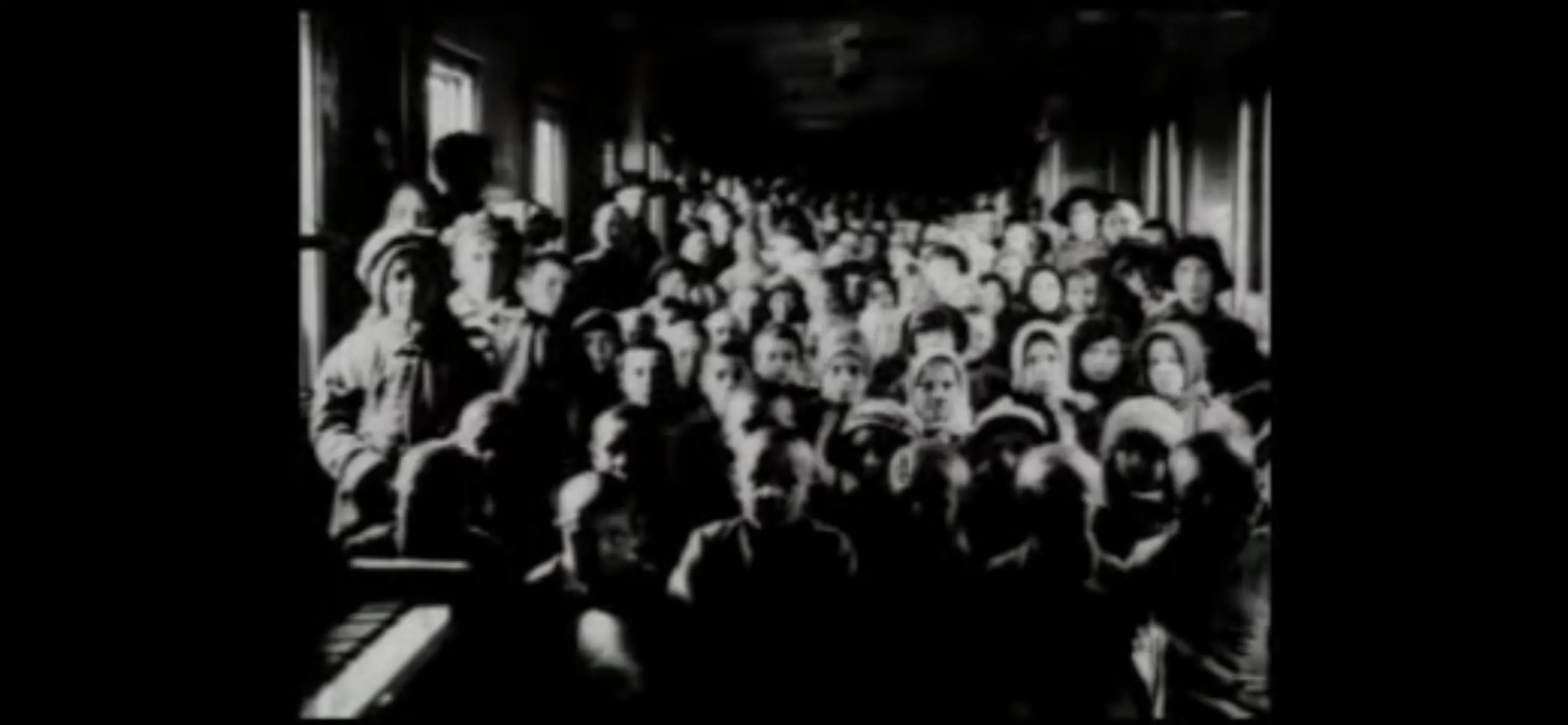
Contemporary prints arrive silent, but watch any decent restoration with live accompaniment and you will swear the original carried a score. The reason lies in Vertov’s rhythmic discipline: every shot ends on a downbeat, every splice aligns with the chug of connecting rods. Musicians—whether deploying Shostakovich-like brass clusters or anarchic junk-percussion—inevitably lock to the visual cadence, proving the director engineered an optical click track avant la lettre. Thus, the absent orchestra becomes a phantom limb the audience hallucinates, evidence that Vertov’s montage theory extends beyond image into neural entrainment.
Listen—metaphorically—to the clatter of wheels: it replicates the internal combustion of ideology, each cycle a thesis-antithesis-synthesis triad. Now compare this sonic architecture to The Life and Works of Verdi (1914), which relies on pre-existing operatic arias to graft sentiment onto mute frames; Vertov refuses external libretto, preferring the locomotive’s indigenous music, thereby achieving a purity that even the most avant-garde Wagnerian would envy.
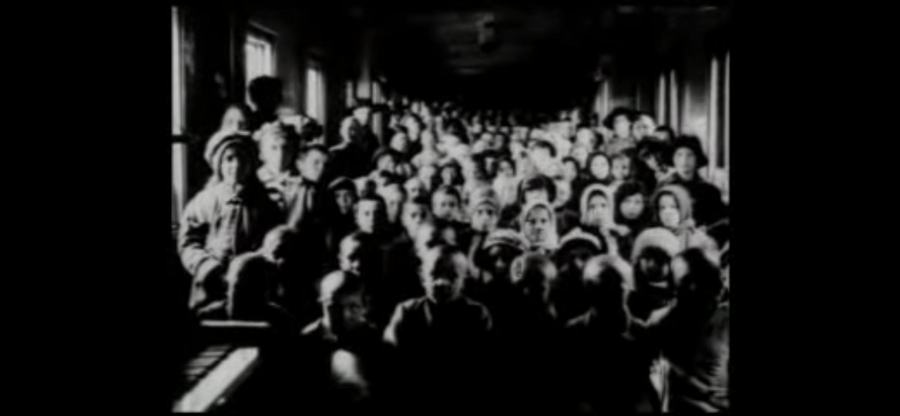
The close-up reigns sovereign. A Ukrainian teenager—freckles, crooked collar—stares into the lens while a subtitle (intertitle on a separate card) proclaims: “Yesterday illiterate, today delegate.” The declaration is mundane propaganda; the face is not. Micro-twitches at the corner of his mouth betray incredulity at his own fortune, the way a lottery winner still expects the ticket to be yanked back. Vertov holds the shot until discomfort metastasizes: the boy blinks, swallows, and in that swallow an entire social order slides from feudal throat into proletarian stomach. The moment lasts maybe four seconds—yet because the frame is isolated by harsh skylight that silverizes the boy’s pupils, the image detonates in the mind long after the train departs.
Such physiognomic warfare resurfaces—though for reactionary ends—in The Branded Soul (1917), where close-ups of the penitent nun manufacture mystic awe. Vertov, communist dermatologist, instead exposes pores as fields of class struggle; every blackhead is a bourgeois relic, every sweat droplet a potential torrent against palaces.
Nitrate stock, monochrome by chemistry, nevertheless secretes color in the mind. When crimson banners flap across the frame, their hue is absent yet hallucinated—a synesthetic side effect of prolonged ideological heat. Scholars label this chromatic suggestion; viewers simply feel the red burn the back of the retina. Vertov exploits this by juxtaposing scarlet textiles against snowy vistas, knowing the audience will paint the missing pigment more fiercely than Technicolor could manage. The gambit anticipates the saturated propaganda murals of the 1930s, but here the paintbrush is neurons.
Curiously, several reactionary melodramas of the same era—Tempest and Sunshine (1914), Shifting Sands (1918)—also flirt with red symbolism, though merely to denote passion or peril. Vertov’s red is not accent but engine: the color of history moving, not just warning.
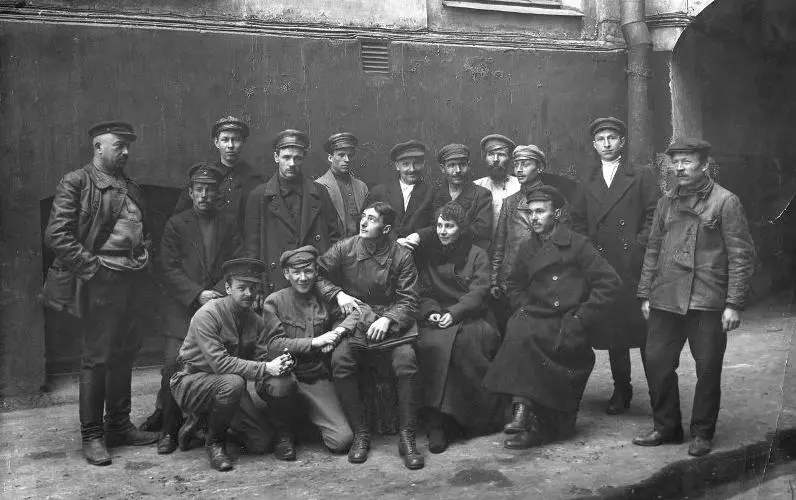
Notice the women: not decorative fluff, but splice-barriers around which narrative reshapes. A telegraph operator, hair pinned with stubby pencils, bangs out state decrees while her foot rocks a cradle; the oscillation between key and crib forms a duet of creation and communication. Vertov loves such double exposures of labor. Compare that with the flapper comedies of the late 1910s—say Twin Beds (1920)—where women’s bodies jitter for laughs; here, female bodies think aloud.
Yet the film is not matriarchal utopia. The director’s gaze still eroticizes the symmetry of machines—loving shots of drive-rods resemble phallic worship. Feminist critique can thus ambush Vertov: while he liberates women from kitchen kitsch, he shackles them to the same industrial tempo that devours male sinew. Still, within early Soviet cinema, any acknowledgment of double burden counts as radical aperture.
Today, when TikTok activists stitch clips into viral agit-prop, they unknowingly ride Vertov’s rails. The algorithmic feed is merely the agit-train digitized: every swipe equals a station stop, every micro-doc a banner raised. The crucial difference lies in ownership; Vertov’s apparatus belonged to the collective, whereas platform capitalism pockets the fare. Still, the formal grammar—juxtaposition, acceleration, self-reflexivity—springs from that rattling boxcar of 1921.
Film schools teach Eisenstein’s Battleship Potemkin (1925) as the template for revolutionary montage, yet Vertov’s train predates and outruns it. Where Eisenstein sculpts drama in five acts, Vertov disperses drama across mileage, a geography of upheaval. One wonders how different cinema might have evolved had the agit-train model become dominant: movies not confined to auditoria but projected on clouds, river mist, the sides of banks—an everywhere cinema dissolving the border between spectator and world.
Rating Vertov’s film with stars feels like using a tsarist ruble in a soviet canteen: the currency is obsolete. Instead, imagine a semaphore on a midnight steppe: the arm lifts, swings, stops—red, white, red—then disappears into darkness. That flicker is the appropriate verdict. It announces arrival, departure, possibility. A century later, the signal still blinks, urging each viewer to board whatever wheezing locomotive their era provides, to splice their own fragile strip of images into the endless reel called history.
So, if you can—find the restoration, rope a local percussionist, project it against a brick wall at dusk. Let the train roar again. And when the lights come up, notice how the world outside momentarily jitters, as if every passerby might be an intertitle in a film still running. That tremor, comrades, is the truest propaganda: not what you are told to see, but the moment you realize you are capable of operating the projector.
IMDb —
1934
Community
Log in to comment.