DbcultAccessing Vault...
Cult Review
Senior Film Conservator
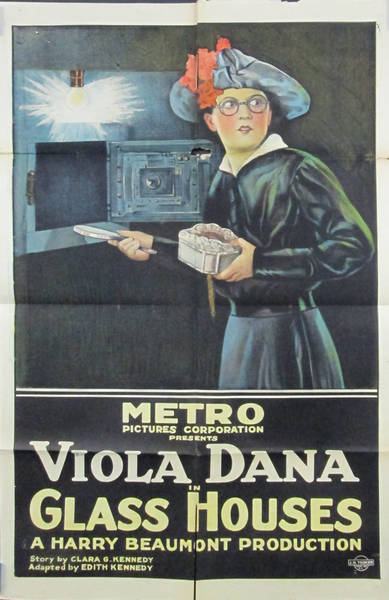
Glass Houses is the cinematic equivalent of a champagne coupe hurled against a parquet floor—effervescent, reckless, and astonishingly intact after the crash. Shot through with the brittle sparkle of 1922, it refuses the weepy romanticism of Smilin' Through or the pastoral melodrama of Polly of the Storm Country. Instead, it weaponizes the gag-and-gasp mechanics of farce to expose how easily identity can be tailor-made like a department-store dress pattern.
The narrative’s vertebrae hinge on Joy Duval’s masquerade: a silk-stocking heiress playing a calico-clad companion. Clara Genevieve Kennedy’s screenplay treats social mobility like a shell game; every time we think the pea of authenticity is under the thimble of performance, the camera glances away and the con re-congeals. When Joy and Billy wake to find themselves garage-marooned, the film stages its most subversive set-piece: two bodies separated by the length of a Duesenberg yet bound by the era’s rabid gossip hydra. The gag lands harder because director James W. Horne refuses close-ups; we observe the duo through a key-hole-wide iris shot, as if even the lens itself were scandalized.
Helen Lynch’s Joy is a master-class in micro-gesture. Watch the instant she pivots from dowdy companion to luminous bride: shoulders drop a quarter-inch, pupils flare, and the coy bend of her wrist becomes a manifesto. Ellsworth Gage’s Billy, saddled with the thankless “rich ne’er-do-well” archetype, escapes caricature by injecting a vein of self-mockery; his eyebrow arches like a dandy’s cane yet trembles with genuine bewilderment whenever Joy outmaneuvers him. Mayme Kelso’s Aunt Harriet deserves an entire ethnography—part Stoic philosopher, part bargain-hunting Lady Bracknell, she delivers lines via title cards that snap like winter twigs: “Virtue, my dear, is simply the art of being found out too late.”
Cinematographer Friend Baker lenses the mansion as a labyrinth of reflective surfaces. In one blink-and-miss-it gag, Joy’s silhouette superimposes over a stained-glass panel depicting Saint Veronica; the veil of the saint and the veil of the heroine’s lie collapse into one translucent joke. Elsewhere, a rogue wind gust slams a French window shut, fragmenting Billy’s reflection into half a dozen jittery shards—an omen that identity here is kaleidoscopic, never monolithic. Contrast this visual bravado with the pastoral single-point perspective of No Trespassing, and you appreciate how Glass Houses weaponizes interior décor as moral argument.
Where contemporaries like Every Girl's Dream treat femininity as a finish line, Glass Houses treats it as a revolving door. Joy’s shift from sepia servant to platinum-blonde socialite is achieved without a single dissolve; instead, the camera holds on her face while a different gown is literally tugged over her head by frantic maids, the fabric eclipsing the lens for three frames—an Eisensteinian cut-by-costume. The film insinuates that womanhood is not essence but upholstery, a proposition both cynical and weirdly liberating.
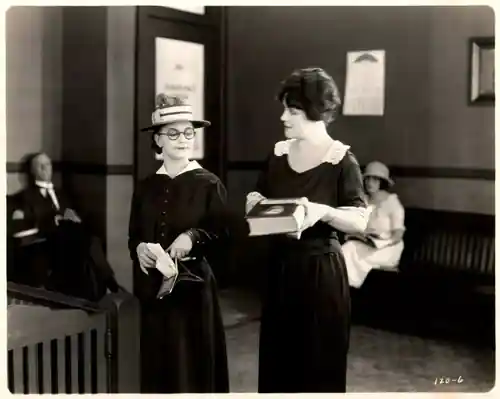
The Angel Face Ann subplot feels plucked from a pulp magazine, yet it dovetails thematically: if Joy can counterfeit a governess, why can’t the newspapers counterfeit her? A montage of front-page caricatures—each more grotesque—culminates in a police line-up where three brunette mannequins wear Joy’s stolen gown. The gag anticipates the modern meme cycle by a full century: outrage first, verification optional. The real Angel Face (a delicious cameo by Viola Dana) finally appears swaddled in ermine, smoking a cigarette through a ten-inch holder, looking like a Beardsley illustration that has shimmied off the page.
Though silent, the film leaks sound through visual synecdoche. A dropped silver tray cues a flurry of exclamation-rich title cards; a Charleston danced on a parquet floor is rendered via percussive intertitles that jitter across the screen like musical notation. Recent restorations have commissioned a jazzy score that interpolates “Limehouse Blues” in minor key during the garage misadventure, transforming slapstick into noir foreplay.
For decades the only extant copy languished in a Parisian basement, mislabeled as La Femme de Verre, its nitrate stock oozing like molasses. A 2018 crowdfunding campaign spearheaded by the San Francisco Silent Film Festival—aided by a grant from the Éclair laboratory—yielded a 4K wet-gate restoration. The new print reveals texture: the pores in Helen Lynch’s powder, the bruised lavender shadows under Aunt Harriet’s eyes, the sequins on Angel Face’s gown that twinkle like malicious stars.
Stack Glass Houses beside Dick Turpin's Ride to York and you witness the polarity of early ’20s storytelling: highwaymen versus high-society, outdoor adventure versus indoor intrigue. The film’s urbane snark also feels miles away from the proto-surreal brutality of Une Brute, yet both share a fascination with masks—one literal, one metaphorical. If Gas lampooned modernity through gadgetry, Glass Houses lampoons modernity through manners, proving that the Jazz Age was busy mocking itself long before historians got the punch line.
Glass Houses endures because it understands that identity is a prank we play on the world, and the world, eager conspirator, plays back. In an era of curated avatars and viral misidentification, the film’s central gag—being mistaken for someone infinitely more notorious—feels prophetic. Yet its optimism is almost radical: love, the film insists, can survive even when built on a foundation of shattered glass and refracted illusions. That the final shot frames the reunited couple through a cracked windshield, sunrise spangling each fracture into tiny kaleidoscopic suns, offers a benediction both fragile and blindingly bright. Watch it, then watch your reflection—chances are you’ll wink first.
IMDb 5.2
1933
Community
Log in to comment.