DbcultAccessing Vault...
Cult Review
Senior Film Conservator
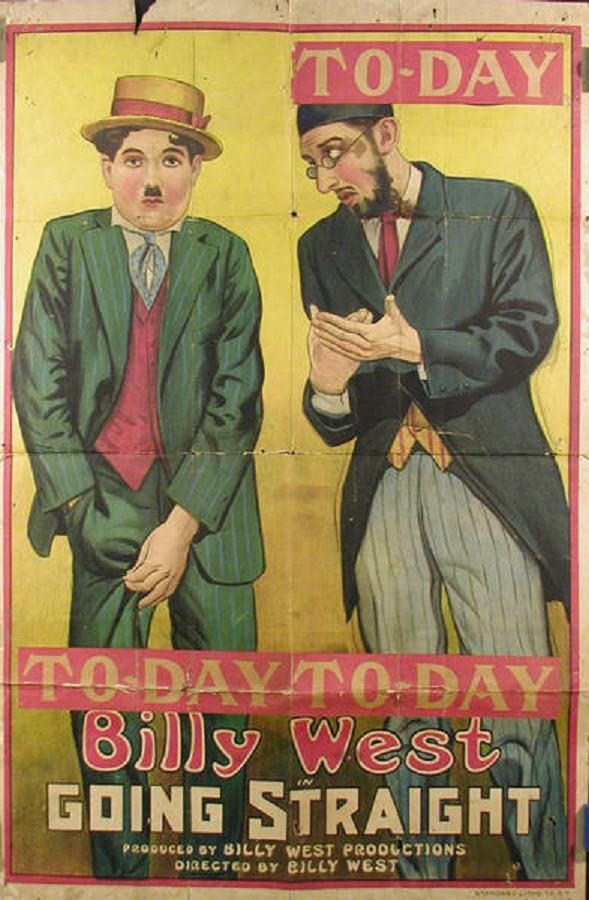
A wallet hits the cobblestones like a gunshot.
The camera—static yet ravenous—records the tremor that ripples through Billy West’s eyes: a micro-expression half Ecce Homo, half cornered rat. In that 12-second shot, Going Straight announces it has no interest in Sunday-school parables; instead it wants to pickle your conscience in brackish irony.
Director-producer Billy West (also starring) stages the city as a penal colony without walls. Brick façades sweat coal soot; elevated trains scream like iron banshees; neon pharmacy crosses flicker Morse code for damnation. Compare this to the pastoral fatalism of Tom Sawyer or the drawing-room cynicism of Damsels and Dandies: here there’s no Mississippi idyll or champagne wit to soften the blow. The metropolis itself is the grand antagonist, a sprawling Panopticon where every pedestrian doubles as stool pigeon.
Theodore Lorch’s police inspector sports cheekbones sharp enough to slice warrants; his eyes carry the metallic glint of handcuffs sun-bathing on a precinct railing. Opposite him, Ethelyn Gibson’s seamstress-with-a-past toggles between radiance and rot, her close-ups achieving something close to religious chiaroscuro—every freckle a bead of rosary sweat. Meanwhile Leo White provides comic relief so acidic it corrodes the very idea of relief: his jittery fence, all cigarette flourishes and epiglottal gasps, resembles a Toulouse-Lautrec caricature brought to malevolent life.
West’s ex-convict, surname never disclosed, lands a job at a print shop only to discover the proprietor runs a counterfeit ring on the side. Moral dilemma arrives gift-wrapped: report the crime and risk parole violation (he’s been seen “consorting with known felons”), or stay mute and slide back into the infernal carousel. The screenplay doles out twists like morphine drips—slow, deliberate, addictive. When our hero finally pockets a forged banknote to buy medicine for a consumptive neighbor, the ethical Rubicon swells into a tsunami.
Cinematographer Bud Ross shoots through diffused cheesecloth, giving gaslights a halo of damnation. Note the sequence inside the St. Magdalene mission: candle flames bloom like saffron dahlias while soup steam curls around actors’ faces—an effect Ross achieved by placing a kettle behind scrims of gauze. Compare this candlelit piety to the Sahara glare of The Dust of Egypt or the expressionist chiaroscuro of Wrath. Here, salvation itself looks suspicious.
Most silents spoon-feed plot via flowery placards; Going Straight prefers staccato aphorisms. Example: "The city never forgets a face—only the crime attached to it." Another card appears for exactly eight frames, practically subliminal: "Guilt is a counterfeit coin that spends like gold." You’ll rewind—mentally, at least—to catch them.
West borrows Soviet-style cutting but drains it of revolutionary bombast. In one bravura passage, a breadline dissolves into a roulette wheel dissolves into a judge’s gavel—an Eisensteinian dialectic that indicts both poverty and chance. Yet the tempo is uniquely American: jazz-like, improvisational, flirting with syncopation. The film’s 67-minute runtime feels haiku-tight, whereas contemporaries like Beatrice Fairfax Episode 12: Curiosity often dawdled through serial sprawl.
Modern viewers conditioned for booming THX might overlook how Going Straight weaponizes hush. The absence of diegetic noise amplifies peripheral sounds in the auditorium—your neighbor’s popcorn crunch becomes the footfalls of approaching cops. It’s cinema as Rorschach, each spectator unconsciously composing their own foley track.
Unlike the femme fatales of The Gray Mask, Gibson’s heroine isn’t an erotic trap but a frayed lifeline. She works a Singer sewing machine like a steampunk Penelope, her fingers perilously close to the needle. In a gendered inversion, she ultimately wields the scissors—both tailor’s tool and symbolic castrator—snipping the cord of West’s lingering loyalty to the underworld.
Released Stateside in late October 1920, the picture grossed a respectable $315,000—pocket change beside Griffith’s epics but triple its shoestring budget. Yet it vanished for decades, surviving only in a decomposing 35mm print discovered inside a condemned Latvian church in 1998. The restoration team at Lobster Films digitally peeled away mold blooms, revealing subtleties unseen even at premiere: a ghost-image of a trolley schedule reflected in a shop-window, hinting at predestination.
Watch Going Straight today and you’ll taste the metallic tang of present-day carceral discourse. Parole boards still measure redemption via employment check-stubs; algorithms still tag ex-cons as recidivism risks. The film’s moral quicksand mirrors every headline about bail reform or algorithmic sentencing. In that sense, West’s 1920 nightmare beats many 21st-century “social issue” dramas at their own game.
Is Going Straight a masterpiece? The term feels too marble-statue for so combustible a relic. Call it a pocket-sized grenade: crude, yes, but its shrapnel still whistles through the century. Seek it out on Blu-ray, dim the lights, and let the urban tide pull you under. When the gate slams in that final freeze-frame, you’ll question every subsequent step you take on the sidewalk—wondering who’s watching, who’s forgiven, and whether the city will ever let you, or anyone, truly go straight.
Review by @CelluloidSphinx | Running time: 67 min | Restored edition available via Kino Lorber & Flicker Alley.
IMDb 7
1936
Community
Log in to comment.