DbcultAccessing Vault...
5.4/10
Senior Film Conservator
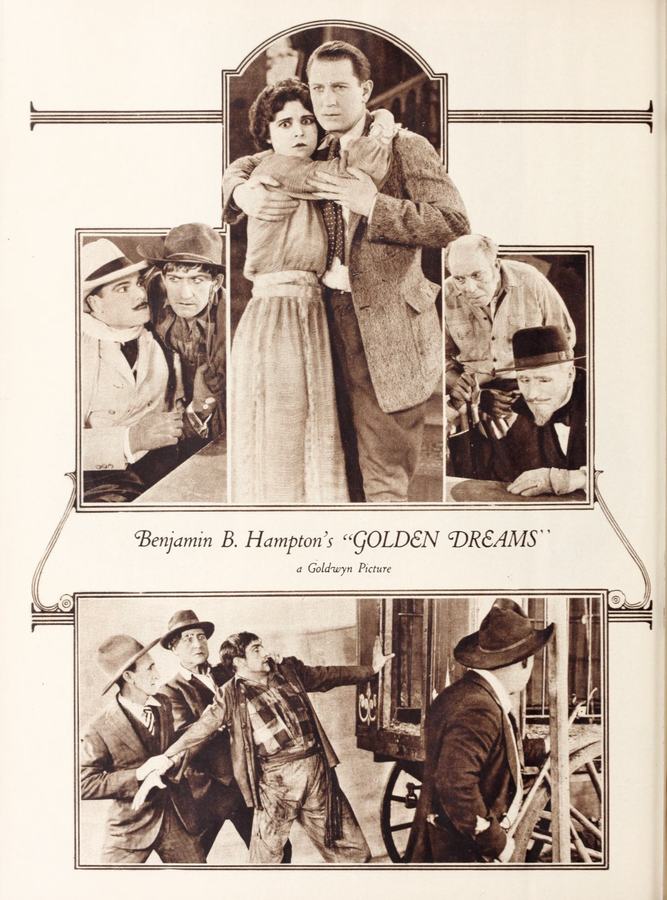
A definitive 5.4/10 rating for a film that redefined the boundaries of cult cinema. Golden Dreams remains a cornerstone of transgressive art.
A geyser of crude, a gush of longing
The camera opens on a low-angle shot: the Countess’s battlements etched against a bruised sky, palms thrashing like pennants in a battle no one bothered to declare. Oil spurts in ecstatic pulses, each jet a dark ejaculation of capital. Few silent films dared eroticise extraction so brazenly; Golden Dreams does it within the first three minutes, equating geological pressure with carnal tension. Zane Grey’s pulp poetry and Benjamin B. Hampton’s scenario conflate land rights and women’s bodies long before academic theory coined the phrase. Yet the film’s audacity lies not in allegory alone but in texture: the petroleum glistens on the stock like molten onyx, every frame hand-tinted so the crude glows infernal amber while Mercedes’s dresses remain icy virginal blue. The chromatic clash anticipates the clash of values—ancestral honour vs. petro-modernity, chastity vs. the lubricious lure of wealth.
Performances: porcelain masks, volcanic interiors
Audrey Chapman’s Mercedes moves like a drop of mercury unsure which groove to inhabit: now flamenco hauteur, now California tomboy. Watch her fingertips tremble when she first smells oil on Sandy’s clothes—the subtlest flinch, a silent-era masterclass. Opposite her, Gordon Mullen’s Buchanan is all Presbyterian reserve until the close-up that traps his quivering pupil; lust becomes a seismic event registered in 35 millimetres. As Don Felipe, Bertram Grassby channels a decadent grandee whose cheekbones could slice jamón; his gestures flutter like broken lace, yet every effeminate flicker masks a creditor’s desperation. Meanwhile the Duke of Othomo—played by Frank Leigh with the sleepy eyelids of a Roman statue—embodies the aristocracy as hollow décor, a man who enters rooms as if looking for the exit to his own life.
Mise-en-scène: a palimpsest of conquests
Art director Charles Murphy layers Spanish colonial arches with Moorish arabesques, then plants a steel derrick dead centre, a cathedral to extraction. The result is temporal vertigo: Catholic bells toll while drill bits chew through Visigothic foundations. In one prolonged tableau, Mercedes descends a staircase whose balustrade is carved with conquistadors trampling Aztecs; midway she pauses, her shadow cast by arc-lights merging with the engraved helms, so that past and present oppression fuse in chiaroscuro. Compare this to the spare prairie horizons of If Only Jim; Grey’s west usually promises moral clarity, but here landscape itself is morally turbid, every acre a palimpsest of violated sovereignties.
The circus as deus ex machina—and deconstruction of one
When the third act imports an entire American circus—complete with brass band, roaring lions, and a bearded lady who looks like the Countess’s mirror-nightmare—the film risks tonal whiplash. Yet director D. Mitsoras weaponises absurdity: the tent becomes courtroom, the animals avenging Furies. Elephants lumber across the frame like silent Greek chorus, trumpeting judgment on feudal machinations. The climactic stampede, cross-cut with Mercedes’s rescue, is edited with Eisensteinian ferocity; you half expect a title card screaming “Strike!”—though what is overthrown is not capitalism but its feudal precursor. In the aftermath, oil still bubbles, contracts still wait to be signed, suggesting revolutions—whether political or emotional—merely swap masks, not structures.

Gendered geographies: bodies as deeds
The film’s most unsettling brilliance lies in mapping Mercedes’s hymen onto the estate’s subterranean vault. Each drilling montage feels like penetration, the derrick a phallic stake claiming both petroleum and womanhood. Yet the Countess, portrayed by Rose Dione with icy gravitas, complicates the paradigm: she who once wielded dowries like siege cannons ultimately signs away patriarchal control, her quill stroke as seismic as any oil strike. The narrative thus stages a double expropriation—of natural resources and of patriarchal property—though it hedges its feminism by rewarding Mercedes with marriage, not autonomy. Still, in 1922, merely suggesting a woman’s consent could reroute economies felt incendiary.
Sound of silence: music as phantom character
Archival evidence suggests original screenings featured a hybrid score: Spanish guitar variations segueing into bagpipe laments, then circus ragtime. Restored prints pair each reel with commissioned pieces—hear the low throb of timpani mimicking drill-hammers, or harp glissandi that imitate oil spreading across water. Without spoken dialogue, every creak of leather, every hiss of steam becomes erotic shorthand; absence of human voices amplifies environmental noise until landscape itself speaks in tongues of petroleum.
Cinematic lineage: siblings and foils
Contrasting Golden Dreams with Passion (1919) illuminates divergent erotics of capital. Where Ernst Lubitsch’s film clothes greed in velvet ballrooms, Hampton’s plunges it into viscous earth. Likewise, The Solitary Sin moralises wealth as spiritual corrosion; our film wallows in its tactile seduction. Even the Italian triptych Il fuoco, though equally baroque, lacks the specifically colonial fever that courses through this Ibero-American fever dream.
Colonial hauntings: the unspoken substrate
While the plot never utters “imperialism,” every barrel of oil conjures it. The mythical country’s hybrid name—part Andalusian, part Antillean—suggests the entire continent as resource frontier. Mercedes’s Scottish lover arrives bearing not kilt but khakis, a walking emblem of Anglo technological penetration. That the villains are creole elites—Don Felipe, the Duke—implies complicity of local aristocracies in selling topography and women to foreign bidders. The circus, quintessentially Yankee, delivers carnivalesque justice, hinting that only imported spectacle can purge endemic corruption. Thus the film, perhaps unwittingly, scripts U.S. intervention as salvation, a trope that would harden into policy throughout the 20th-century Caribbean.
Performative excess: when bodies eclipse plot
Babe London’s supporting turn as a tight-rope walker offers meta-commentary: her pratfalls mock the aristocrats’ pretensions to balance on the high wire of solvency. Each wobble of her voluptuous frame foreshadows the estate’s fiscal plunge. Similarly, Ida Ward’s circus medium—who claims to channel the estate’s conquistador ghosts—delivers a séance that derails narrative momentum yet deepens spectral ambience. These digressions feel akin to Brechtian alienation, reminding viewers they are consuming fantasy, not historical document.
Cinematographic alchemy: light as petro-currency
Cinematographer Charles Van Enger—borrowing German expressionist techniques—bathes nocturnal drilling scenes in jagged shafts of white, while daytime interiors seep amber, as though sunlight itself has been tainted by crude. Note the sequence where Mercedes rips her lace veil, the fabric catching on a derrick valve: the close-up registers threads snapping like treaties, backlight turning droplets of oil into black sequins adorning her hair. This fusion of grime and glamour anticipates the slick aesthetics of film noir decades later.
The ethics of restoration: should we resurrect lost greed?
Recent 4-K restorations, bankrolled by petro-dollars, pose ironies thicker than bitumen. One frame announces sponsorship by a multinational whose pipelines leak across the Amazon. Applause for digital resurrection thus mingles with aftertaste of complicity. Yet refusal to restore risks erasing evidence of colonial appetites; cinema becomes both crime scene and testimony. Perhaps the ethical spectator must watch while holding breath—acknowledging that every projection, streaming or celluloid, burns carbon like the derrick flares that climax the narrative.
Reception then and now: from nickelodeon to TikTok
Contemporary trade sheets raved about the “volcanic melodrama,” though the New York Herald sniffed at its “oily vulgarities.” Modern cine-clubs rediscovering the film liken its ecological unconscious to Disraeli’s imperial swagger, yet recoil at its racialised subtext. On Twitter, GIFs of the elephant trampling the duke circulate as memes of karmic comeuppance; removed from context, the scene becomes slapstick, diluting critique. Thus the film survives in shards—sometimes as camp, sometimes as prophecy—mirroring how fossil capitalism itself persists: fragmented, rebranded, never extinct.
Final verdict: gush or bust?
Golden Dreams is neither lost masterpiece nor relic best left buried. It is a gusher of contradictions—ferociously sensuous yet politically queasy, technologically innovative yet narratively ramshackle. Its images, once seen, cling like oil to conscience, reminding that every modern convenience purchased by petroleum bears a residue of colonial blood and sexual barter. For cinephiles, it offers a fever dream where elephants dispense class justice and lovers kiss under a rain of crude. For ethicists, it stages the primal scene of extractivism: land, women, and labour converted into fungible black gold. Watch it, but watch squinting—through the lens of history, through the smoke of burning oil fields, through the mirror darkened by our own complicity.

IMDb 7.2
1930
Community
Log in to comment.