DbcultAccessing Vault...
5.1/10
Senior Film Conservator
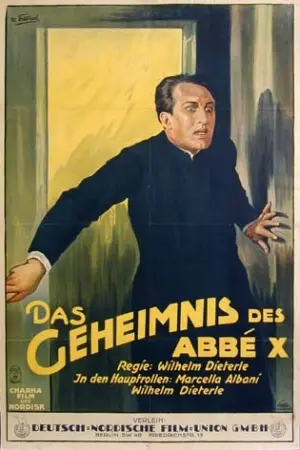
A definitive 5.1/10 rating for a film that redefined the boundaries of cult cinema. Das Geheimnis des Abbe X remains a cornerstone of transgressive art.
Is Das Geheimnis des Abbe X worth watching today? Short answer: Yes, but only if you find beauty in the slow, agonizing decay of a guilty conscience and the stark aesthetics of Weimar-era cinema.
This film is for the cinephile who treats a movie like an archaeological dig, seeking the roots of psychological noir. It is absolutely not for anyone looking for a fast-paced thriller or modern narrative payoffs.
1) This film works because it weaponizes the silence of the medium to mirror the suffocating silence of the confessional booth.
2) This film fails because the third-act resolution relies on a series of convenient coincidences that feel beneath the gravity of the preceding hour.
3) You should watch it if you are a fan of William Dieterle’s early work or if you enjoyed the dark moral ambiguity of Landru, der Blaubart von Paris.
In the landscape of 1927 cinema, Das Geheimnis des Abbe X stands as a peculiar monolith. While Hollywood was busy perfecting the slapstick of The Hick or the lightheartedness of A Full House, the German industry was descending into the psychological abyss. This film is less about a 'secret' in the traditional sense and more about the gravitational pull that a secret exerts on a man’s soul. William Dieterle doesn't just play the Abbe; he inhabits him with a stiff, almost skeletal rigidity that suggests a man holding himself together by sheer force of will.
The plot moves with a deliberate, almost glacial pace. This is not a flaw; it is a choice. Every scene in the rectory or the church is framed to make the characters look small against the architecture of faith. For example, there is a sequence where the Abbe stands before a large crucifix, and the lighting—harsh and unidirectional—bisects his face. It’s a literal visual representation of his fractured psyche. It works. But it’s flawed.
The narrative stakes are high, yet the film often retreats into melodrama. Marcella Albani provides a necessary emotional counterpoint, her expressive face doing the heavy lifting that the intertitles sometimes fail to convey. Compared to the raw vulnerability seen in Shame, Albani’s performance here feels more curated, more theatrical, but no less effective for the era.
It is fascinating to watch Das Geheimnis des Abbe X through the lens of William Dieterle’s later career. Before he became a titan of Hollywood’s Golden Age, he was here, experimenting with the 'Kammerspielfilm' style—the chamber drama. The direction is surprisingly intimate. He avoids the sweeping vistas of The Desert's Toll and instead focuses on the micro-expressions of his cast. This is a film of hands: hands gripping rosaries, hands trembling over letters, hands reaching out in a darkness that never quite lifts.
The cinematography by Karl Puth deserves a mention. While it doesn't reach the expressionistic heights of the most famous films of the era, it utilizes a sophisticated palette of greys to suggest a world where moral clarity has vanished. There is a specific moment when the Abbe walks through a crowded market, and the contrast between his black robes and the chaotic, light-filled stalls creates a sense of profound isolation. He is in the world, but not of it. This visual isolation is a recurring theme that keeps the viewer engaged even when the pacing stumbles.
Yes, Das Geheimnis des Abbe X is worth watching for anyone interested in the evolution of the psychological drama. While it lacks the visceral punch of The Night Cry, it offers a more intellectualized form of suspense. It is a film that demands your full attention, rewarding the patient viewer with a rich, if somewhat bleak, meditation on the nature of truth.
If you are looking for a historical curiosity that bridges the gap between silent melodrama and the coming age of sound-era noir, this is it. It isn't a masterpiece, but it is a vital piece of the cinematic puzzle. It captures a moment in time when film was discovering it could be more than just a spectacle; it could be a confession.
Pros:
Cons:
One of the most debatable aspects of the film is its treatment of the church. Is it a sanctuary or a cage? Dieterle seems to lean toward the latter. In one of the film's most striking scenes, the Abbe is seen through the lattice of the confessional, his face literally barred by the wood. It is a brutal, simple image. It suggests that the very tools of his faith are the ones that imprison him. This is a bold stance for 1927, and it gives the film a subversive edge that remains sharp nearly a century later.
The film also benefits from a strong supporting cast. Paul Biensfeldt and Hermann Picha bring a groundedness to the production, preventing it from floating off into pure abstraction. They represent the 'normal' world that the Abbe is increasingly alienated from. Their presence makes his internal struggle feel more grounded in reality. When compared to the ensemble work in The Last Chance, the cast here feels more synchronized, working toward a singular, somber mood.
Ultimately, the film's greatest strength is its refusal to offer easy answers. While the plot eventually resolves, the moral questions it raises linger. Can a man truly be forgiven if he cannot forgive himself? Is the law of God superior to the law of man when innocent lives are at stake? These are the questions that Das Geheimnis des Abbe X leaves you with, long after the final frame has faded to black.
Das Geheimnis des Abbe X is a somber, technically proficient drama that showcases the burgeoning talent of William Dieterle. It is a film of shadows and sighs, of heavy doors and heavier hearts. While it may lack the legendary status of other 1927 releases, it is a significant work that deserves a place in the conversation about early psychological cinema. It is stilted. It is slow. But it is also deeply moving. If you have the patience for it, the Abbe’s secret is one worth uncovering. It’s a 7/10 for history buffs, and a 6/10 for the casual classic movie fan. It works. But it’s flawed. And in that flaw lies its humanity.

IMDb 6.3
1936
Community
Log in to comment.