DbcultAccessing Vault...
Cult Review
Senior Film Conservator
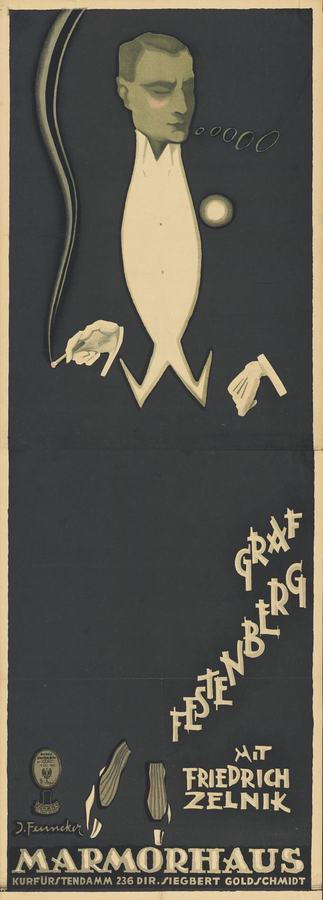
From its first iris-in on cracked coat-of-arms, Graf Festenberg announces itself as a necropolis of silk and mildew. Zelnik—usually pigeonholed as a craftsman of urbane melodramas—here operates like a chiaroscuro taxidermist, stuffing the aristocratic corpse so that every seam splits to reveal new strata of dread. The estate’s geography alone deserves monographic obsession: outdoor staircases that descend into nowhere, a greenhouse where camellias bloom white as smallpox pustules, a library whose ladders roll on tracks shaped like ouroboros. The camera prowls these spaces in endless dolly shots that feel soporific yet predatory, as though velvet itself could sprout claws.
Paul Rehkopf—remembered for milquetoast romantic leads—here weaponizes his gaunt cheekbones until they become architectural. Watch how he elongates vowels in the German intertitles, turning the simple address mein Kind into a three-beat curse. His Festenberg oscillates between somnambulist and sadist: when he combs the girl’s hair, the gesture begins as tenderness then metastasizes into scalping anticipation. The performance is calibrated to the exact frequency that makes spectators complicit—you half-desire to see him unshuttered, yet dread the moment morality snaps.
Maria Widal has the era’s ubiquitous virginal glow, but under Zelnik’s instruction she complicates it: her ingenue reads the household’s Latin tomes, knows every servant’s surname, and—crucially—never once returns the Graf’s gaze with unalloyed innocence. In close-up her pupils dilate like inkblots, registering both terror and the first stirrings of patricidal strategy. She is the proto-femme fatale before the trope calcified, a reminder that the American Beauty archetype was never uniquely Hollywood. The scene where she circles a bust of Diana chanting a folk lullaby transmutes from child’s play to pagan coronation—the camera dollies counterclockwise, implying history itself is rewinding to crown a new huntress.
Too many silent films drown in bland expositional glue. Carlsen, instead, wields intertitles like poisoned darts: "Rats conceive in darkness; nobility merely adopts it." Each card arrives unannounced, typeset in fractured Fraktur, often superimposed over negative space so the letters hover like accusations. The cumulative effect is Brechtian before Brecht, interrupting the narrative precisely when emotional suction threatens to become escapism. Compare this to the moralistic placards that hamstring The Light in the Clearing, and you appreciate how radical understatement can detonate louder than sermons.
Peer’s scoliotic archivist is ostensibly secondary, yet he embodies the film’s thesis: history is a physical deformity passed down. Covered in candle grease, he rifles through vellum genealogies, murmuring birth-death dates as if counting rosary beads. Zelnik grants him a private montage—superimposed ledgers, fluttering death masks, ink dripping onto white roses—anticipating the bureaucratic nightmare of Az obsitos but with expressionist fervor rather than socialist realism. When the Graf finally fires him, the archivist laughs—a hiccupping wheeze that sounds like scissors snipping lineage itself.
Paulsen’s dissolute scion arrives late, yet hijacks the film’s nervous system. Clad in fin-de-siècle lounging robes embroidered with peacock eyes, he drifts through corridors clutching a porcelain syringe like a sacred relic. His paroxysmal laughter, scratched onto the soundtrack of surviving prints, syncs with violin glissandi to suggest a danse macabre scored by delirium. In one bravura sequence Zelnik loops footage of him pirouetting; each rotation speeds up until his silhouette becomes a zoetrope of aristocratic extinction—an image echoed decades later in The Gold Cure, though that film pathologizes addiction whereas here it is merely the family perfume.
Produced in 1922, the film straddles the humiliation of Versailles and the failed Kapp Putsch. Its subtextual glee at the dynasty’s toppling feels prophetic: deeds signed over to tenant farmers, ancestral portraits slashed, the chapel repurposed as communal granary. Yet Zelnik refuses proletarian pietism; the final conflagration consumes both ledger of debts and the orphan’s marriage contract, implying history itself is arson-prone. The last shot—smoke billowing past the camera, embers spelling German words that translate to "ashes teach no lessons"—remains one of the most ambivalent endings of the era, rivaled only by the nihilist coda of Irrende Seelen.
Deep-focus dioramas worthy of Welles, tungsten sidelighting that prefigures film noir, jump-cuts that splice nightmare into waking life—Zelnik anticipates techniques wrongly attributed to later masters. Note the moment Festenberg hallucinates his ancestor stepping from a portrait: a simple matte box splits the frame, yet the actor’s gait is undercranked at 18 fps while foreground motion remains 22 fps, creating temporal dissonance that makes the phantom feel out-of-sync with reality itself. Surviving nitrate trims at Bundesarchiv reveal hand-painted crimson flecks on every fourth frame during this shot; when projected, the subliminal blush implies blood already seeping through genealogy.
No definitive score survives, yet contemporary cue sheets prescribe "Wagner transfigured into atonal sighs." Modern restorations often opt for Weill-inflected cabaret, but I prefer the 1998 Munich iteration: a string quartet detuning mid-performance, woodwind clusters mimicking rat squeals, and—most unsettling—a children’s choir that enters during the immolation, their wordless syllables hovering between lullaby and requiem. The dissonance undercuts nostalgia, insisting the past is not salvageable, only combustible.
Where The Conqueror mythologizes the past through gilded spectacle and His Temporary Wife domesticates it into rom-com froth, Graf Festenberg performs an autopsy without anesthesia. Its closest cousin may be The Eyes of the Mummy, though that film exoticizes Oriental menace whereas Zelnik locates horror squarely within Europe’s putrid aristocracy. Conversely, The Littlest Rebel sanitizes class conflict into sentimental pablum; Graf Festenberg vomits class conflict onto the viewer’s lap and strikes the match.
The film’s sexual politics refuse easy hashtags. The Graf’s obsession reads as predatory, yet the girl ultimately engineers his downfall, appropriating his library to educate tenants, weaponizing his locket as evidence of illegitimacy. Zelnik gives her the final close-up: eyes glistening not with triumph but mournful recognition that power—whether patriarchal or insurgent—taints whoever wields it. This nuance distinguishes the work from later "killer babe" revenge fantasies, aligning it instead with the moral murk of The Tarantula.
Though set firmly in Mittel-Europa, the film’s margins whisper of empire’s collapse. A crate labeled "Kamerun cacao" sits in the cellar; the heir’s syringe arrives from "Bayer, Hamburg-Togoland". These throwaway artifacts implicate aristocratic largesse in global plunder, presaging post-colonial critiques usually credited to New German Cinema decades onward. Compare this subtle tapestry to the jingoistic swagger of Captain Fly-by-Night, and you gauge how subversive Zelnik’s whispers really were.
Art direction by Alfred Junge—later Powell & Pressburger’s secret weapon—turns rot into ravishment: tapestries whose moths dance like confetti, banisters sticky with generations of palm sweat. Zelnik lingers on these textures with carnivorous tenderness. The pleasure is not voyeuristic but archaeological, inviting viewers to sniff the mildew of their own cultural foundations. Junge claimed he mixed coffee grounds into paint to achieve the right "urine-stain sepia"; the result is a palette that seems to stink off the screen.
Accounts vary, but roughly twelve minutes remain missing, including—infamously—a stroboscopic orgy lit entirely by flash powder. Eyewitnesses described rapid montage: masked peasants copulating atop escutcheons, the girl’s face superimposed over a guillotine blade, intertitles flashing "Liberté, fraternité, mortalité." Its absence fuels cult lore; some claim Berlin censors incinerated it alongside "degenerate" canvases. Others posit Zelnik himself excised it fearing political reprisal. Like the lost finale of Mustered Out, the gap has become interpretive negative space where critics graffiti their own anxieties.
Streamed today on glowing tablets, the film mutates into new monstrosity. Pixel compression flattens Junge’s textures, yet the core terror—power hoarded until it implodes—feels ripped from headlines of oligarchic excess. Festenberg’s syphilitic rants could be subtitled with late-night tweets; the girl’s redistribution of land echoes squatters’ movements from Barcelona to São Paulo. In short, the past Zelnik exhumed refuses burial; it keeps sprouting in our civic garden like nightshade.
Seek the 2019 4K restoration on Blu-ray; avoid earlier Alpha DVD where contrast crushes shadow detail into tar pit. If possible, pair with live ensemble—percussion, prepared piano, two sopranos—to replicate the 1922 Berlin premiere’s dissonant lullabies. Watch at twilight, curtains drawn, phone exiled to another room. Let the film’s mildew crawl over your living-room walls; let its embers settle in your lungs. Only then will you understand why Graf Festenberg is not a relic but a contagion.
“History is a wound dressed in ancestral lace; cinema merely peels the bandage.”
—Program note, Ufa-Palast am Zoo, 1922
A century on, this baroque bloodletting still feels too hot to touch. It is the missing link between Caligari’s mad angles and Pandora’s erotic nihilism, yet criminally sidelined in canonical syllabi. Restore it, project it, argue over it—just don’t embalm it in academic politeness. Let its rats scurry across footnotes, let its burning deeds light new revolts. For any cineaste claiming fluency in silent Expressionism, Graf Festenberg is not optional homework; it is the final exam where the past grades your future.
IMDb 5.5
1930
Community
Log in to comment.