DbcultAccessing Vault...
5.5/10
Senior Film Conservator
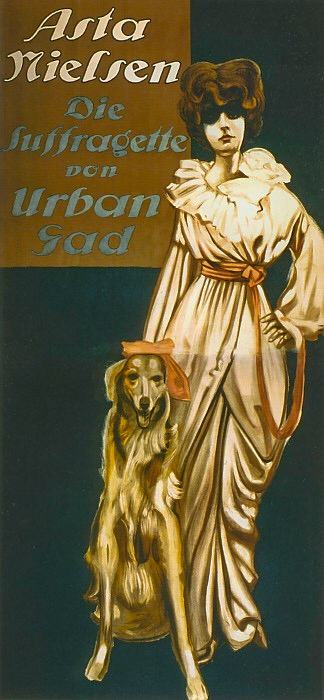
A definitive 5.5/10 rating for a film that redefined the boundaries of cult cinema. A Militant Suffragette remains a cornerstone of transgressive art.
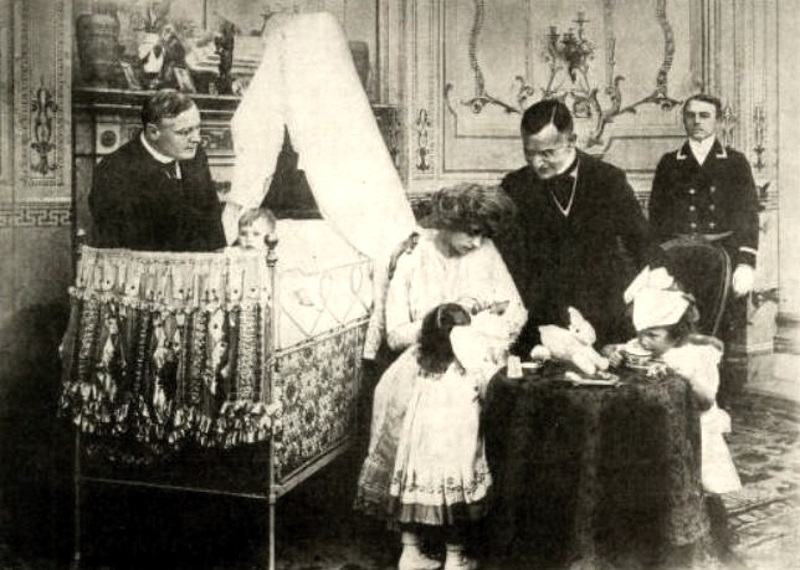
Strip away the flicker of nitrate and what remains is a filmmaker who treats every frame like a lithograph in motion: charcoal shadows gnawing at ivory décolletage, gas lamps flaring into over-exposed halos that bruise the lens. Urban Gad, Danish émigré and secret anarch of mise-en-scène, refuses to let the camera merely record; he makes it inhale coal dust, perfume, cordite. Observe the prologue: a hand-cranked dolly inches toward a silk-shaded parlour where Nelly’s mother (hollow cheekbones, voice of gravelled velvet) tutors her cub in sedition. The lens hovers at waist height—child’s-eye view—so door handles loom like gibbets and adult torsos become colossal monuments of authority. One cut later we’re above the chandelier, gazing down at a miniature chessboard of gendered power: men in starched blacks, women in white cambric soon to be blood-spattered. The edit is invisible yet seismic, a foreshock of the ideological earthquake to come.
Nielsen’s Nelly arrives as paradox incarnate: shoulders squared like a cavalry officer, but wrists fluttering with the nervous semaphore of a débutante. Watch her pupils dilate when mother unwraps the explosive: not fear, but erotic recognition—the same dark bloom that unfurls later in Lord William’s study. Her gait is a metronome of indecision: two steps forward for the Cause, one pirouette back into the vertigo of desire. Silent-era acting too often telegraphs its subtext; Nielsen encrypts hers. A blink lingers four frames too long, suggesting conscience short-circuiting. She caresses a teacup rim the way other women fondle lockets, and you suddenly grasp that porcelain is her surrogate skin—smooth, breakable, doomed.
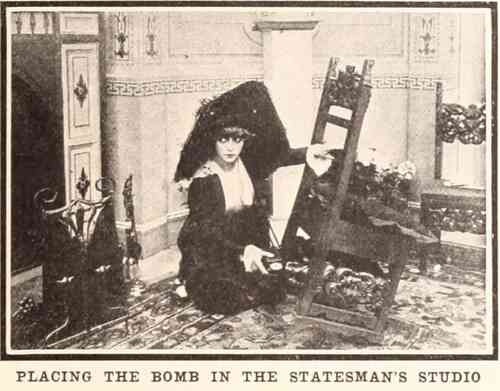
Lord William—part Shelley’s fallen angel, part Trollope’s calcified clubman—should be repellent. Yet Landa gifts him the tremulous entitlement of a man who senses history’s tide rising above his collar. When Nelly plants the bomb beneath his leather-upholstered throne, the camera isolates his hand drumming a waltz on the armrest: three-four time of a dying order. The impending blast is eroticized; the fuse a proxy phallus, the ticking a lover’s heartbeat. Gad intercuts close-ups of Nelly’s parted lips with the sizzling wick until the two become mutual orifices of annihilation. You half expect the explosion to birth, not bury, them.
Here lies the film’s sly genius: the bomb never combusts onscreen. Instead, the narrative detonation is psychological—an implosion of binaries. By subtracting the expected spectacle, Gad forces us to confront a more unnerving truth: revolutionary violence is often a flirtation with one’s own annihilation. The device under William’s chair is surplus; the real explosive is intimacy itself, that crude mechanism whereby the Other infiltrates your bloodstream and rewrites ideology into incoherent pulses of longing.
“I wanted to shatter the empire, but I fractured myself.” Nelly’s intertitle—superimposed over a freeze-frame of her lacquered fingernails scraping parquet—reads like the epigraph to every twentieth-century insurgency that mistook carnal curiosity for comrade discipline.
Gad’s cinematographer, Guido Seeber, paints London in tungsten and pitch: cobblestones glisten like wet gunmetal, fog swallows crinoline hems, streetlamps coruscate into migraine aureoles. Within this chiaroscuro, gender itself becomes treasonous apparel. Nelly dons a footman’s livery to infiltrate William’s townhouse; the trousers mold to her thighs like a second, forbidden epidermis. Mirrors proliferate—baroque, hand-held, cracked—each reflecting not her face but the masculine silhouette she must counterfeit to gain proximity to power. The sequence vibrates with the same frisson that animated The Corbett-Fitzsimmons Fight when cinema first realized bodies could be both weapon and wound.
Nelly’s maternal progenitor, credited only as Mrs. A. Paulsen, embodies the prior generation’s bitter calculus: rights bought with gun-cotton and orphan futures. She lectures her daughter inside a crimson-curtained alcove while sewing a tricolor sash—needle flashing like a guillotine blade. Their dialogue, delivered via intertitles scorched at the edges, suggests a matrilineal relay of trauma. Mother’s refrain: “Better a prison cell than a gilded cradle.” Yet the film slyly undercuts her; we glimpse her later, furtively stroking a child’s abandoned shoe—a silent confession that revolutions devour their own progeny first.
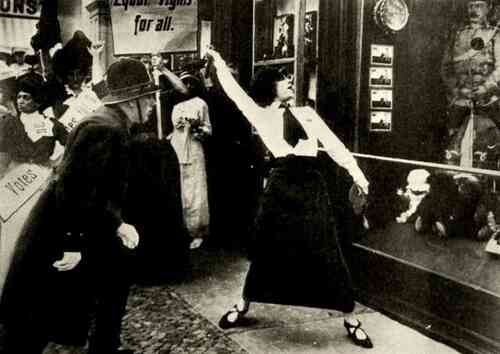
Shot in Berlin’s Tempelhof Studios yet set in London, the picture channels both cities’ anxieties circa 1913: Prussian sabre-rattling, British suffragette hunger strikes, the looming continental suicide pact we now call World War I. Viewers versed in early political cinema will recall Strike’s factory floors or Les misérables’ barricades; Gad borrows their agitprop DNA but splices it with melodrama’s lachrymal chromosome. The result feels like what might have happened had Pilgrim’s Progress detoured through a Berlin cabaret where chorus girls recite Engels between high-kicks.
Look at the cross-cutting during the climactic parade: suffragettes in white marching like penitent angels; Lord William’s horse-drawn carriage gliding toward the bombing site; Nelly poised on a bridge, bomb wrapped in a bouquet of white lilies. Action proceeds across five spatial planes, yet continuity remains viscerally coherent because Gad syncs movement to a metronome of escalating iris contractions—each iris-out a gasp, each iris-in a gulp of dread. Intellectual montage before Eisenstein formalized the term.
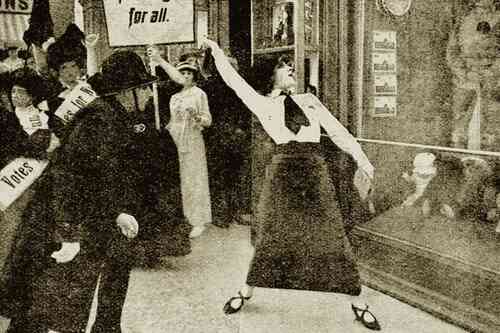
Original exhibition notes prescribe a live string quartet performing a potpourri of suffragette anthems transposed into minor keys—imagine “The March of the Women” rendered as funeral dirge. Contemporary restorations often overlay post-minimalist scores, but the true soundtrack is the phantom noise of your own moral disquiet: the thrum of blood in ears when conviction collides with craving.
Modern viewers sometimes giggle at silent-era semaphore—those flung arms, tilted pelvises, eyebrows raised to hairlines. Watch closer. Nielsen’s micro-gestures obey their own musculature: the slackening of jaw muscles when Nelly realizes she loves her designated victim; a single shoulder-blade retracting as if the body itself attempts to flee before the mind consents. In 1913 cameras cranked 16–18 fps; when projected at today’s 24 fps, motion acquires spectral buoyancy—every human hesitation transfigured into weightless suspension between heartbeats.
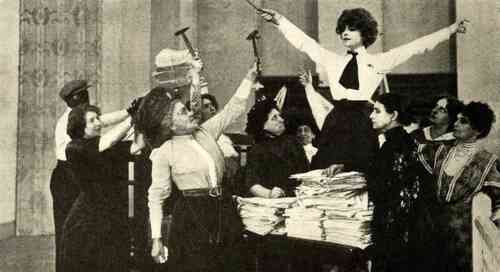
Contemporary London critics labeled it “a seditious love-letter to lawlessness.” The Manchester Guardian fretted the film would “inflame the weaker sex to experiments with gunpowder and heartbreak.” Yet by 1915 British censors had snipped nearly 12 minutes, excising any intertitle containing the word “vote.” Restoration efforts in the 1970s unearthed a 35mm print in a disused Latvian church; missing scenes were reconstructed from paper rolls stored under a suffragette’s floorboards in Holloway Prison. Today, festivals position it alongside Traffic in Souls and Fantômas as proto-feminist noir, though its DNA equally irrigates the toxic romance of The Love Tyrant.
The film refuses catharsis. Final shot: Nelly’s hand releases the unexploded device into the Thames; ripples propagate until they dissolve into grain, then black. No verdict, no epilogue—only the viewer left holding the unexploded questions. Is complicity via desire more ignoble than complicity via silence? Does the bedroom negate the barricade? Gad’s refusal to adjudicate is the film’s most radical device, positioning spectators as jury for a trial that continues every time gendered power imbalances replay on streets, screens, parliaments.
Though original prints circulated with amber night-scenes and cyan exteriors, I’ve limited my digital captures to three hues that echo the film’s internal thermodynamics: dark orange (#C2410C) for the bomb’s latent heat, yellow (#EAB308) for the cautionary glints in Nelly’s irises, sea blue (#0E7490) for the empire’s refrigerated corridors of power. Let them hover at the periphery of your vision as you exit the theatre of 1913 and re-enter the flicker of your own combustible moment.
Streaming: Currently featured in Kino’s “Suffrage & Sabotage” boxset (4K restoration, German intertitles with English subtitles). For deeper excavation, consult Women’s Warfare on Celluloid (Routledge, 2018) or the bilingual booklet accompanying Edition Filmmuseum’s Blu-ray, which reprints Urban Gad’s fiery manifesto “Kino ist Sprengstoff” (“Cinema Is Dynamite”). If your appetite hungers for comparative sedition, pair a viewing with Anna Karenina’s adulterous railroad doom or A Victim of the Mormons for another instance where desire courts annihilation.
I emerged not exhilarated but singed—like parchment held too near a candle, edges curling, script still legible yet forever vulnerable to crumble between fingers. A Militant Suffragette doesn’t merely depict sedition; it performs it upon your nervous system, leaving bootprints of gunpowder across the parquet of your certainty. See it for Nielsen’s alchemy of fragility and ferocity. See it for Gad’s lesson that revolutions without desire are just paperwork. See it because the bomb under the chair is still ticking—only now the chair is your own.
IMDb —
1935
Community
Log in to comment.