DbcultAccessing Vault...
Cult Review
Senior Film Conservator
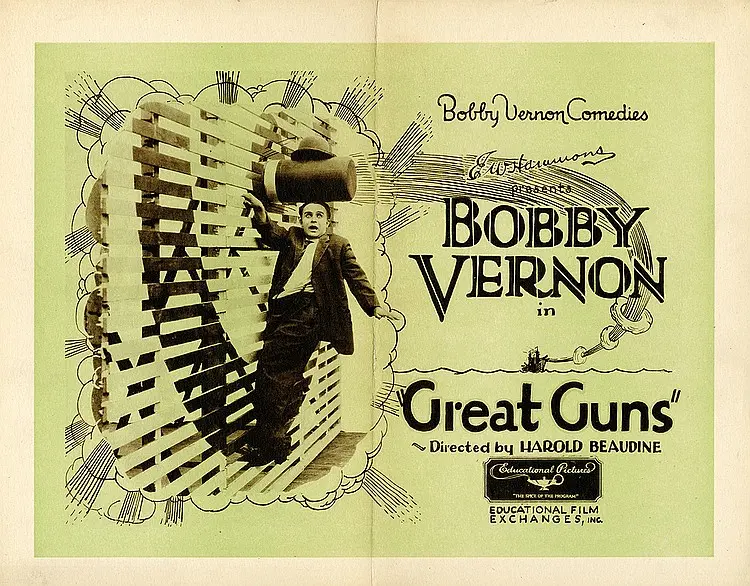
Is Great Guns worth your time in the modern era? Short answer: Yes, but primarily as a fascinating study in 1920s 'thrill-comedy' that pushes dark humor to its absolute limit. This film is a mandatory watch for fans of Harold Lloyd and those who enjoy seeing the 'starving artist' trope taken to a literal, life-threatening extreme. It is certainly not for anyone who requires a coherent, grounded narrative or finds the slapstick of the silent era too repetitive.
Before we dive into the mechanical brilliance of the stunts, let's address the core identity of this film. It is a work of frantic desperation. Bobby Vernon, often overshadowed by the likes of Keaton or Chaplin, delivers a performance here that is defined by a specific kind of high-strung anxiety. This isn't just about falling down; it's about the psychological collapse of a man who has lost his pants, his art, and his will to live, only to realize that dying is much harder than it looks.
Yes, if you want to see how the 1920s handled the concept of 'suicide-by-hire' with a wink and a smile. Great Guns is a relic of a time when cinema was obsessed with height and the danger of the modern city. The skyscraper sequence alone justifies the runtime, offering a raw, vertigo-inducing experience that feels more visceral than many modern CGI-heavy blockbusters. It captures a specific moment in Hollywood history where the stakes were high and the safety nets were non-existent.
1) This film works because Bobby Vernon’s physical comedy turns a dark premise into a high-octane pursuit of survival.
2) This film fails because the middle act relies too heavily on repetitive 'disguise' gags that lose their punch.
3) You should watch it if you want to see a proto-action comedy that balances genuine tension with absurd slapstick.
The film opens with a sequence that feels remarkably modern in its cynicism. Bobby is not just a struggling artist; he is a persecuted one. The moment his rival ruins his painting isn't played for pathos, but for a kinetic, reactionary spark. The theft of his trousers by a tailor is a brilliant piece of physical comedy that highlights the class-based humiliations common in silent shorts. When Bobby is forced to borrow the janitor's oversized, grease-stained pants, the visual contrast alone carries the scene.
Consider the restaurant scene. Bobby is trying to maintain the facade of a successful gentleman while his trousers are literally falling apart. It’s a masterclass in 'embarrassment comedy.' The way he maneuvers around the tables, trying to keep his date from noticing his attire, mirrors the social anxieties we still feel today. It works. But it’s flawed. The pacing in this section feels a bit rushed, as if director Keene Thompson was eager to get to the 'big' stunts on the skyscraper.
If you’ve seen The Nervous Reporter, you know that the 1920s loved a good high-rise gag. However, Great Guns takes a darker turn. Bobby climbs the steel framework not to save a girl or catch a thief, but to jump. This shift from 'accidental danger' to 'intentional peril' gives the sequence a unique edge. The camera work here is surprisingly sophisticated for 1927, using low-angle shots to emphasize the distance between Bobby and the pavement.
There is a specific moment where Bobby slips and dangles by a single hand. You can see the wind whipping his hair and the genuine strain in Vernon's muscles. There are no green screens here. The terror is palpable. When he eventually finds himself back on the ground, the transition from 'suicidal' to 'terrified of death' is handled with a quick, punchy energy that defines the rest of the film. It’s a tonal whiplash that somehow manages to land on its feet.
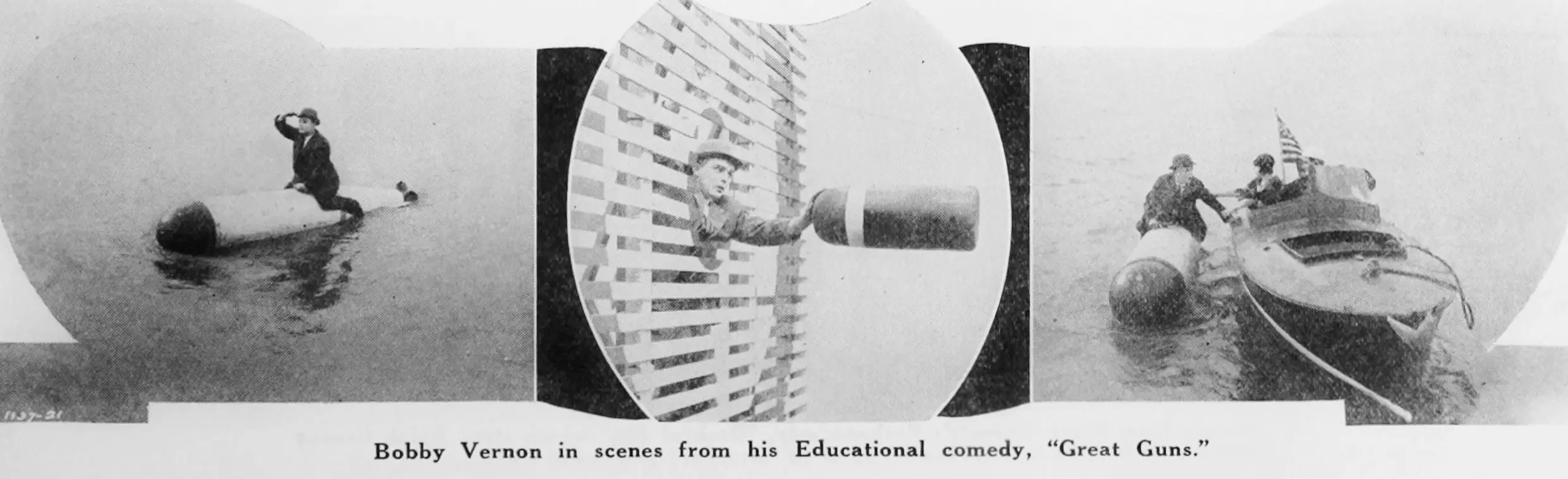
The most inventive—and occasionally frustrating—part of the film is the 'hitman' subplot. Having failed to kill himself, Bobby hires a professional to do the job. The twist, of course, is that he immediately regrets it. This turns the film into a proto-thriller. The hitman’s use of disguises (a postman, an old woman) turns every mundane interaction into a potential death sentence. This is where the film’s pacing becomes a bit uneven.
For example, the postman gag is funny the first time. By the third time Bobby jumps out of his skin at the sight of a mailbag, the joke feels stretched thin. It lacks the escalating complexity of a Buster Keaton sequence. Instead of building the gag, Thompson simply repeats it. However, Vernon’s wide-eyed terror remains infectious. He has a way of vibrating with anxiety that makes even the repetitive moments watchable. He isn't a stoic hero; he’s a frantic mess, and that makes him relatable.
Keene Thompson’s direction is utilitarian but effective. He understands that in a film like this, the star is the movement. The cinematography doesn't strive for the poetic beauty of something like La Belle Russe, but it excels at capturing the geography of a chase. You always know where Bobby is in relation to his pursuers, which is vital for the comedy to land.
The editing is particularly sharp during the final chase sequence. As the girl (played by the charming Marion Harlan) tries to reach Bobby before the hitman does, the cross-cutting between the painting sale and the ocean-bound target practice creates a genuine sense of urgency. The final location—a target out in the ocean used for battleship practice—is an inspired choice. It’s a literal 'dead zone' that serves as the perfect stage for a climax that involves both explosives and a ticking clock.
Bobby Vernon is an interesting figure in silent cinema. He doesn't have the iconic status of Lloyd, but in Great Guns, he demonstrates why he was a staple of the Christie Film Company. He represents the 'everyman' who is constantly being crushed by the gears of the city. Unlike Keaton, who often conquers his environment through ingenuity, Vernon often survives through sheer, frantic luck. This makes Great Guns feel more chaotic and less 'composed' than the masterpieces of the era, but that chaos is exactly where its charm lies.
Comparing this to other films of the time, such as Stop That Wedding, you can see a clear trend toward high-energy climaxes. However, Great Guns stands out because of its willingness to play with the concept of mortality. The idea of a man being used as a target for a battleship is objectively horrifying, yet Thompson manages to make it hilarious. It’s a testament to the era’s ability to find light in the darkest of situations.
Great Guns is a loud, proud, and incredibly fast-paced piece of silent cinema. It doesn't have the emotional depth of Chaplin's work, nor the geometric perfection of Keaton's, but it has a raw energy that is impossible to ignore. It’s a film that lives and dies by its stunts, and luckily, those stunts are spectacular. Bobby Vernon might be an artist in the film, but his real art is the way he falls, jumps, and runs for his life.
Is it a perfect film? No. The middle section drags, and the resolution of the hitman plot is a bit too convenient. But for those 70 minutes, you are transported to a world where a missing pair of pants can lead to a naval bombardment. It’s absurd, it’s dangerous, and it’s undeniably fun. If you can handle the frantic pace and the dated 'misunderstanding' tropes, you’ll find a gem that still sparkles with a bit of 1920s madness.
IMDb 5
1930
Community
Log in to comment.