DbcultAccessing Vault...
Cult Review
Senior Film Conservator
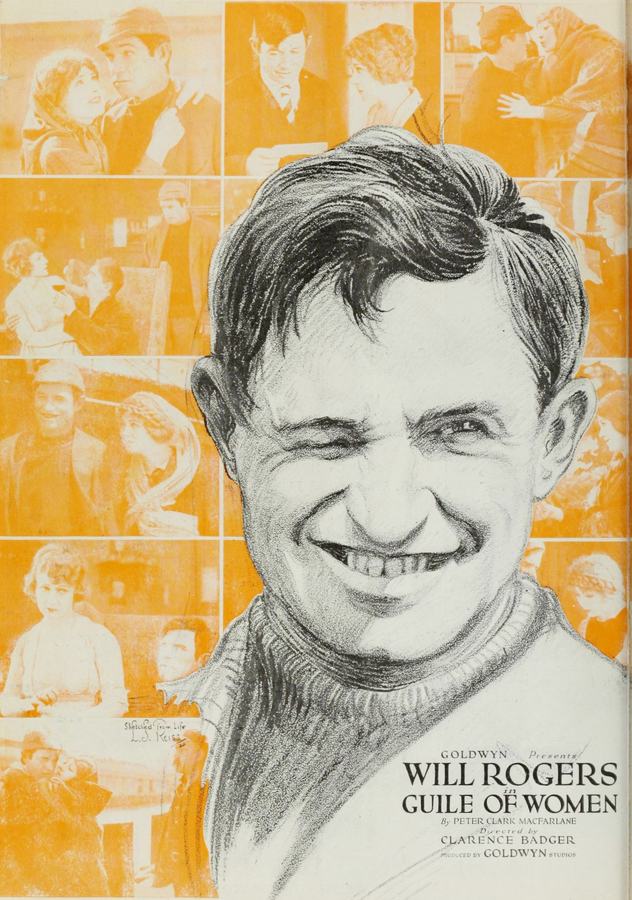
In the cinematic landscape of 1921, the presence of Will Rogers usually signaled a certain brand of rustic wisdom—the cowboy philosopher whose rope tricks were matched only by his sharp social commentary. However, Guile of Women presents a fascinating departure from this established persona. Here, Rogers sheds the chaps for the woolens of Hjalmar Maartens, a Swedish sailor whose innocence is so profound it borders on the metaphysical. This isn't just a role; it's a subversion of the American 'Common Man' archetype, transposed onto a maritime immigrant experience that feels both alien and intimately relatable.
The film opens with a visual grammar that emphasizes the vastness of the sea compared to the narrow, predatory confines of the shore. Director Clarence G. Badger, who would later find fame with the flapper-era 'It' girl comedies, demonstrates here a surprisingly deft hand at managing tone. He balances the inherent comedy of a 'big lug' being outsmarted with a genuine sense of pathos. We see Hjalmar not as a fool, but as a man whose internal moral compass is calibrated for a world that no longer exists—a world where a handshake is a contract and a smile isn't a weapon.
The narrative structure of Guile of Women is episodic, almost like a dark folk tale. Each chapter introduces a new female figure who perceives Hjalmar as nothing more than a bounty to be harvested. From the initial swindles that leave him penniless to the more complex emotional manipulations that leave him spiritually bankrupt, the film paints a grim picture of human interaction. Unlike the more lighthearted romp of Flappers and Friskies, there is a biting edge to the 'guile' mentioned in the title.
Consider the performance of Jane Starr as Hulda. She doesn't play the villain with mustache-twirling obviousness; instead, she utilizes a soft-focus vulnerability that makes Hjalmar’s eventual betrayal feel like a physical blow to the audience. This isn't the theatrical villainy found in The Fire Flingers; it is a mundane, everyday cruelty that feels far more modern than the film’s centenarian status would suggest. The repetition of these betrayals serves a dual purpose: it generates comedy through the 'rule of three,' but it also builds an unbearable tension. How much can one man's spirit endure before it shatters?
To understand where Guile of Women sits in the silent canon, one must look at contemporary explorations of the 'gullible hero.' While The Shell Game deals with the mechanics of the con, Rogers' vehicle focuses on the psychological fallout. There is a thematic kinship here with Man's Plaything, yet Badger’s film avoids the melodrama of the latter in favor of a dry, almost Scandinavian stoicism. The film’s pacing is deliberate, allowing the audience to sit with Hjalmar’s confusion.
Furthermore, when comparing the film to Rogers' other work like Bull Arizona, the contrast is stark. In the westerns, Rogers is the master of his environment. In Guile of Women, he is a fish out of water—literally and figuratively. This displacement is the engine of the film's conflict. The 'Swedishness' of the character isn't just for laughs; it represents a pre-industrial purity being ground down by the gears of urban American cynicism. It’s a theme that echoes in Fighting Through, though here the battle is entirely internal.
The cinematography, though limited by the technology of 1921, makes excellent use of shadow and depth. The scenes set in the cramped boarding houses feel heavy and oppressive, a visual manifestation of the traps being set for Hjalmar. This is contrasted with the brief, luminous shots of the sea, which represent his lost innocence. The intertitles, often a weak point in silent films, are handled with a surprising amount of wit, likely influenced by Rogers' own penchant for aphorisms. They don't just explain the plot; they provide a sardonic commentary on the 'battle of the sexes.'
The supporting cast, featuring veterans like Lionel Belmore and Nick Cogley, provides a solid foundation for Rogers to play against. Cogley, in particular, brings a weathered groundedness that prevents the film from floating off into pure caricature. The ensemble works in harmony to create a world that feels lived-in and dangerous, much like the atmosphere in Obsession. Every character Hjalmar meets seems to have a hidden agenda, creating a pervasive sense of paranoia that mirrors the protagonist's growing disillusionment.
The entrance of Mary Warren as Annie marks the film's most critical pivot. By this point, the audience—and Hjalmar—has been conditioned to expect the worst. When Annie appears, she is framed with a clarity that suggests purity, but the film cleverly plays with our expectations. Is she just a more sophisticated predator, or is she the 'true' woman Hjalmar has been searching for? This ambiguity is the film's greatest strength. It forces the viewer to confront their own cynicism.
Unlike the romantic idealism found in Diamonds and Pearls or the aristocratic artifice of The Incomparable Mistress Bellairs, the relationship between Hjalmar and Annie is built on a foundation of skepticism. The climax isn't a grand romantic gesture, but a quiet, terrifying moment of vulnerability. Hjalmar’s struggle to trust Annie is more harrowing than any physical threat he faced in his maritime travels. It is a profound exploration of the 'burnt child' syndrome, rendered with a sensitivity that was rare for the era.
Ultimately, Guile of Women is a film about the cost of experience. Hjalmar begins as a blank slate and ends as a man who understands the weight of the world. While the film is marketed as a comedy, its undercurrents are deeply philosophical. It asks whether it is better to be a happy fool or a miserable sage. This existential inquiry is what elevates it above other contemporary comedies like The Winning Stroke or the more straightforward adventure of Prairie Trails.
The film’s resolution is satisfying not because it promises a 'happily ever after,' but because it offers a realistic hope. It acknowledges that while 'guile' is a permanent fixture of the human condition, so too is the capacity for genuine connection. Rogers’ performance in the final reels is a masterclass in subtlety; his eyes reflect a mixture of fear and desire that speaks volumes more than any spoken dialogue could. It is a reminder that even in the silent era, the most powerful stories were those that captured the quietest human moments.
In the broader context of silent cinema history, Guile of Women serves as a bridge between the broad slapstick of the 1910s and the more sophisticated character studies of the late 1920s. It shares the grit of Armstrong's Wife and the satirical bite of Red and White Roses. For fans of Will Rogers, it is an essential piece of the puzzle, revealing a dramatic range that his later talkies often obscured. For fans of cinema, it is a poignant, funny, and surprisingly dark look at the perils of the heart.
As the credits roll—or rather, as the final iris-out occurs—we are left with the image of a man who has finally found his harbor. But the sea is never far away, and the lessons learned in the shadows of the city will stay with him forever. It is a haunting conclusion to a film that refuses to offer easy answers, making it a minor masterpiece of the silent era that deserves a modern re-evaluation alongside works like Gypsy Anne or the German expressionist struggles of Leben heisst kämpfen.
IMDb —
1921
Community
Log in to comment.