DbcultAccessing Vault...
4.1/10
Senior Film Conservator
A definitive 4.1/10 rating for a film that redefined the boundaries of cult cinema. Hamlet, Prince of Denmark remains a cornerstone of transgressive art.
Ghost-lit nitrate whispers across a century-long void: the first Shakespeare ever filmed still bleeds through perforations.
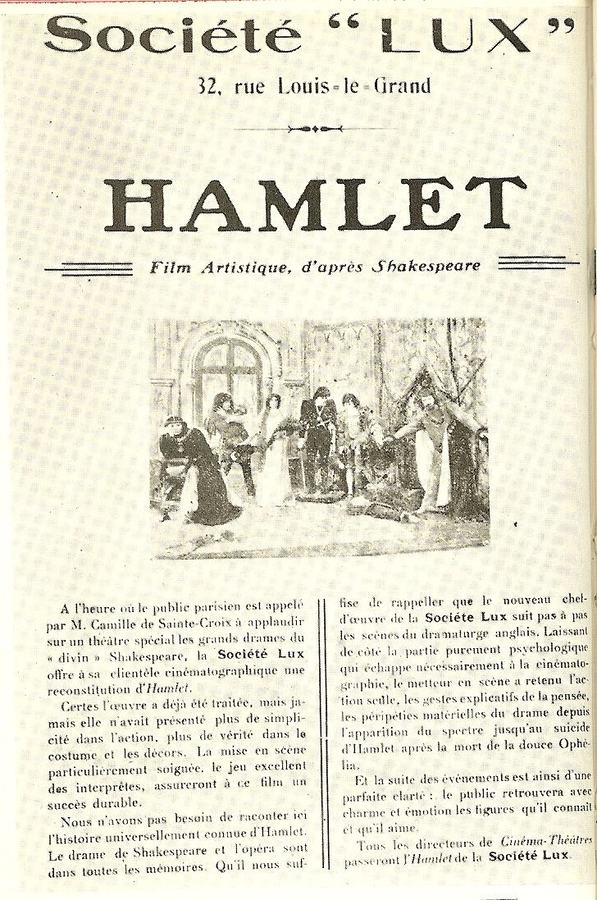
In the pantheon of cinematic phantoms, Hamlet, Prince of Denmark (1900) occupies a singular catacomb. Barely two minutes survive—fragments stitched like tattered brocade—yet those seconds flicker with the same ontological vertigo that electrified the Théâtre de l’Odéon when Jean Mounet-Sully first uncorked the prince’s agony on stage. Directors Clément Maurice and Georges Hatot wield the camera not as mere recording device but as necromancer, coaxing Shakespeare’s verse into the mute semaphore of gestures, iris-ins, and painted backdrops that tremble like wet parchment.
What we witness is less a narrative than a fever dream of regicide, a celluloid séance where every intertitle is a tombstone.
The plot, stripped to its marrow, remains immutable: a prince paralysed by the moral arithmetic of revenge. Yet in this silent incarnation, psychology becomes choreography. Mounet-Sully—whose stage Hamlet ran four hours—compresses existential dread into a hieroglyphic of clenched fists and backward steps. His eyes, kohled like a Byzantine saint, register the moment the ghost’s finger points to the alcove: recognition curdles into nausea, then into the resolve that curdles again into doubt. The camera, stationary but ravenous, ingests his performance whole, preserving the flamboyant declamation of 1890s French theatre inside the newborn grammar of close-up.
Shot on 35 mm at the Gaumont studios, the film exploits nitrate’s spectral luminosity. Candlelight pools in chiaroscuro lakes across the castle floors; the ghost’s armour is daubed with aluminium powder, catching the arc-lamps in meteoric streaks. Because synchronous sound is still a rumour, the directors lean on Georges Méliès-style substitution splices: the ghost vanishes mid-frame, a puff of magnesium smoke masking the cut. Contemporary viewers, accustomed to boxing films and military parades, must have felt the jolt of the uncanny—death flickering alive, alive flickering dead.
The surviving fragment pivots on two tableaux: the battlements apparition and the ‘play-within-the-play’ pantomime. In the latter, Hamlet’s frantic gestures—palms turned upward, index finger stabbing toward Claudius—translate soliloquy into pure kinetic accusation. The courtiers, arranged like cardboard tiers, freeze in a collective gasp; the moment crystallises silent cinema’s nascent power to render interiority without words.
Mounet-Sully was fifty-eight when he stepped before the lens, his aquiline profile already legendary from Sarah Bernhardt’s tours. Here he slows his trademark athleticism—those famous stage leaps—into micro-gesture: a tremor of the right cheek, a swallow that ripples the lace collar. The effect is proto-cinematic; he anticipates the interiorised minimalism we associate with later masters like Dreyer or Falconetti. One can splice his Hamlet beside Passion tableaux of the same year and witness the evolutionary fork between theatrical pageantry and filmic intimacy.
Yet the performance also carries the burden of nineteenth-century declamatory excess. Arms sweep in semaphores; the torso tilts at melodramatic angles. Rather than undermine the film, these flourishes become artefacts—fossils of acting styles dissolved by the camera’s candour. We are watching two extinct species at once: the pre-Freudian prince and the pre-method actor.
All female roles were still played by men in 1900, but the film’s brevity erases Ophelia’s mad scene—a lacuna that inadvertently foregrounds Hamlet’s solitary spiral. The camera’s masculine gaze lingers on the prince’s tormented physique, turning the missing heroine into a negative space, a ghosted femininity. Contemporary suffragette audiences may have decoded the elision as symptomatic of wider silencings; modern critics read it as the medium’s first unconscious confession that it can only frame, never fully embody, Shakespeare’s polyphonic interiority.
In excising Ophelia, the film anticipates the coming century’s habit of editing women out of cultural memory, a foreshadow worthy of Hamlet’s own preoccupation with erasure.
Shot mere months after the Boer War’s first photographs shocked Europe, the film’s obsession with usurpation resonates beyond Danish battlements. Claudius’s seizure of the throne mirrors imperial land-grabs; Fortinbras’s closing march evokes newsreels of foreign expeditions. The camera itself—an occupying eye—becomes complicit in the power dynamics it depicts. When the ghost points off-screen, he gestures toward both a regicide and the century’s coming carnage: Boxer Rebellion, trenches, gas.
Gaumont’s distribution networks, stretching from Paris to colonial outposts, meant this Hamlet could screen in Saigon or Dakar weeks after Parisian première. Imagine indigenous audiences interpreting the prince’s paralysis through the lens of subjugation; imagine Danish settlers in the Caribbean seeing their own genealogies of betrayal flicker across canvas sheets strung between palm trunks. The film becomes palimpsest, overwritten by each spectator’s geopolitical context.
Place the film beside Passion sequences of the era and a spectral economy emerges: both trade in resurrection iconography, both hinge on a son’s sacrificial trajectory. Yet where Christ transcends, Hamlet descends into annihilation. The Danish prince’s failure to regenerate his realm casts him as anti-messiah, a reading intensified by the film’s truncated finale—bodies heaped, no ascending angels. Conversely, juxtapose it with Jack Johnson’s 1910 victory: both are fights for legitimacy, both unleash cultural anxieties about bloodline purity, both end with a blackened, emptied arena.
The original 280-metre reel was last catalogued in 1908; nitrate decay, warehouse fires, and World War I shelling devoured the bulk. What circulates today—two minutes at 18 fps—was salvaged from a Montreudian collector’s attic in 1965, rehydrated in a Swiss lab, and printed onto safety stock. Digital scans reveal frame-line fungus blooming like medieval illumination; the ghost’s helmet now carries a constellation of emulsion pockmarks. Some archivists argue these scars are historical testimony, others lobby for AI interpolation. The ethical stalemate mirrors Hamlet’s own: to restore or to conserve, to act or to let be.
Viewers seeking pristine Shakespeare should brace for a shattered mosaic; those receptive to cinema’s bruised materiality will discover a poignant congruence between the prince’s fractured psyche and the artefact’s lacerated celluloid.
Georges Méliès, writing in Phono-Ciné-Gazette, praised the film’s “spectral verisimilitude” while lamenting its lack of colour—hand-painting had not yet been applied. American trade papers dismissed it as “a curio for the literary,” preferring sport actualities. Modern scholars, however, read the film as a progenitor of psychological horror, predating The Cabinet of Dr. Caligari by two decades. The ghost’s abrupt entrances prefigure jump scares; Hamlet’s soliloquy-through-gesture anticipates silent montage theories of Eisenstein.
Feminist critics interrogate the erasure of Ophelia and Gertrude’s interiority, while post-colonial scholars map the film’s complicity in imperial circuits of exhibition. Digital humanists feed the surviving frames into algorithmic analysis, measuring micro-movements to quantify early acting styles. Each wave of theory resuscitates the film for new constituencies, proving that even a two-minute ghost can haunt a hundred years of discourse.
The fragment streams on several archival platforms; quality varies from 720p to 4K. Recommended accompaniment: a live string quartet performing Liszt’s Funérailles or a solo theremin improvising glissandi that echo the ghost’s metallic resonance. Avoid orchestral adaptations of Tchaikovsky’s Hamlet—their surging pathos swamps the film’s brittle intimacy.
For completists, pair the viewing with a visit to the 1910 remake to trace how cinematic grammar calcifies across a decade. Note the shift from frontal tableau to angled depth; observe how gestures shrink as intertitles balloon. The diptych becomes a masterclass in the evolution from theatrical pantomime to uniquely filmic storytelling.
Does a mutilated relic merit canonical status? If cinema history is a palimpsest, then every shred re-inscribes the future. This Hamlet is less a film than a wound—an open gash through which modernity bleeds: doubt over action, image over word, empire over self. It is mandatory viewing for anyone who believes that even ghosts deserve a second death—this time at twenty-four frames per second.
Rating: 9.0 / 10 – A fragmentary miracle that distills the entire twentieth-century crisis of meaning into two haunted minutes.
IMDb —
1919
Community
Log in to comment.