DbcultAccessing Vault...
6/10
Senior Film Conservator
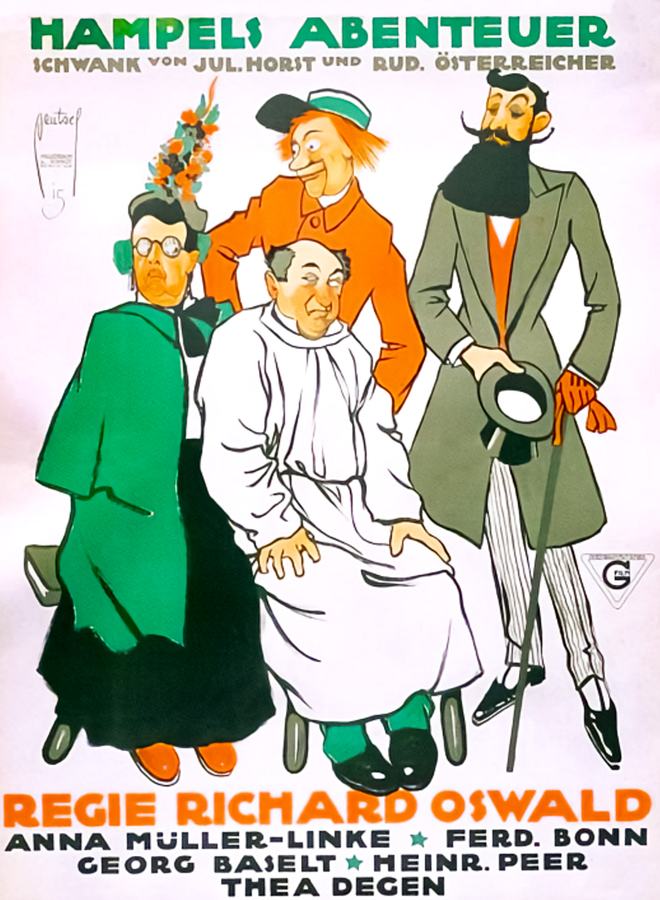
A definitive 6/10 rating for a film that redefined the boundaries of cult cinema. Hampels Abenteuer remains a cornerstone of transgressive art.
There's a peculiar magic to rediscovering a film like Richard Oswald's Hampels Abenteuer, a cinematic journey that, even across the chasm of a century, speaks with surprising clarity to the eternal human yearning for something more. It's not merely a historical artifact; it's a vibrant tapestry woven with threads of slapstick, genuine pathos, and an undeniable spirit of adventure. Oswald, a master storyteller of the early German screen, crafts a narrative that transcends its silent origins, inviting us into a world where the mundane can, with a single misstep, blossom into the extraordinary.
At the heart of this delightful escapade is Adolf Suchanek's Hampel, a character who embodies the everyman in extremis. Suchanek imbues Hampel with a magnificent timidity, a nervous energy that manifests in a constant fidget and a perpetually bewildered expression. He is the quintessential office drone, a cog in the vast, impersonal machine of urban bureaucracy, his life a monotonous rhythm of inkwells and ledgers. Oswald's genius lies in presenting Hampel not as a caricature, but as a relatable soul whose internal world is far richer than his external circumstances suggest. We witness Hampel's fervent daydreams, often depicted with whimsical visual flourishes: he imagines himself a swashbuckling hero, a dashing lover, a man of consequence, all while his physical reality remains confined to a cramped desk and the disapproving gaze of his colleagues. This stark contrast between his vibrant inner life and his drab outer existence sets the stage for the grand adventure that is about to engulf him.
The catalyst for Hampel's transformation arrives in the form of a misdelivered envelope—a classic plot device, yet executed here with a fresh, almost fated, precision. This seemingly innocuous piece of correspondence, intended for a secret operative, thrusts Hampel headlong into a labyrinthine plot involving espionage, hidden agendas, and a shadowy cabal. Suddenly, the meek clerk is mistaken for a man of action, a figure of vital importance, and the sheer absurdity of the situation is played for maximum comedic effect. Suchanek's physical comedy shines brightest here, as Hampel’s attempts to navigate this bewildering new reality are a masterclass in awkward charm. He stumbles, he blusters, he attempts to project an air of confidence that is utterly betrayed by his trembling hands and wide, innocent eyes.
The world Hampel enters is populated by a vibrant array of characters, each contributing to the film's rich texture. Ferdinand Bonn delivers a chilling performance as Baron Von Kroll, the primary antagonist whose malevolent gaze and imposing physical presence cast a long shadow over Hampel's journey. Bonn eschews overt villainy for a more insidious portrayal, suggesting a calculating intellect beneath the polished exterior. His pursuit of Hampel is relentless, creating a palpable sense of tension that underscores the comedic elements. Thea Degen, as Lady Isolde, is a vision of enigmatic allure. Her character embodies the femme fatale archetype, her motives shrouded in mystery, her beauty both a promise and a threat. Degen's performance is captivating, her every glance and gesture hinting at deeper secrets, making her a compelling, if morally ambiguous, figure in Hampel's burgeoning adventure. She represents the seductive danger of the unknown, a stark contrast to Hampel’s safe, predictable world.
In stark contrast to these figures of intrigue, Anna Müller-Lincke shines as Lotte, the virtuous and spirited young woman who becomes Hampel’s unlikely love interest. Müller-Lincke brings a refreshing authenticity to her role, portraying Lotte not as a damsel in distress, but as a woman of considerable inner strength and empathy. Her interactions with Hampel are tender and humorous, providing a grounding force amidst the unfolding chaos. Their blossoming romance is the emotional anchor of the film, offering a poignant counterpoint to the thrilling escapades. Georg Baselt, as the eccentric Professor Alistair Finch, provides much-needed guidance and comic relief. Baselt’s portrayal of the absent-minded but brilliant academic is delightful, his character serving as a mentor figure who helps Hampel decipher the convoluted plot he’s stumbled into. Heinrich Peer, in a supporting role, further fleshes out the ensemble, adding another layer of authenticity to the bustling world Oswald creates.
Richard Oswald, credited as the writer, demonstrates a profound understanding of narrative pacing and visual storytelling, hallmarks of the silent era. While the director's chair for this specific film isn't explicitly listed in the provided details, Oswald's creative imprint is undeniable, shaping the film's whimsical tone and intricate plot. He masterfully balances slapstick comedy with genuine suspense, ensuring that Hampel’s journey, while often farcical, never loses its emotional core. The visual language of the film is remarkably sophisticated for its time, employing dynamic camera work and expressive intertitles to convey mood and accelerate the plot. Oswald understands that in silent cinema, every gesture, every facial expression, every set piece must speak volumes, and he guides his cast to deliver performances that are both nuanced and broadly appealing. The editing, too, deserves commendation, as it propels the narrative forward with an energetic rhythm, particularly during chase sequences and moments of heightened tension.
The film’s thematic explorations are surprisingly deep. At its core, Hampels Abenteuer is a meditation on escapism and the discovery of inner strength. Hampel’s initial yearning for adventure is a universal sentiment, one that resonates with anyone who has ever felt trapped by routine. His transformation is not instantaneous or entirely smooth; it’s a gradual, often hilarious, process of shedding inhibition and embracing the unknown. This journey of self-discovery is echoed in films like The Sundowner, where characters are similarly thrust into new environments that force them to confront their true selves, albeit in a more rugged, existential context. Where The Sundowner explores the vastness of the Australian outback as a crucible for character, Oswald’s film finds its crucible in the urban labyrinth, a place where hidden dangers and unexpected opportunities lie around every corner.
The production design of Hampels Abenteuer is another unsung hero, meticulously crafting environments that enhance the narrative. From Hampel's cramped, cluttered office, which perfectly encapsulates his mundane existence, to the shadowy, opulent salons where Lady Isolde holds court, every set piece is designed to tell a part of the story. The use of light and shadow is particularly effective, creating an atmosphere of mystery and suspense that is crucial for the espionage elements. Darkened alleyways and dimly lit interiors heighten the sense of danger, while brightly lit public spaces offer moments of respite, albeit often brief. This careful attention to visual detail elevates the film beyond a simple comedic adventure, imbuing it with a cinematic richness that rivals more overtly dramatic productions of the era, such as The Painted World, which similarly utilized its visual artistry to create immersive, fantastical realms, though often with a more overtly stylized approach.
Oswald’s narrative structure, though seemingly simple, is ingeniously crafted. The plot twists and turns with a delightful unpredictability, keeping the audience engaged and constantly guessing Hampel’s fate. This intricate plotting, reminiscent of the best adventure serials, demonstrates a sophisticated understanding of audience engagement. It's a journey that, while lighthearted, never shies away from moments of genuine peril, making Hampel’s eventual triumphs all the more satisfying. The interplay between comedy and suspense is finely tuned, allowing the humor to defuse tension without undermining the stakes. This balance is a delicate art, and Oswald executes it with remarkable finesse, creating a rollercoaster of emotions that is both thrilling and heartwarming.
When considering Hampels Abenteuer within the broader landscape of silent cinema, its unique blend of comedy and adventure stands out. It shares a spiritual kinship with films that explore the trials and tribulations of ordinary people thrust into extraordinary circumstances, much like the melodramatic social commentaries of Ten Nights in a Barroom, though Oswald’s film leans more into personal transformation rather than overt moralizing. The romantic entanglements and power dynamics at play also bring to mind films like The Love Tyrant, where relationships are often complicated by external forces and societal expectations. However, Hampel’s romantic journey is far less cynical, imbued with an innocent charm that is utterly endearing.
The film's adventurous spirit and moments of physical daring can be compared to action-oriented features such as Saved in Mid-Air, though Hampel’s heroism is often accidental or reluctant, adding a layer of humor to the proceedings. Unlike the deliberate heroics of an aviator, Hampel's courage is forged in the crucible of necessity. The intricate web of intrigue and betrayal also finds parallels in films like The Traitress, but Oswald infuses his plot with a lighter touch, preventing it from descending into pure melodrama. Even the psychological depth, though presented through a comedic lens, invites comparison to more serious works. While it certainly doesn't aspire to the profound tragic complexity of Hamlet, Hampel’s internal struggle with his identity and fear is a compelling, if humorous, exploration of the human psyche.
The film also resonates with narratives of personal journey and transformation seen in works like Nuori luotsi, where an individual's resolve is tested against formidable challenges, and At the Cross Roads, which explores pivotal moments of decision. Hampel's adventure is essentially a series of crossroads, each demanding a choice that pushes him further beyond his comfort zone. The ensemble dynamics, particularly between Hampel, Lotte, and Professor Finch, echo the character-driven relationships found in The Three of Us, where the interplay between distinct personalities drives much of the dramatic and comedic tension. The thrilling escapades and encounters during his journey also bring to mind the episodic nature of films like Diligencekusken fra San-Hilo, where the journey itself is as much a character as the individuals undertaking it.
Moreover, the film's ability to create a sense of impending danger, despite its comedic leanings, positions it alongside thrillers such as The Rattlesnake or the atmospheric mystery of Az éjszaka rabja, albeit with a lighter touch. Hampel's encounters with Baron Von Kroll are genuinely tense, demonstrating Oswald's versatility in juggling genres. The narrative’s ultimate resolution, while triumphant, avoids the stark, often fatalistic conclusions of films like The Life Story of John Lee, or The Man They Could Not Hang, instead opting for a more hopeful and affirming outlook on human potential. Even historical adventures like Arrah-Na-Pogue, with their grand scope and romanticized derring-do, share a lineage with Hampel’s journey, proving that the spirit of adventure can manifest in vastly different settings and scales.
What truly elevates Hampels Abenteuer is its timeless message. It’s a celebration of the ordinary individual, a testament to the idea that heroism isn't exclusive to the physically imposing or the socially powerful. It resides within the quiet courage to step outside one's comfort zone, to face the unknown, and to discover capabilities previously unimagined. Hampel’s adventure is not just about foiling a nefarious plot; it’s about finding his voice, his confidence, and ultimately, his true self. The film leaves us with a profound sense of satisfaction, not merely because the antagonists are vanquished and love prevails, but because Hampel, the unassuming clerk, has become the hero of his own story. He returns to his former life not as the same timid soul, but as a man subtly yet fundamentally transformed, carrying the echoes of his grand adventure within him.
Richard Oswald’s creation is more than just a relic of early cinema; it’s a vibrant, engaging piece of storytelling that continues to captivate. Its blend of humor, suspense, and heartwarming romance ensures its place as a distinguished entry in the annals of silent film. The performances are compelling, the direction assured, and the narrative, though fantastical, remains deeply human. For those seeking to delve into the rich tapestry of early filmmaking, Hampels Abenteuer offers an utterly rewarding experience, a delightful reminder that even the most unassuming among us can embark on the most extraordinary of journeys.
The film stands as a testament to the power of imagination and the enduring appeal of a good story well told. It reminds us that sometimes, the greatest adventures begin with a simple misstep, an unexpected turn, and the courage to embrace the unforeseen. It's a gentle, yet powerful, cinematic embrace, encouraging us all to look for the adventure lurking just beyond the familiar horizon.

IMDb —
1920
Community
Log in to comment.