DbcultAccessing Vault...
6.4/10
Senior Film Conservator
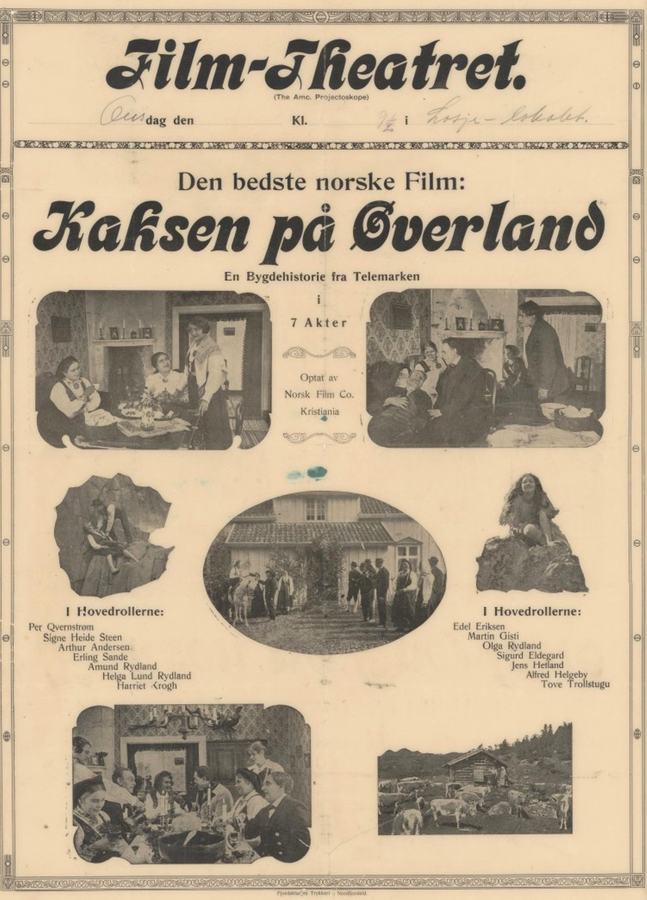
A definitive 6.4/10 rating for a film that redefined the boundaries of cult cinema. Kaksen på Øverland remains a cornerstone of transgressive art.
A valley of sheep and secrets
The first thing that strikes you is the light—not the postcard aurora you expect from fjord-country legend, but a cool, razor-thin Nordic glow that cinematographer Ivar Jentoft bends like glass. He glides across Telemark’s quilt of summer green, lingers on the fiddle-player’s calloused fingertips, then tilts upward until the sky becomes a vaulted confession booth. Within this cathedral of grass and guilt, Kaksen på Øverland plants its saga of inheritance and music, announcing itself as less a rural curio than a psychological tinderbox.
The plot, deceptively simple, ripples outward like rings in a mountain tarn: a prosperous heir covets the neighbor’s poorer yet artistically free life; a father forbids; a father dies; the heir’s desired fiddle morphs into a siren of culpability. No title cards moralize—Olsen’s screenplay trusts faces, weather, and that Hardanger’s keening drone to carry the burden. The result feels closer to a ballad than to narrative cinema, a lineage it shares with The Girl-Woman yet surpasses in moral opacity.
Amund Rydland plays the boy, Aslak, with the gangly volatility of someone who has grown too fast for his skin; every blink seems to measure acreage against arpeggios. Opposite him, Martin Gisti’s fiddler, Eilev, moves with feral grace, a smirk tucked in the corner of his mouth as though he already hears the funeral psalm. Tove Trollstugo, the dead man’s bereaved sister, has eyes that could pickle winter; watch how she studies Aslak during the wake scene—half accusation, half lament—without ever voicing either.
Because the film is silent, micro-gestures balloon into tectonic events. When Aslak’s bow first scrapes a hesitant note, the camera isolates his thumb: it trembles, whitens, releases. In that 12-frame shudder we read every suppressed revolt against the patriarch. Compare this to the histrionic eye-rolling of The Captive God; here, understatement wields a scalpel.
Sound in a silent film? Olsen bends the paradox until it sings. During interior scenes, the intertitles simply read “Slåtten kjem” (“The tune is coming”), and the orchestra pit of Oslo’s Kinematografen Paléet would oblige with a traditional springar. Modern archival prints retain those cues as subtitles; even without live musicians, your memory supplies the drone, the trill, the octave leap that signals the dance. Thus the fiddle becomes both diegetic and non-diegetic, a Greek chorus carved from spruce.
Aslak’s arc parallels the instrument: first a fragile curiosity, then a surrogate tongue, finally a gavel that judges. When he lifts it in the hayloft after the funeral, moonlight stripes the strings like frost on barbed wire. You sense, with a shiver, that he is not caressing wood but cradling the weapon that may have unmanned his lineage.
Until 2018, Kaksen på Øverland survived only in fragmentary reels at the Norwegian Film Institute: water damage gnawed the emulsion like lichen on stave-church timber. Then a 4K photochemical restoration—funded by Telemark’s regional council—mined the original camera negative from a disused barn in Sauherad. The tinting strategy revived the amber afternoons and cobalt evenings implicit in the screenplay’s seasonal cues. Scratches remain, but they read now like frost-fissures on a fjord, not scars.
The new print premiered at the Bergen Silent Film Festival where it shared a program with Der Fund im Neubau – 2. Teil. The pairing revealed how Norwegian and German approaches to guilt diverge: the latter externalizes culpability into expressionist shadow; Øverland buries it under moss and morality.
Though Lutheran hymns thread the soundscape, salvation remains MIA. The village pastor, played by Sigurd Eldegard with a brow perpetually furrowed like a ploughed field, delivers no benediction. His sole function is to witness Aslak’s final dance—a pagan stamping that erupts inside the barn while congregants gather outside. The sacred and the profane share one roofbeam, yet neither claims victory, a theological stalemate that feels shockingly modern.
Compare this to the tidy moral algebra of Her Atonement where crime must birth contrition. Olsen refuses such bookkeeping; guilt here is ambient, like the scent of pine after rain.
Inter-war Norwegian cinema seldom questioned patriarchy; land passed from sire to son like a relay baton. Øverland detonates that tradition. After the father’s corpse is carted off, the farm’s control reverts not to Aslak but to creditors. The phallus, symbolized by the patriarch’s cedar walking-stick, snaps in two during a late-film brawl, the crack echoing like a rifle across the plateau. From that moment, masculinity must re-invent itself or perish. Aslak’s attempt—he sows the fields at dawn, competes with laborers twice his girth—reads as tragic vaudeville; his true rebirth occurs only when he allows the fiddle to speak what his vocal cords cannot.
Women in Øverland occupy peripheral frames yet magnetize meaning. Olga Rydland’s Ingeborg, the dead man’s betrothed decades earlier, floats through parlors in black crepe, her eyes twin censers of incense. She never utters suspicion, but when she closes the piano lid with a muted thud, the gesture lands like a verdict. Edel Eriksen’s housemaid, Mette, smuggles Aslak food after his patricide ostracism; her covert solidarity anticipates the proletarian empathy found later in Young America.
Olsen fractures chronology with flash-cuts that predate La Jetée by four decades. The father’s death replays in stroboscopic shards: a boot on frost, a raven’s blink, a fiddle scroll slicing the frame. These subliminal blips last fewer than eight frames, yet they seed the viewer with after-images that bloom during the final reel. You exit the cinema unsure whether you remember the film or dreamt it—a quality it shares with the hallucinatory battlefields of Bei unseren Helden an der Somme.
Telemark’s landscape is no postcard but a stakeholder. Note the cross-cutting between Aslak’s plucking and the river’s plucking of stones: each musical phrase coincides with a gush of spring melt, suggesting that fiddling is merely human ventriloquism of the earth’s own erosive score. When the boy finally hurls the instrument into the torrent, the splash is greeted by a cut to glacier-milk water—a reminder that nature absorbs our sin and symphony alike.
Lars von Trier cited Øverland in a 1998 interview as proof that Nordic guilt predates Dogme by eighty years. Joachim Trier’s Oslo, August 31 borrows the river-as-confessional motif. Even the slow-TV phenomenon of Norwegian broadcasting owes a debt: the patient grazing shots, the willingness to let real-time sheep-chewing generate suspense.
The restored DCP tours arthouse venues under the auspices of the Scandinavian Heritage Foundation; check their calendar for North-American stops. If geography betrays you, the Norwegian Film Institute streams a 2K version with optional English subtitles—though you’ll miss the tactile thrill of 16mm grain shivering like birch leaves.
There are films you watch and films that watch you. Kaksen på Øverland belongs to the latter cabal. Long after the screen darkens, the Hardanger’s sympathetic strings keep vibrating inside your ribcage, tuning each heartbeat to the key of ancestral doubt. The father’s murder remains unsolved because the film knows the true culprit is heritage itself—the ancient edict that land must supersede song. Until we revoke that clause, we are all, like Aslak, dancing on barn boards suspended over an abyss of our own inheritance.
IMDb 5.9
1934
Community
Log in to comment.