DbcultAccessing Vault...
3.9/10
Senior Film Conservator
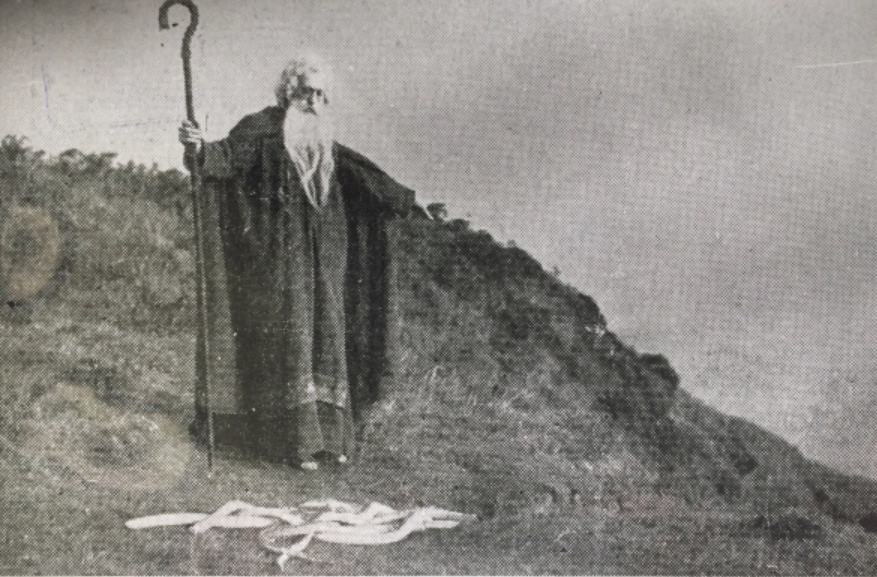
A definitive 3.9/10 rating for a film that redefined the boundaries of cult cinema. In the Days of Saint Patrick remains a cornerstone of transgressive art.
In the flickering light of early 20th-century cinema, few works carry the weight of national identity as profoundly as In the Days of Saint Patrick (1920). This is not merely a film; it is a liturgical artifact, a celluloid prayer that seeks to codify the foundational mythos of the Irish spirit. Directed by and starring the versatile J.B. Carrickford, the production stands as a testament to the ambitions of a burgeoning domestic film industry attempting to reclaim its narrative from the shadows of foreign interpretation. Unlike the high-octane maritime brutality found in The Sea Wolf of the same year, Carrickford’s work opts for a contemplative, almost pastoral pace that mirrors the slow, inevitable spread of the faith it depicts.
The visual language of the film is one of stark contrasts. The cinematography, though limited by the technical constraints of 1920, utilizes the natural Irish landscape with a reverence that borders on the pantheistic. The settlements established by the Bishop are not presented as grand architectural feats, but as humble, organic growths within the landscape—a sharp stylistic departure from the opulent aristocratic settings of Sangue blu. Here, the beauty is found in the texture of the stone, the mist over the hills, and the earnest expressions of a cast that seems recruited from the very earth they tread.
J.B. Carrickford’s portrayal of Patrick is a masterclass in silent-era gravitas. He eschews the melodramatic flourishes common in contemporary American imports, choosing instead a stoic, inward-looking intensity. When he confronts the druidic shadows, it is not with the theatricality of a stage magician, but with the quiet authority of a man who has seen the divine. This performance provides a fascinating counterpoint to the more enigmatic protagonists of the era, such as the title character in The Silent Master, where silence serves mystery rather than ministry.
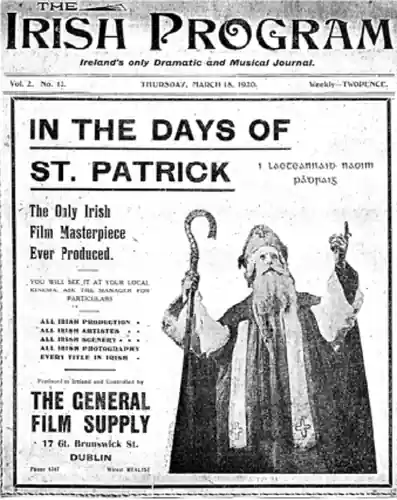
The cast list reads like a census of early Irish theatrical talent. Herbert Mayne and O'Carroll Reynolds provide the necessary dramatic friction, representing the old world’s resistance and eventual capitulation to the new doctrine. The presence of Miss. Poole and Maude Hume adds a layer of maternal and spiritual grace to the proceedings, ensuring the missionary effort is seen as a communal evolution rather than a solitary conquest. This ensemble approach creates a tapestry of conversion that feels lived-in and authentic, distinct from the singular focus found in films like Viviette, which centers more narrowly on personal romantic entanglements.
One cannot overlook the logistical feat of coordinating such a large cast—from Jack Drago to Alice Cardinall—in an era where Irish film production lacked the industrial infrastructure of Hollywood or London. Every frame is saturated with a sense of collective purpose. The settlements themselves, portrayed through a mix of location shooting and artisanal set design, serve as characters in their own right. They represent the transition from the nomadic to the monastic, a shift that the film handles with a surprisingly sophisticated understanding of historical sociology.
When placed alongside The Trap, Carrickford’s narrative feels remarkably linear and purposeful. While many films of 1920 were beginning to experiment with complex editing and psychological suspense, 'In the Days of Saint Patrick' remains steadfast in its chronological hagiography. This isn't to say it lacks sophistication; rather, its sophistication lies in its restraint. It avoids the dizzying artifice of The City of Illusion, opting instead for a clarity of vision that mirrors the Saint’s own singular focus.
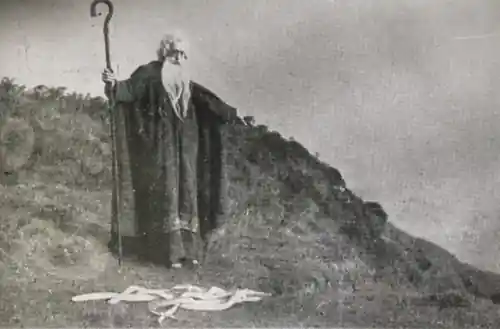
The film’s pacing might challenge modern audiences accustomed to the rapid-fire montage of contemporary cinema, yet for the patient viewer, there is a rhythmic beauty to the long takes. The sequences depicting the establishment of the missionary sites possess a documentary-like quality, reminiscent of the observational style seen in Around the Clock with the Marines, though infused with a much deeper spiritual subtext. It is a cinema of presence, where the act of being in a holy place is as important as the actions performed within it.
The film subtly navigates the political landscape of 5th-century Ireland, showing Patrick’s interactions with local chieftains not just as religious conversions, but as diplomatic maneuvers. This adds a layer of realism that is often missing from later, more sanitized versions of the Saint’s life. The tension between the burgeoning Christian settlements and the established social order provides a dramatic backbone that prevents the film from descending into mere propaganda. It shares a certain thematic weight with My Four Years in Germany, insofar as both films deal with a protagonist navigating a complex, often hostile foreign environment to establish a new order of truth.
Furthermore, the inclusion of characters like Dermot McCarthy and Eddie Lawless highlights the human cost of this transition. The film does not shy away from the struggle, the fatigue, and the inherent conflict of uprooting ancestral beliefs. This groundedness is what elevates the work above the whimsical escapism of A Tropical Eggs-pedition or the lightheartedness of Die Bademaus. This is a story of blood, soil, and spirit.
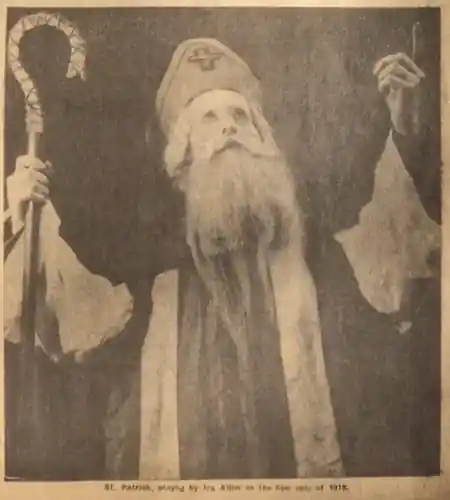
Technically, the film is a fascinating study in the limitations and triumphs of the era. The use of natural light is particularly effective, creating a chiaroscuro effect in the forest scenes that feels almost like a Caravaggio painting come to life. The costume design, handled with what appears to be meticulous attention to historical (or at least traditional) accuracy, avoids the flamboyant excesses of The Love Mask. Instead, the rough-hewn robes and simple iron crosses reinforce the film’s commitment to an ascetic aesthetic.
The editing, while rudimentary by today’s standards, possesses a deliberate cadence. There is a sense of inevitability in the way the scenes unfold, as if the history itself is being dictated by a higher power. This is quite different from the frantic energy of Italy's Flaming Front, which sought to capture the chaos of war. Carrickford, by contrast, seeks to capture the peace of a new order. The film’s survival is a miracle of archival preservation, allowing us to witness the birth of Irish cinema through a lens that is both deeply parochial and universally resonant.
To watch In the Days of Saint Patrick is to step into a time machine—not just back to the 5th century, but to the early 20th, when the medium of film was first discovering its power to shape national consciousness. It lacks the cynical edge of Some Gal or the adventurous grit of Nanette of the Wilds, but it possesses a soulful integrity that is rare in any era. It reminds us that cinema, at its best, can be a vessel for the sacred.
While it may not offer the tragic catharsis of Stolen Hours, it provides something perhaps more enduring: a sense of continuity. It is a bridge between the ancient oral traditions of the island and the modern visual storytelling that would eventually take its place. J.B. Carrickford and his sprawling cast achieved something remarkable—they turned a missionary settlement into a cinematic landmark, ensuring that the legacy of Patrick would remain etched not just in stone and parchment, but in the very light and shadow of the silver screen. For anyone interested in the intersection of faith, history, and the origins of Irish film, this remains an essential, if demanding, viewing experience.
IMDb —
1910
Community
Log in to comment.