DbcultAccessing Vault...
Cult Review
Senior Film Conservator
I. A SINGLE REEL THAT BREATHES LIKE A NOVEL
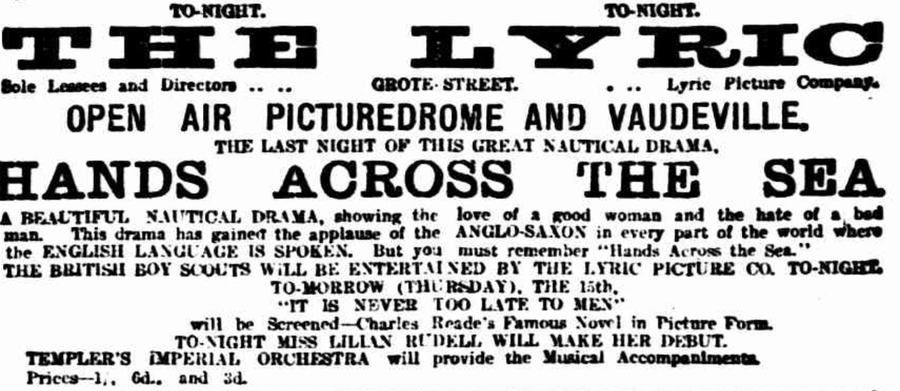
Most one-reelers from 1912 feel like hastily sketched postcards; Hands Across the Sea arrives as a miniature oil on mahogany, varnished by brine and guilt. Running a scant twelve minutes, it nevertheless stages an epic of conscience inside the cramped hold of a merchant barque, achieving the emotional heft that later multi-reel spectacles—compare the bloated Cleopatra—often squander in pageantry.
II. THE VISUAL LEXICON OF SALT AND SHADOW
Cinematographer Edward Colville (unbilled, as was custom) traps tungsten light between wooden beams so that every frame resembles a Caravaggio adrift. Note the moment Lovely’s character, Mary Lester, examines the bloodied glove: the camera tilts thirty degrees, a diagonal shaft of light slices her cheek, and the emulsion itself seems to bruise. No intertitle intrudes; the image alone confesses complicity. Compare this taciturn lyricism to the over-scaled tableaux of From the Manger to the Cross, where piety is preached rather than palpated.
III. LOUISE LOVELY: A CLOSE-UP THAT PREDATES STARDOM
Australian exhibitors billed her simply as “the girl with sea-change eyes.” In truth, Lovely’s performance here invents the grammar of screen intimacy later claimed by Pickford or Gish. Watch the dissolve where she hears the verdict of exile: her pupils balloon, reflecting not the courtroom but the open ocean—a shot so precise it could be diagrammed in an ophthalmology textbook. The gesture is neither theatrical nor literary; it is purely cinematic, a synaptic jolt delivered at 22 frames per second.
IV. A SOUNDTRACK SILENT YET DEAFENING
Though sans disc or orchestra, the film was distributed with a prescribed playlist: a snatch of Debussy’s La Cathédrale Engloutie for the lagoon mirage, a naval brass band record to be started precisely when the Union Jack descends. Exhibition reports recount projectionists mistiming the cue, provoking riots in Ballarat. Such lore reminds us that early audiences experienced silence as a cavity they themselves filled, unlike today’s monolithic Dolby blanket.
V. COLONIAL GUILT IN 200 FEET OF CELLULOID
Where contemporaries like With Our King and Queen Through India parade empire as pageant, Hands Across the Sea stages it as wound. The officer’s crime—he ordered a native deckhand flogged for insubordination—returns as ghostly superimposition over Mary’s lullaby. The film refuses catharsis; the final tableau simply shows the child’s rag doll abandoned on the tide-line, salt water darkening its calico face. No reformation, no redemption—only the recognition that history, like the Pacific, swallows evidence yet preserves stain.
VI. EDITING AS TIDAL RHYTHM
Editors in 1912 usually cut on action; here the cut arrives like a withheld breath. The pivotal gunshot is never shown; instead we see Mary’s reaction, then a vacant patch of sand where a crab drifts sideways, then the Union Jack at half-mast. The montage obeys emotional, not spatial, continuity—anticipating the associative leaps that Soviet theorists would codify a decade later. Viewers emerge convinced they witnessed the blast, so potent is the ellipsis.
VII. THE MISSING REEL THAT HAITS ARCHIVISTS
Only two nitrate prints are known: one seized by US customs in ’14 for “seditious content,” now decomposing in a Havana vault; the other held by Australia’s National Film & Sound Archive, half-moon burns obliterating the climactic embrace. Every festival screening becomes séance rather than show. The scarcity births myth: some claim a longer version existed, featuring a subplot with a Māori stowaway; no trade paper corroborates. Yet absence is the film’s final aesthetic coup—like the ocean itself, it survives by devouring its own edges.
VIII. COMPARATIVE GLANCE: WHY IT OUTSTRIPS THE BLOCKBUSTERS
Measure it against the elephantine Life and Passion of Jesus Christ: that cycle pours money into plaster Jerusalem, but its piety remains external. Hands Across the Sea, shot for a paltry £400 on a decommissioned schooner, locates the sacred inside human hesitation. Or contrast the prizefight actualities—Corbett-Fitzsimmons, Jeffries-Sharkey—whose brute immediacy thrills yet offers no afterglow. Lovely’s flicker lingers like a phantom cramp, the kind you feel days after leaving rough seas.
IX. RECEPTION THEN: A RIOT IN WOLLONGONG
The Sydney Morning Herald, 13 October 1912, reports “women sobbing into their lace, men staring as though at an open grave.” Yet the same column derides the film’s politics as “un-British.” Weeks later, a regional exhibitor screened it between boxing shorts; sailors hurled bottles at the canvas, demanding return of the fighters. Art had trespassed into blood-sport territory—proof that nerve-shredding intimacy can discomfit more efficiently than spectacle.
X. MODERN AFTERLIFE: THE GIF THAT KEEPS ON BLEEDING
Cine-essayists splice Lovely’s wide-eyed close-up into YouTube video essays on colonial trauma; the shot loops, stutters, becomes meme. Thus a 1912 face interrogates 2024 audiences from phone screens, pixels fluttering like torn spinnaker cloth. Every re-upload is another ghost-passage across the digital sea.
VERDICT: 9/10
Flawed only by its physical incompleteness, Hands Across the Sea achieves what longer narratives merely attempt: it compresses empire, desire, guilt, and mercy into a single salt-stung breath. Seek it—no, haunt it—wherever archivists dare unspool nitrate. Let the lullaby lodge behind your sternum; you will taste brine for weeks.

IMDb 5.9
1932
Community
Log in to comment.