DbcultAccessing Vault...
Cult Review
Senior Film Conservator
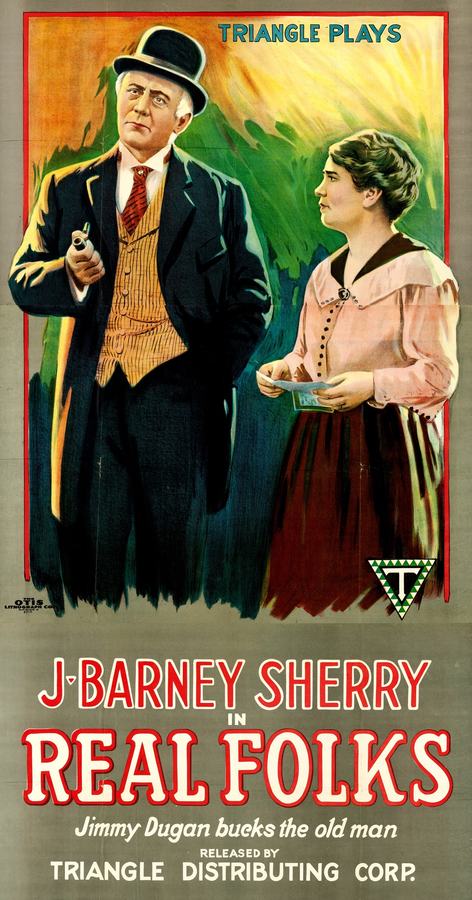
The first time oil spurts from Pat Dugan’s makeshift derrick it looks less like liquid currency and more like the earth itself coughing up a verdict: prosperity, yes, but also a sentence. Real Folks—silent, sepia, stubbornly optimistic—never shows us the gusher in frenetic montage. Instead director Kate Corbaley holds the frame until the viscous ribbon arcs against a white sky, a moment so still you can almost smell sulfur collide with wild-oat pollen. It’s the film’s covert manifesto: wealth will saturate these characters, but never simply cleanse them.
From that baptism of crude we descend into the machinery of American reinvention. Pat, played by J. Barney Sherry with shoulders hinged like a barn door, believes money is merely ancestry spelled backwards. He drags his clan from emerald memory to West-Coast dust, then to East-Coast marble, chasing what he cannot articulate: legitimacy. The performance is all beetle-browed conviction, yet Sherry lets flickers of terror glint whenever the camera dollies close—an immigrant terrified that fortune might peel away as abruptly as it arrived.
Enter Francis McDonald as Jimmie, sun-browned calves still ghost-tanned by overalls. McDonald moves like someone perpetually surprised by sidewalks; every step is half bounce, half apology. The narrative hinge—college fisticuffs and flight—could feel mechanical, yet Corbaley scripts the scuffle as slapstick existentialism: a single punchline that detonates Pat’s dynastic blueprint. The camera chases Jimmie through quadrangles carved for Puritan portraits, then releases him into Long Island’s salt-sprayed contradictions.
His partnership with Garbaldi—George C. Pearce in scenery-chewing Neapolitan mode—could have slid into caricature. Instead the duo’s greenhouse becomes a parliament of outcasts: Irish, Italian, ex-stevedores, chorus girls nursing bruised ambitions between potted hydrangeas. Note the color symbolism Corbaley sneaks into monochrome: yellow marigolds nodding beside white lilies, an omen of Joyce’s hybrid pedigree.
Fritzi Ridgeway’s Joyce arrives veiled in cigarette smoke and unpaid rent, yet she wields intellect like a parasol against the dowager set. Watch her maiden exchange with Jimmie: he fumbles a bouquet, scattering Strelitzia across flagstones; she kneels, reciting Linnaeus nomenclature under her breath—an erudite liturgy that instantly flips the power balance. Ridgeway’s large, mirth-thirsty eyes telegraph calculation without cruelty; she wants love but refuses rescue.
The film’s midpoint swerves into bedroom-faraday territory when Pat rents the neighboring estate, unaware his son lurks behind wisteria. Corbaley stages the reveal through a pair of opera glasses: Pat surveys the horizon, lens drifting until he spies Jimmie pruning roses. The iris-in on Sherry’s face—half pride, half apoplexy—could be a Keystone template, but the emotional undertow is Chekhovian.
Pat’s ultimatum—marry society or forfeit fortune—echoes through countless Jazz-age melodramas, yet Corbaley complicates the trope by making the high-born option repellently vapid. Enter Betty Pearce as Lady Blessington’s niece, all enamel smiles and eugenic opinions; she treats the Irish like exotic livestock. When she corners Jimmie at a regatta, the background extras freeze in tableau, as though even the universe anticipates his refusal.
But the film’s true duel is generational, not romantic. Pat’s insistence on pedigree is less snobbery than existential dread: if his lineage can’t penetrate the social citadel, the wound of displacement never scabs. His climactic confrontation with Joyce—in which she serves him tea laced with unflinching candor—plays out in a single two-shot: faces half-lit by firelight, the remainder swallowed by shadow. She quotes Heine’s “Die Heimkehr”; he counters with a gruff Yeats line. Literature becomes munition; by the time she mentions her own dead mother’s Dublin roots, the old man’s scowl trembles into something perilously close to kinship.
Cinematographer T.D. Crittenden lenses California like a drought-ridden Delacroix: ochre heat mirages shimmer until the oil derrick erupts, black spray lacquering skies in chiaroscuro excess. Transition to Long Island and the palette cools—silver birches, pallid sand—yet Corbaley keeps one jarring prop: Pat’s crimson touring car, a mobile wound amid muted blues. Inside the greenhouse, gauzy diffusion renders petals spectral, as though flowers might ascend rather than wilt.
Intertitles—often a silent film’s Achilles heel—here crackle with idiomatic zest. My favorite: “Prosperity is a fine tailor, but he buttons the vest so tight you can’t breathe.” The syntax feels plucked from a Dublin pub, not a Hollywood writers’ room, suggesting Corbaley and co-writer Jack Cunningham eavesdropped on the very accents they sought to reproduce.
Devotees of La Tosca will detect a parallel obsession with encroaching modernity trampling sacred art; here, oil derricks supplant frescoed altars. Meanwhile the ostracism motif in The Social Leper resurfaces through Joyce’s penniless gentility, though Corbaley opts for reconciliation rather than tragic exile. Even Strife’s class-warfare vocabulary echoes in Pat’s board-room tirades, yet Real Folks tempers militancy with blarney.
Notice Alberta Lee as Mrs. Dugan, often dismissed as mere narrative upholstery. In the third reel she wordlessly inventories the marble foyer of their rented manor, fingertips grazing busts of Roman emperors as though confirming a long-deferred hallucination. The shot lasts three seconds, but her breathless half-smile encapsulates immigrant vertigo more eloquently than pages of monologue.
Ridgeway’s genius lies in calibrated transparency: when Joyce overhears Pat’s rant about “gold-diggers,” her eyes film with hurt yet her spine stiffens, a gesture repeated later when she refuses Jimmie’s offer of secret nuptial funds. The mirroring implies personal evolution without declarative speech—pure cinema.
Though originally toured with a synchronized medley of Irish fiddle and plantation banjo—mortifying fusion to modern ears—recent restorations commissioned by the San Francisco Silent Festival pair a minimalist accordion with brushed snare. The new score undercuts the film’s ostensible triumphalism: during the climactic oil-fire celebration, the accordion sustains a single dissonant chord, hinting that every fortune feeds on combustion, human or subterranean.
For decades Real Folks languished in the shadow of The Way of the World and A Corner in Colleens, partly because 35mm nitrate prints were auctioned as fertilizer celluloid during the Depression. A near-complete 16mm reduction positive surfaced in a Butte, Montana parish archive in 1998; digital 4K scanning revealed textures hitherto invisible—grains of sand fused to Pat’s boots like stardust. The restoration is currently streamable via Kino Cult and occasionally screens at the Billy Wilder Theater paired with live accompaniment.
Because America keeps rebooting the same fever dream—strike riches, reinvent tribe, barter authenticity for admittance—Real Folks plays like a folk song that refuses to resolve. Corbaley neither vilifies wealth nor sanctifies poverty; she insists character is the only currency whose dividends outlast market swings. When the end title card fades on three silhouettes—Pat, Jimmie, Joyce—watching another gusher ignite, their faces mingle awe with trepidation, the expression of people who understand that every blessing arrives with a bill, payable in the coin of self-recognition.
Verdict: Seek it out, even if silent cinema isn’t your meadow. Let its rough palms and velvet petals remind you that America’s greatest gushers aren’t underground; they’re in the stubborn, flammable heart.
IMDb 5.4
1935
Community
Log in to comment.