DbcultAccessing Vault...
1.6/10
Senior Film Conservator
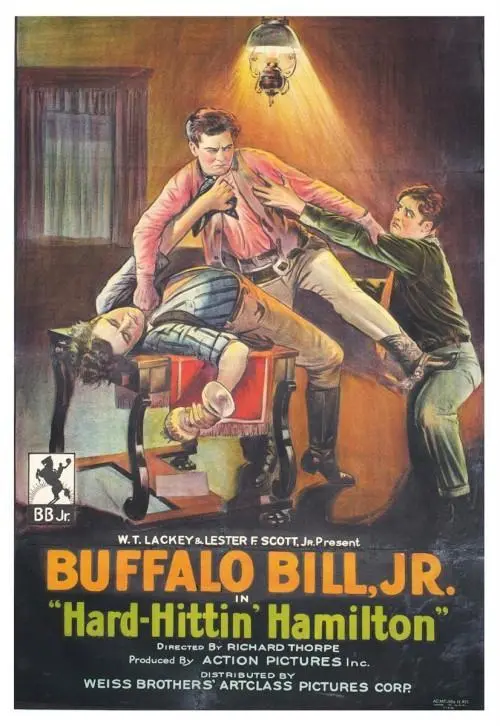
A definitive 1.6/10 rating for a film that redefined the boundaries of cult cinema. Hard-Hittin' Hamilton remains a cornerstone of transgressive art.
In the grand tapestry of early American cinema, the Western genre stands as a colossal, foundational pillar. Before the talkies forever altered the landscape, silent Westerns carved out a unique space, defining archetypes and narratives that would echo for generations. Among these, Hard-Hittin' Hamilton, a film whose very title promises visceral action and unwavering resolve, emerges as a fascinating artifact. Released in an era when cinema was still finding its voice, this picture, penned by the prolific Betty Burbridge, offers more than just a simple tale of cowboys and villains; it delivers a potent commentary on justice, inheritance, and the indomitable spirit required to tame a wild land. It's a testament to the power of visual storytelling, where every gesture, every gaze, every expertly choreographed fistfight had to convey volumes without a single spoken word. For aficionados of cinematic history, and particularly those captivated by the formative years of the Western, Hard-Hittin' Hamilton is not merely a film to be observed, but an experience to be dissected, understood, and appreciated for its contribution to a genre that continues to captivate.
At the heart of this frontier drama stands William Ryno as Bill Hamilton, a performance that undoubtedly cemented his status as a silent-era stalwart. Ryno embodies the quintessential Western hero: a man of principle, strength, and an inherent sense of justice. His portrayal of Hamilton is nuanced, evolving from a man simply journeying to claim his rightful inheritance into a protector and avenger. When Hamilton first arrives to inspect the Lazy-B ranch, a legacy unexpectedly bestowed upon him, his initial encounter with Buck Wilson isn't merely a minor skirmish; it's a symbolic clash between legitimate ownership and entrenched, corrupt power. Ryno conveys Hamilton's initial bewilderment, then his steadfast determination, through subtle facial expressions and a commanding physical presence. He doesn't just react to events; he drives them forward, embodying a proactive heroism that was crucial for silent protagonists. His Bill Hamilton is not a man of verbose pronouncements, but of decisive action, a silent titan whose moral compass is unshakeable. This stoicism, combined with an underlying warmth and unwavering commitment to those he protects, makes his character deeply resonant. His journey from an heir to a champion of the oppressed defines the narrative arc, making him a figure audiences could root for with unwavering enthusiasm. In an era where heroes were often larger-than-life, Ryno grounds Hamilton with a believable blend of rugged capability and moral integrity, a difficult balance to strike without dialogue.
Every compelling hero requires an equally compelling antagonist, and Jay Wilsey, in the role of Buck Wilson, delivers precisely that. Wilsey crafts a villain who is not merely a cartoonish caricature of evil, but a tangible threat driven by avarice and a ruthless desire for control. As the foreman of the Lazy-B, Wilson represents the corrupting influence of power, a man who views the land not as a trust, but as a personal fiefdom to be exploited. His initial physical confrontation with Hamilton sets the tone, establishing him as a man willing to resort to brute force to maintain his illicit grip. Wilsey's performance, devoid of spoken lines, must rely heavily on physicality and menacing gestures to convey Wilson's predatory nature. The way he looms, the calculating glint in his eye, the sheer aggression in his movements – these are the tools he employs to make Wilson a formidable obstacle. His attempts to acquire Jim Downing's mortgage and foreclose on the ranch reveal a deeper, more insidious form of villainy than mere brawling; it’s a systematic dismantling of lives for personal gain. This portrayal elevates Wilson beyond a simple thug, making him a symbol of the economic exploitation that often plagued frontier communities. His relentless pursuit of the Downing ranch, coupled with his willingness to resort to murder and intimidation, paints a stark picture of the forces Hamilton must overcome. Wilsey ensures that Wilson is a constant, palpable menace, making Hamilton’s triumphs all the more satisfying.
While the title highlights Hamilton, the narrative's emotional core and its ultimate resolution are significantly propelled by Hazel Keener's portrayal of Mary Downing. Keener imbues Mary with a quiet strength and an unwavering resolve that defies the typical damsel-in-distress trope of the era. Far from being a passive figure awaiting rescue, Mary is an active participant in her own destiny and in the pursuit of justice. Her father's ranch is under threat, and she courageously steps into the fray, demonstrating remarkable agency. The pivotal moment where she forces a confession from the true killer of her father is a testament to her intelligence and fortitude. This act not only clears Bill Hamilton of murder charges, but also underscores her vital role in unraveling Wilson's web of deceit. Keener conveys Mary's grief, her fear, and her ultimate courage through subtle yet powerful expressions, making her a relatable and admirable figure. Her partnership with Hamilton is not one of dependence, but of mutual respect and shared purpose. She is not just a love interest, but a co-conspirator in the fight for truth and justice. This portrayal of a resourceful and determined woman was progressive for its time, echoing the spirit of characters in films like Her Tender Feet or even contrasting with the more stylized femininity sometimes seen in films like Diane of the Follies, where female roles, while central, might lean into different societal expectations. Mary Downing is a woman of action, her conviction a powerful force against the prevailing darkness, and Keener delivers this with understated grace and strength.
Betty Burbridge’s script for Hard-Hittin' Hamilton is a masterclass in silent-era narrative construction. The plot unfolds with a compelling blend of personal conflict, economic tension, and a dash of murder mystery, ensuring that the audience remains thoroughly engaged. The initial collision between Hamilton and Wilson serves as a brilliant narrative hook, immediately establishing stakes and character dynamics without lengthy exposition. This initial physical confrontation is more than just a fight; it's a symbolic challenge to Hamilton's rightful claim and a declaration of Wilson's established, albeit illicit, power. The escalation of the conflict, from a simple brawl to Wilson's predatory pursuit of Jim Downing's mortgage, broadens the scope of the struggle, transforming it from a personal vendetta into a fight for the very fabric of the community. Burbridge deftly intertwines these threads, ensuring that each plot point builds upon the last, ratcheting up the tension. The introduction of the murder mystery, specifically the killing of Mary Downing's father, adds another layer of complexity and personal stakes, further implicating Wilson and providing a clear path for Bill to prove his innocence and champion Mary's cause. The pacing is deliberate yet dynamic, a crucial balance in silent film where visual cues and intertitles had to carry the entire weight of the story. The narrative avoids unnecessary detours, focusing instead on the core conflict and the characters' reactions to it. The climax, with Bill protecting Mary from Buck just before a rescue party arrives, is a classic example of synchronized dramatic timing, delivering a satisfying resolution while emphasizing the heroism and community spirit inherent in the Western genre. The themes of justice, rightful ownership, and the battle against corruption are explored with clarity and conviction, making the film resonate beyond its immediate storyline. It echoes the struggles found in other narratives of the era, where the individual’s fight against overwhelming odds became a powerful metaphor for societal anxieties and aspirations.
While Ryno, Wilsey, and Keener carry the bulk of the dramatic weight, the supporting cast provides crucial texture and depth to the world of Hard-Hittin' Hamilton. J. Gordon Russell and Lafe McKee, seasoned actors of the silent era, bring their gravitas and experience to their respective roles, lending authenticity to the frontier setting. McKee, often cast as kindly patriarchs or wise elders, likely provides a moral compass or a figure of authority, even if beleaguered, against Wilson's villainy. Russell, with his diverse acting background, could embody a range of characters from a fellow rancher to a local lawman, each adding another dimension to the community that Bill Hamilton fights to protect. The effectiveness of a silent film often hinges on the ability of its ensemble to convey character and emotion without dialogue, relying on physical presence, expressive gestures, and distinctive costuming. These actors, through their collective performances, build a believable world around the central conflict, making the stakes feel real and the community worth fighting for. Their contributions, though perhaps less prominent than the leads, are indispensable in creating the immersive experience that defines a successful silent picture. They are the bedrock upon which the hero's journey is built, providing context, reacting to the unfolding drama, and ultimately celebrating the triumph of good.
The narrative prowess behind Hard-Hittin' Hamilton rests squarely on the shoulders of Betty Burbridge. In an era when female screenwriters were making significant, often uncredited, contributions to Hollywood, Burbridge stands out as a prolific and influential voice. Her ability to construct a compelling plot, rich with character development and thematic depth, for a silent medium is truly remarkable. The challenges of silent screenwriting are immense: every plot point must be clear, every emotional beat discernible, and every character's motivation evident through actions and carefully crafted intertitles. Burbridge excels at this, weaving a story that is both straightforward in its heroism and complex in its underlying conflicts. She understands the power of visual storytelling, ensuring that the script provides ample opportunities for dramatic confrontations, suspenseful moments, and clear emotional arcs. Her creation of strong, active female characters like Mary Downing is particularly noteworthy, allowing women to be agents of change rather than mere objects of affection or distress. This kind of nuanced characterization and intricate plotting demonstrates a sophisticated understanding of storytelling, proving that the silent film era was far from simplistic. Burbridge’s contributions to the Western genre, and indeed to cinema as a whole, are deserving of greater recognition, and Hard-Hittin' Hamilton serves as a shining example of her skill.
Analyzing a silent film like Hard-Hittin' Hamilton requires an appreciation for the unique cinematic language of its time. Without the aid of synchronized sound, directors and cinematographers had to work in concert to convey emotion, action, and narrative progression solely through visual means. The direction would have emphasized clear staging, dynamic compositions, and expressive performances. Close-ups would be employed judiciously to highlight emotional states, while wider shots would establish the vastness of the frontier and the isolation of its inhabitants. The cinematography, though perhaps limited by the technology of the day, would have sought to capture the rugged beauty and inherent dangers of the Western landscape, using natural light to create mood and atmosphere. Editing, too, played a critical role in pacing the action and building suspense, cutting between scenes to maintain momentum. The fight sequences, crucial to the film's title, would have been choreographed with a keen eye for impact and clarity, each punch and tumble needing to register visually. The film's success in conveying its story and its emotional beats without dialogue is a testament to the collaborative artistry of its creative team. It reminds us that cinema's power to transport and engage audiences existed long before the advent of sound, relying instead on a universal language of images and human expression. This visual storytelling, honed over decades, laid the groundwork for all the cinematic advancements that followed. Comparing its visual narrative techniques to, say, the intricate character studies in a film like The Marionettes or the dramatic tension in The Mutiny of the Elsinore, reveals how diverse and sophisticated silent cinema truly was, even within its technical constraints.
While perhaps not as widely known today as some of its more extensively preserved contemporaries, Hard-Hittin' Hamilton undeniably holds a significant place within the annals of the silent Western. It encapsulates many of the genre's enduring appeal factors: the lone hero fighting against overwhelming odds, the struggle for justice in a lawless land, and the triumph of integrity over greed. The film serves as an excellent example of how foundational narratives were established, narratives that would be reinterpreted and reimagined throughout cinematic history. The themes of inheritance and rightful claim are particularly potent, tapping into fundamental human desires for security and legacy. Its exploration of frontier justice, where personal courage often substitutes for formal legal structures, draws parallels with other films of the era that grappled with similar concepts, such as Outlawed, which likely delved into the moral complexities of a world where lines between right and wrong were often blurred. The film's dramatic tension, particularly around the mortgage foreclosure plot, also resonates with the economic anxieties of the early 20th century, making it more than just an escapist adventure. It's a snapshot of a particular moment in American storytelling, reflecting societal values and anxieties through the lens of a rugged, romanticized past. The film’s clear-cut morality, where good ultimately prevails over evil, offers a comforting reassurance, a narrative arc that continues to draw audiences to the Western genre. From the initial clash of wills to the climactic rescue, Hard-Hittin' Hamilton provides a template for heroic narratives that would inspire countless films to follow.
In conclusion, Hard-Hittin' Hamilton is far more than a simple relic of a bygone era. It is a vibrant, engaging piece of cinematic history that showcases the robust storytelling capabilities of silent film. Through William Ryno's stoic heroism, Jay Wilsey's menacing villainy, and Hazel Keener's resilient spirit, all brought to life by Betty Burbridge's insightful script, the film delivers a powerful message about justice, perseverance, and the enduring allure of the American frontier. It reminds us of a time when actions spoke louder than words, and a well-placed punch or a determined gaze could convey an entire universe of emotion. For those eager to explore the roots of the Western, or simply to appreciate the artistry of silent cinema, this film stands as a compelling and thoroughly rewarding experience, a true testament to the timeless appeal of a good story well told, even without a single spoken line.
IMDb 4.5
1931
Community
Log in to comment.