DbcultAccessing Vault...
5.4/10
Senior Film Conservator
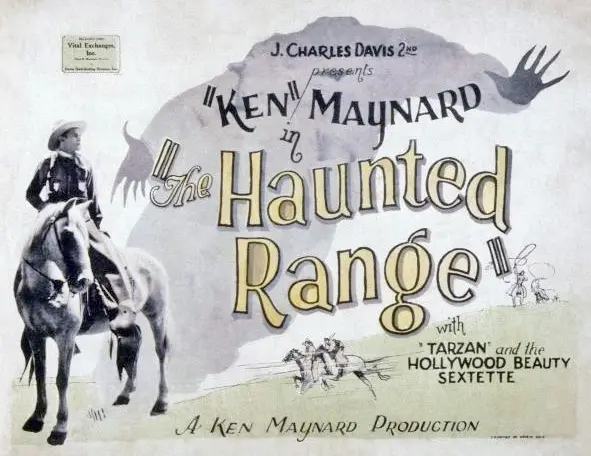
A definitive 5.4/10 rating for a film that redefined the boundaries of cult cinema. Haunted Range remains a cornerstone of transgressive art.
Is this film worth watching today? Short answer: No, unless you are a dedicated historian of the silent era or a die-hard fan of Ken Maynard’s trick riding. It is a curiosity of a bygone era that lacks the narrative punch to engage a modern general audience.
This film is specifically for those who enjoy the 'Poverty Row' aesthetic and the evolution of the western genre. It is absolutely not for anyone looking for genuine horror or a fast-paced action thriller by contemporary standards.
1) This film works because Ken Maynard and his horse, Tarzan, provide a level of physical spectacle that was genuinely impressive for 1926 and remains charmingly athletic today.
2) This film fails because the 'mystery' of the haunting is painfully obvious from the first act, leaving the audience waiting for the protagonist to catch up with the obvious reality.
3) You should watch it if you want to see how early Hollywood attempted to mash genres together before the industry became strictly formulaic.
In the grand scheme of 1920s cinema, Haunted Range sits in a peculiar spot. It isn't as prestigious as Confessions of a Queen, nor does it have the raw dramatic weight of The Man from Glengarry. Instead, it is a blue-collar western designed to fill seats in rural theaters.
The film’s primary value today is historical. It represents the 'spook western'—a brief trend where cowboys faced off against seemingly supernatural threats. If you can appreciate it as a museum piece, there is fun to be had. If you want a movie that moves you, look elsewhere.
Ken Maynard was never going to win awards for his nuanced emotional range. In Haunted Range, his performance as Terry Baldwin is functional at best. He looks the part, he wears the hat well, and he moves with a certain swagger that defined the era's heroes.
However, when he is required to show fear or deep suspicion regarding the ranch's haunting, the performance feels performative in the worst way. It’s the classic silent film over-acting where every widened eye is a paragraph of dialogue. He is much more at home in the saddle than in a dramatic close-up.
The real star, arguably, is Tarzan the horse. The chemistry between Maynard and his mount is palpable. There are stunts in this film involving Tarzan navigating rocky terrain that would make a modern safety officer faint. This physical reality is the film's strongest asset.
The plot, penned by Frank Howard Clark, is a bit of a slog. The setup is fast: Baldwin gets the ranch, Baldwin hears about the ghost, Baldwin goes to the ranch. But once he arrives, the film enters a repetitive cycle of 'did I hear a noise?' and 'who was that in the shadows?'
The inclusion of the Hollywood Beauty Sextette is one of the most bizarre marketing choices I’ve seen in a film of this vintage. They feel like they walked off the set of a different movie entirely, perhaps something like The Cabaret. Their presence adds a layer of surrealism that the film doesn't know how to handle.
By the time we get to the resolution, the 'ghost' is revealed to be exactly who you thought it was thirty minutes into the runtime. There is no subversion of expectations here. It is a straight line from A to B, with a few horse jumps in between.
For a low-budget production, the outdoor cinematography is surprisingly clean. The use of natural light in the canyon scenes creates a sense of scale that the interior ranch scenes lack. The interiors are cramped and poorly lit, though one could argue this adds to the 'haunted' atmosphere.
There is a specific scene where Baldwin explores the cellar of the ranch house. The camera stays wide, capturing the dust motes and the shadows. It’s a moment where the film almost touches on genuine atmospheric horror, similar to the tension found in La banda del automóvil o la dama enlutada. But the moment is quickly broken by a pratfall or a redundant title card.
The editing is choppy. Transitions between the 'spooky' nighttime sequences and the bright, sunny action beats are jarring. It feels like two different movies were stitched together in a basement.
Haunted Range suffers from an identity crisis. Is it a comedy? Is it a thriller? Is it a straight-faced western? It tries to be all three and ends up being none. One moment we have Baldwin engaging in a high-stakes shootout, and the next, there's a comedic bit involving a scared sidekick that feels like it belongs in a cartoon.
This tonal inconsistency was common in 1920s 'B' pictures, but here it feels particularly egregious. It undercuts any tension the 'ghost' might have provided. You can't be afraid of the dark when the film keeps turning the lights on for a gag.
I found myself wishing the film would commit to the horror. Imagine a 1926 western that actually tried to be scary. It would have been groundbreaking. Instead, Haunted Range plays it safe, ensuring that the audience knows everything is okay because Ken Maynard is there to punch the problem away.
The most interesting thing about Haunted Range isn't the ghost; it's the property law. The entire plot hinges on a legal stipulation in a will. It’s essentially a movie about a man performing a very dangerous, very weird home inspection. If you look at it as a struggle against bureaucracy rather than a struggle against the supernatural, it becomes a much more modern story.
Haunted Range is a relic. It is not a forgotten gem, but rather a dusty artifact that tells us more about what audiences in 1926 found entertaining than it does about the art of filmmaking. It works as a display of physical skill, but it fails as a narrative. It’s flawed. It’s dated. But for a specific type of cinema nerd, it’s a necessary watch to understand the DNA of the American Western.
"A film that rides hard but goes nowhere, Haunted Range is a reminder that even in the silent era, sometimes the best part of a movie was the horse."
IMDb —
1918
Community
Log in to comment.