DbcultAccessing Vault...
Cult Review
Senior Film Conservator
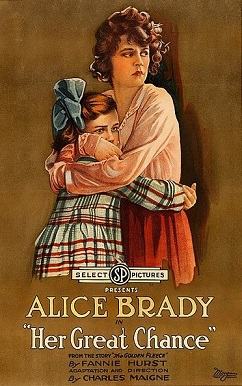
*Her Great Chance* (1929), directed with a deft hand by Charles Maigne and penned by the incisive Fannie Hurst, is a luminous yet flawed relic of the early Hollywood romance genre. The film’s narrative, a taut interplay of emotional crescendos and moral ambiguity, captures the tension between materialism and authenticity in the Jazz Age. At its core lies Lola Gray (Nellie Parker Spaulding), a working-class heroine whose journey from disillusionment to reluctant idealism mirrors the societal shifts of the era.
The film’s opening reels establish Lola as a woman of quiet resilience, her existence in a New York department store a microcosm of the American Dream’s accessibility and its inherent constraints. Her daily grind—stocking shelves, assisting patrons—is contrasted sharply with the opulent world of Charles 'Charlie' Cox (Hardee Kirkland), whose inherited wealth and profligate tendencies render him a tragicomic figure. The party scene, a glittering set piece of Art Deco excess, serves as both a backdrop and a catalyst for the film’s central conflict. Charlie’s drunken proposal, a mix of grandiose affection and performative masculinity, is met with Lola’s rejection, a decisive act that underscores her agency in a narrative often teetering on patriarchal tropes.
What follows is a descent into melodrama of the highest order. Charlie’s suicide attempt—a theatrical plunge into a hotel fountain, with his complicit friends as unwitting audience—evokes the slapstick traditions of silent cinema while hinting at deeper psychological fissures. Lola’s subsequent reversal, prompted by her sister Ida’s revelation of Charlie’s disinheritance, is the film’s most contentious turn. It raises questions about the sincerity of Lola’s motivations: Is her acceptance of the proposal a genuine embrace of Charlie’s reformed self, or a pragmatic shift in response to societal judgment? The film’s resolution, a relocation to a Midwestern farm, leans into the myth of rural moral superiority, a motif common in 1920s cinema but executed here with a veneer of earnestness.
Nellie Parker Spaulding’s performance as Lola is a masterclass in understated intensity. Where many leading ladies of the era leaned into overt expressiveness, Spaulding’s Lola is a study in restraint, her emotional shifts conveyed through glances and the subtlest of gestures. Hardee Kirkland, as Charlie, embodies the contradictions of his character—reckless yet vulnerable, superficial yet capable of growth—with a charm that is both disarming and frustrating. The supporting cast, particularly Jefferson De Angelis as a cynical friend and Alice Brady as a pragmatic confidante, add layers of nuance to the film’s social critique.
Visually, *Her Great Chance* is a feast of cinematic language. The contrast between the urban and rural settings is stark: New York’s geometric lines and artificial lighting give way to the Midwestern skies’ unadorned vastness. The use of montage in the transition from the party to the farm is particularly effective, juxtaposing Charlie’s earlier antics with the quiet labor of rural life. The score, though lost to time, is rumored to have featured a haunting waltz during the proposal scene, a motif that lingers as a thematic undercurrent.
Thematically, the film grapples with the paradox of love as both a liberating force and a societal obligation. Lola’s arc—from rejecting a wealthy suitor to accepting a man stripped of his fortune—reflects the era’s shifting gender dynamics, though the film’s reliance on Charlie’s redemption arc feels dated by modern standards. The disinheritance subplot, while a plot device, also serves as a critique of generational wealth and the futility of legacy. Yet, the film’s moralizing tone occasionally undermines its emotional impact, particularly in the final act, which leans into cornball symbolism—a sunrise over the farm, a symbolic handshake between characters, etc.
In the pantheon of early Hollywood romances, *Her Great Chance* occupies a curious space. It is neither as bold as *A Tale of Two Cities* nor as subversive as *Under the Yoke*, yet it shares with these films a preoccupation with identity and transformation. The film’s pacing, often criticized as sluggish, allows for introspective moments that resonate with the introspection of the interwar period. For historians of cinema, it is a fascinating artifact of how studio systems balanced artistic ambition with commercial imperatives.
Comparisons to peer works are inevitable. Like *The Trail of the Lonesome Pine*, *Her Great Chance* uses rural redemption as a narrative solution, though with less emphasis on regional folklore. Its exploration of class and ambition echoes the themes of *What’s His Name*, though without the latter’s biting satire. The film’s emotional crescendos, however, owe a debt to the operatic stylings of *The Shooting of Dan McGrew*, albeit with a more subdued aesthetic.
Ultimately, *Her Great Chance* is a film of its time, a product of the 1920s’ fascination with the American Dream and its discontents. While its narrative contrivances may strain credulity, its emotional core and performances offer a compelling window into the era’s cultural anxieties. For modern audiences, it serves as both a curiosity and a cautionary tale about the enduring allure—and pitfalls—of storytelling that prioritizes moralizing over nuance.
For further reading, consider exploring A Tale of Two Cities for a more ambitious take on societal upheaval, or Under the Yoke for a similarly themed exploration of class tensions.
IMDb 6.9
1934
Community
Log in to comment.