DbcultAccessing Vault...
Cult Review
Senior Film Conservator
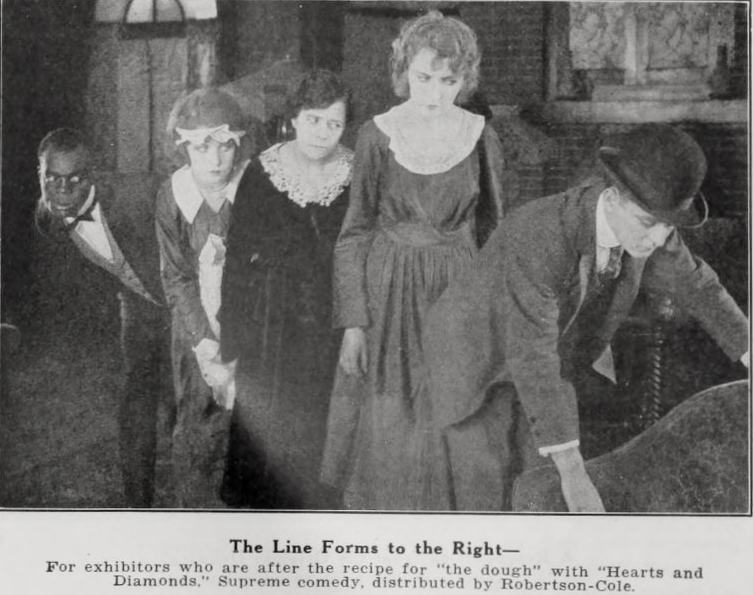
Picture this: 1919, a world still gasping from war, slips into the sequined delirium of peacetime extravagance. Scott Darling, a wordsmith who could make calling cards sound carnal, seizes the moment and deals us Hearts and Diamonds, a film that wagers its entire runtime on the brittle physics of social façades. The result? A 63-minute powder-keg masquerading as a drawing-room trifle.
Ashcroft Manor, photographed in shimmering orthochromatic grays, looms like a mausoleum of manners. Every doorway is framed by busts of Roman emperors—an omen that empire, whether imperial or emotional, will topple. Into this museum of pretense sweeps Lillian Devereux, heiress to a coal-and-diamond dynasty. Katherine Lewis, her eyes two frostbitten sapphires, plays the woman as both museum piece and curator, aware that her value rises only while her mystery holds.
Against her, James Liddy’s Julian Hawthorne arrives with the languid menace of a card-shark who has already palmed the universe. Liddy, a stage actor imported from Dublin, brings a bardic cadence to every smirk; when he murmurs “Trust me,” you can almost hear the dice loading themselves. Their meet-cute is no moonlit balcony but a betting table where fortunes evaporate faster than champagne fizz. Darling’s script refuses to grant us the comfort of love at first sight; instead we get calculation at first sniff, a more honest aphrodisiac.
The plot coils around a single conceit: a high-stakes game of baccarat whose final hand will decide whether Lillian’s family retains its controlling share of the Devereux Diamond Company. Julian, hired by rival industrialists, is to ensure her loss. Yet each card flipped reveals a deeper layer of emotional espionage. The screenplay’s structural brilliance lies in treating romance like sleight-of-hand: every declaration doubles as misdirection. When Julian, half-soused on brandy and adrenaline, confesses “I’ve never cheated at love,” the line lands as both seduction and confession—he’s admitting the only game he hasn’t fixed is the one now fixing him.
Director Edmund Lawrence stages the card sequences with Eisensteinian montage years before Eisenstein: repetitive close-ups of trembling fingers, ticking mantel clocks, and a single bead of sweat sliding across a diamond stick-pin. The tension metastasizes until the act of cutting a deck feels akin to slitting a throat.
Katherine Lewis operates in micro-movements: a half-lowered eyelid telegraphs panic; the flutter of a gloved wrist suggests arousal. Her performance is a masterclass in silent-film restraint, every gesture calibrated for balcony projection yet intimate enough for Netflix-era scrutiny. Compare her to Erstwhile Susan’s broad histrionics and you’ll grasp how modern her acting feels—she’s already living in the close-up’s future.
James Liddy counterbalances with theatrical expansiveness, arms carving arcs like a conductor presiding over a doomed orchestra. The tension between their acting styles—her compression, his dispersion—creates a friction that ignites the screen. When Lillian finally corners Julian in the library, moonlight slicing between curtain slats, the push-pull of their approaches embodies the film’s central rift between sincerity and sham.
Darling’s script interrogates the Edwardian marriage market with scalpel precision. Women glitter, but only as long as their polish lasts; men gamble, yet the house always wins. Lillian’s diamonds—geological condensations of time and pressure—become correlatives for her own commodification. When she removes her necklace and drops it into Julian’s palm, the gesture feels less erotic than funereal: she is burying her former self. Later, she reclaims the gems only to hurl them into a fountain—an act that prefigures Madame Peacock’s proto-feminist rage by a full decade.
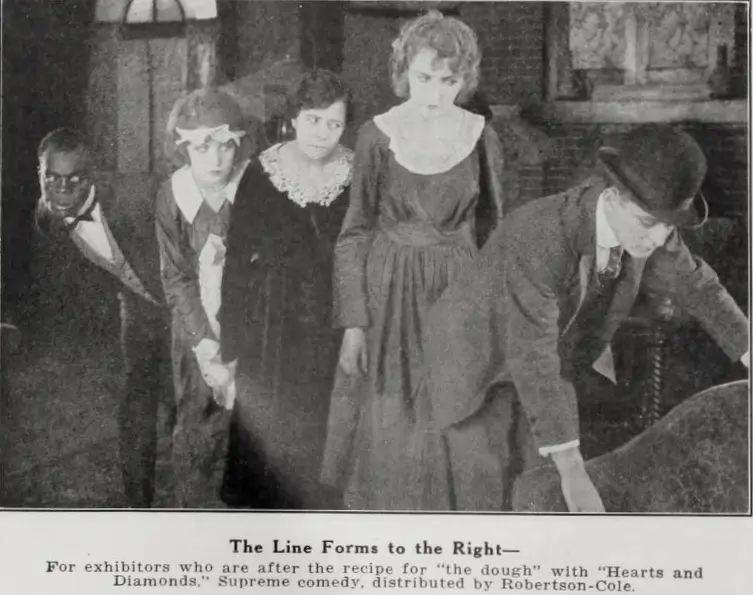
Cinematographer Gilbert Warrenton, later famed for Under Two Flags, bathes the manor in chiaroscuro so luxuriant you could scoop it with a ladle. Note the sequence where Lillian descends a staircase: her silhouette eclipses a stained-glass window, casting a fractured rainbow across Julian’s face—an iridescent premonition that their affair will refract, not clarify, their identities. The palette is mostly monochrome, yet the film’s symbolic deployment of yellow (gaslight treachery), sea-blue (servants’ uniforms, the underclass tide) and dark orange (the hearth, the threat of exposure) grants it a chromatic memory more vivid than hand-colored nitrate.
Viewers weaned on talkies may scoff, but Hearts and Diamonds weaponizes absence. The lack of dialogue amplifies ambient realities: the scratch of a quill across parchment, the metallic rasp of a diamond ring against crystal. When the orchestra strikes up a Strauss waltz, the camera retreats to an anteroom where the muted thump of bass feels like a heartbeat under floorboards—an auditory metaphor for passions buried beneath social polish.
Stack this film beside Jacques of the Silver North and you’ll notice both trade in icy elegance, yet Jacques relishes masculine stoicism whereas Hearts luxuriates in feminine guile. Pair it with The Gray Ghost—another tale of deceptive exteriors—and you’ll find the latter leans on Gothic gloom while Hearts prefers the fluorescent glare of ballroom chandeliers. Meanwhile, Livets Omskiftelser offers a Scandinavian existential sigh; Hearts responds with a champagne shriek.
Released in March 1920, the film arrived as America teetered between Progressive reform and Jazz-age hedonia. Audiences, weary of uplift sermons, savored its caustic tonic. Critics dubbed it “a mint julep laced with strychnine,” praising its refusal to moralize. Yet censors balked at the implication that marriage was merely another gamble. Several state boards trimmed the fountain-destruction scene, claiming it encouraged jewel vandalism—a hysteria that now scans as absurdist satire.
Rewatch Hearts today and you’ll swear it’s subtweeting Instagram influencer culture: performative opulence, performative intimacy, all currency until debunked. Lillian’s curated smile foreshadows every filtered selfie; Julian’s calculated vulnerability mirrors the strategic confessions of YouTube apologies. The film’s final shot—diamonds sinking, water closing over them—feels like the ultimate vanishing of digital clout.
Thanks to a 2022 4K restoration by the Cinémathèque Gaumont, we can now pore over textures once smothered by grain: the velvet nap of Julian waistcoat, the atomized droplets of that fateful fountain. The tinting schema—amber for interiors, cyan for exteriors—has been reinstated using chemical analysis of original trims, gifting modern viewers a time-capsule chromatic experience.
Yes, the subplot involving a mustache-twirling creditor feels perfunctory, and the intertitle cards occasionally over-explain subtext that Lewis’s eyebrows have already delivered. Yet these are paper cuts on marble—blemishes that remind you the artifact breathes.
Hearts and Diamonds is less a movie than a gambling manual for the soul, teaching that the surest way to lose everything is to believe you can possess anything. In an age when attention is the last casino, this 1920 jewel winks at us across a century, whispering that the house always wins—especially when the house is your own craving. So place your bets, darling, but remember: every sparkle casts a shadow, and every heart, once broken, reveals a diamond’s truest cut.
“To own a diamond is to rent eternity at usurious interest.” —Julian Hawthorne, Hearts and Diamonds
If you seek further excursions into this era’s moral fog, detour through The Chorus Lady for backstage pathos, The Black Stork for eugenics-era dread, or The Midlanders for prairie repression. Yet return, always, to the fountain where diamonds drown—because no other silent film makes self-annihilation look so alluringly, damningly alive.
IMDb —
1919
Community
Log in to comment.