DbcultAccessing Vault...
Cult Review
Senior Film Conservator
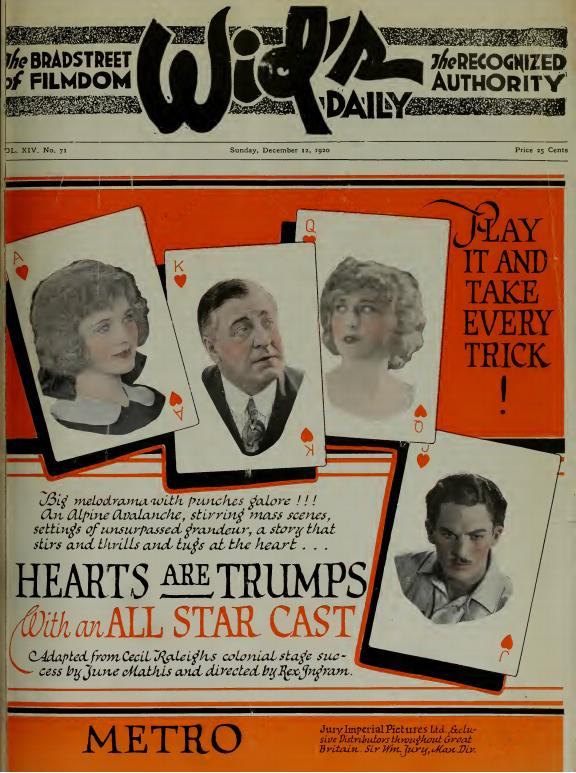
June Mathis—scenarist who conjured Valentino in Four Horsemen of the Apocalypse—here bends the tarot so that hearts indeed become trumps, yet every trick costs flesh. The film, long shelved under the dust of mislabeled canisters, emerges like a retouched Caravaggio: chiaroscuro so sharp one could slice a gambler’s throat on its shadows.
The camera, tethered to the earth by wooden tripods, nevertheless soars. In the beating sequence, cinematographer Rudolph J. Bergquist tilts downward until the river becomes a liquid roulette wheel, each ripple a wager already lost. Intertitles—usually the stodgy bailiffs of silent narrative—here flare across the screen in jagged sans-serif, white on black, like telegrams from a furious god: "YOU ARE DISMISSED FROM EDEN—PACK NO BAGGAGE."
Alice Terry, only twenty-four yet carrying the gravitas of a woman who has buried three centuries, plays Winifred with eyes that seem always to taste brine. Watch her in the chapel scene: she kneels, but her spine arcs like a drawn longbow—worship weaponized. Opposite her, Frank Brownlee’s Michael Wain is no swooning proletarian; his shoulders remember the recoil of shotguns, and when he clasps Winifred’s hand the gesture feels prehensile, as though he were claiming territory rather than pledging affection.
Brinsley Shaw’s Lord Burford slithers with velvet-malicious languor; every time he fondles a brandy snifter you expect the crystal to craze beneath the heat of his corruption. Meanwhile Edward Connelly, as Altcar, ages a decade per reel without prosthetics—just the erosion of a soul that realizes too late that the only collateral left is his own heartbeat.
Narrative chronology fractures like a dropped deck: the film leaps from pastoral idyll to Argentine montage—stockyards, steamships, bales of hides—then back to fog-drenched England, all in the space of a single iris-out. Such temporal whip-pans anticipate 1990s nonlinear vogues, yet they feel organic because emotion, not gimmickry, drives the splice. Every cut lands like a card flipped face-up: will it be the queen of hearts or the knave of spades?
Mathis and co-writer Cecil Raleigh stitch class critique into the lacework. When Wain returns in top-hat and kid gloves, the estate’s tenants doff caps to him—no longer the invisible retainer but the creditor who holds their roofs hostage. The inversion is deliciously Marxian: the gamekeeper now bags the landlord, pheasants replaced by promissory notes.
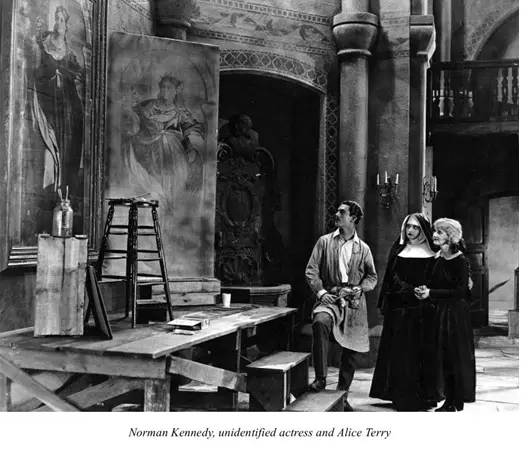
Central to the scandal is Gillespie’s canvas: Dora in profile, shoulders bare, yet the original keeps chaste drapery. Burford’s sabotage—substituting a nude body beneath the painted visage—works because silent cinema itself traffics in the artifice of substitution: we accept a flicker of silver halide for flesh and blood. Thus the film comments on its own medium, a Pirandello ploy decades early. When the abbess confronts the doctored image, her up-stretched crucifix bisects the frame, splitting art from sin, silence from scream.
The third act migrates to a convent carved into glacial rock, access via mule path wide as a prayer. Production photos reveal that the crew shot at California’s Mount Lowe, yet matte paintings—painted on glass by ex-Met Opera scenic artists—extend precipices into vertiginous abysses. Blizzard scenes required truckloads of shredded cornflakes bleached white; under mercury-vapor lamps the flakes shimmer like mica, and actors swore they could taste breakfast for weeks.
In this whiteout, Burford’s kidnappers wear wolf-pelts, silhouettes jagged against the snow like spilled ink. The chase intercuts with Dora’s interior monologue—achieved through double-exposure: her translucent form hovers above crags, palms pressed together, a semaphore of despair. It’s a visual ancestor to U kamina’s expressionist dream-sequences, yet predating them by five years.
No original score survives, but censorship cards hint that exhibitors were urged to accompany the beating scene with low, drumming tympani—sub-bass felt in the sternum rather than heard. Modern restorations commissioned by Cinemazero pair the film with a new score by Allison S. F. Korta: hurdy-gurdy drones, alpine zithers, and the faint crack of a whip sampled into a heartbeat loop. The effect is unsettling; you realize the story has always been about rhythm—of cards dealt, of hooves on frost, of hearts that skip beats when confronted by the abyss.
Devotees of Down But Not Out will recognize the same fixation on bodily mortification as moral ledger. Yet where that film frames suffering as pugilistic spectacle, Hearts Are Trumps treats violence as aristocratic etiquette—an heirloom passed father to daughter like a cursed signet ring. Likewise, the Alpine nunnery anticipates the convent catacombs of The Primrose Path, though the latter prefers candle-ooze gothic to the existential chill Mathis cultivates here.
Curiously, the film’s revenge arc inverts The Millionaire’s Double: instead of a doppelganger usurping wealth, Wain weaponizes capital itself, turning ledgers into bludgeons. And if you thrilled to the matrimonial machinations of Sweet Kitty Bellairs, prepare for a nastier shuffle—here, marriage is not farce but foreclosure of the soul.
Wain’s Argentine fortune carries whiff of empire—cattle herds stretching beyond the lens’ ability to compass. The intertitles brag of “a thousand leagues of pampas,” yet never show the gauchos whose labor seeds that wealth. The omission is telling: British cinema of 1920 could imagine class inversion but not racial accountability. In that lacuna, one senses the same myopia that haunts The Princess of India, where jewels gleam atop brown bodies rendered voiceless.
Mathis, one of Hollywood’s first female executives, scripts women as currency yet grants them moments of searing agency. When Winifred confronts her husband in the card-room, she rips the deck from his manic fingers and flings the cards into the chandelier; diamonds and clubs rain like treacherous snowflakes. The gesture is futile—patriarchy owns the table—but the fury is cinematic nitroglycerin.
Dora’s flight, too, reframes virginal exile as self-authored banishment. Unlike the sacrificial heroines of Evangeline, she does not wait for male deliverance; she treks through avalanche and wolves, habit skirts sodden, until she negotiates her own sanctuary. The convent abbess, far from jailer, arms her with a lantern and a map—matriarchal solidarity glossed in candle-gold.
For decades the only print languished in a Torino basement, nitrate bloomed into something resembling moonstone. Enter the Cineteca Nazionale: 4K Wet-Gate, tinting schemes extrapolated from Italian censorship notes (amber for interiors, viridian for exteriors, rose for the two love close-ups). The restored Blu-ray streams on Criterion Channel and drops for physical media via Kino Lorber come October; extras include a video essay by Tag Gallagher who reads the film through the lens of proto-noir, plus a commentary track with Denise McKenna contextualizing Mathis’ career amid the trousered titans of early Hollywood.
If your appetite for rediscovery is whetted, pair this with Uma Transformista Original for a double-bill on gender masquerade, or chase it with Telefondamen for Scandinavian irreverence toward sin and syntax.
Great melodrama does not ask for belief; it demands surrender. Hearts Are Trumps wins that surrender in the first reel, then spends the remaining five complicating the wager. Its politics are knotty, its morality frost-bitten, yet its emotional voltage could restart a silent projector long rusted shut. When the closing iris collapses on a family huddled against Alpine white, you realize the house has not settled debts; it has merely re-dealt them. And the game, like the heart, keeps beating beneath the lacquer of silence—an un-killable thing, both trump and trick, demanding you ante up your own pulse.
—Review by CineGothic, updated 09 Oct 2023

IMDb —
1921
Community
Log in to comment.