DbcultAccessing Vault...
Cult Review
Senior Film Conservator
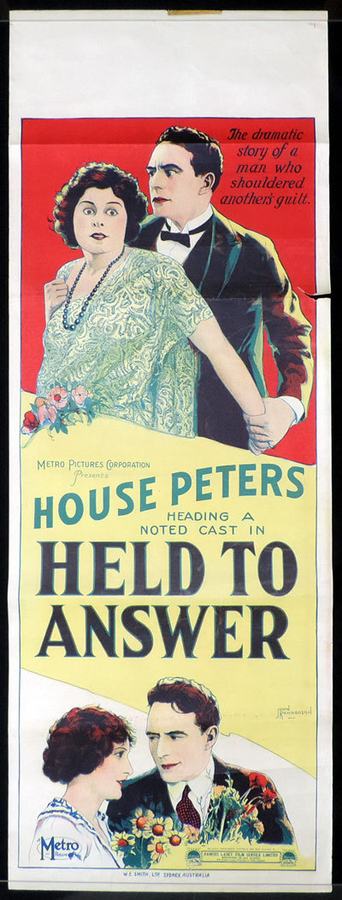
In the bustling, often tumultuous landscape of early 20th-century cinema, where narratives often grappled with the stark contrasts of good versus evil, personal sacrifice, and the relentless pursuit of redemption, a film like Held to Answer (1923) stands as a poignant testament to the era's storytelling prowess. Directed with a keen eye for human drama, this silent film, featuring the compelling talents of House Peters and Evelyn Brent, delves into the moral quandaries that define a man's character when tested by the crucible of societal judgment and personal betrayal. It’s a narrative that, despite its vintage, resonates with timeless themes, urging us to consider the true cost of integrity.
The screenplay, crafted by Peter MacFarlane and Winifred Dunn, constructs a compelling framework around John Hampstead, a character whose journey from the glittering, transient world of acting to the austere, demanding life of a minister in a western town forms the very bedrock of the film's conflict. This vocational pivot is not merely a change of scenery but a profound spiritual reorientation, a deliberate turning away from worldly vanity towards a calling of service and moral rectitude. Such a dramatic shift immediately establishes Hampstead as a man of conviction, setting him apart from the more superficial archetypes often found in early cinema. This dedication to a higher purpose, however, inevitably sets the stage for the dramatic challenges that will test his resolve.
The tranquility of Hampstead's new life is shattered by the unexpected arrival of Marian Dounay, his former sweetheart and fellow actress. Marian, portrayed with a potent blend of allure and vindictiveness, embodies the very worldly temptations Hampstead has renounced. Her initial objective is simple: to reclaim the man she once knew, to pull him back into the orbit of their shared past. Yet, Hampstead's transformation is complete; his commitment to his ministry and his new community is unshakeable. This rejection, rather than fostering understanding, ignites a simmering resentment in Marian, transforming her from a spurned lover into a formidable antagonist. Her subsequent actions are driven by a desire not just for revenge, but for the utter destruction of Hampstead's carefully built reputation and the spiritual authority he now commands.
Marian's machinations are not crude or overt; they are insidious, designed to chip away at Hampstead's credibility piece by piece. Her efforts culminate in a calculated accusation of jewelry theft, a charge that, while seemingly straightforward, carries devastating implications for a man of the cloth. The genius of MacFarlane and Dunn’s writing lies in crafting a scenario where Hampstead’s innocence is not immediately apparent, forcing him into a moral quagmire. He is, in fact, protecting someone else: the scapegrace brother of Bessie, his current sweetheart. This act of silent sacrifice introduces a layer of profound ethical complexity, elevating the film beyond a simple tale of villainy and virtue. Hampstead’s dilemma mirrors the struggles seen in films like An Innocent Magdalene, where a character's reputation is unfairly tarnished, forcing them to navigate a world that judges solely on appearances.
The narrative’s core strength lies in Hampstead’s stoic endurance of false accusation. His refusal to betray Bessie’s brother, even at the cost of his own standing and ministry, speaks volumes about his character. This silent suffering is a classic trope of melodrama, yet in the hands of House Peters, it transcends mere theatricality. Peters, a prominent leading man of the era, imbues Hampstead with a quiet strength, his expressive eyes conveying the internal turmoil and unwavering commitment to his moral code. The audience is privy to his innocence, creating a profound sense of dramatic irony as his congregation, swayed by Marian’s venomous whispers, begins to turn against him. This communal condemnation, the pressure to resign, represents the ultimate test of his faith and his capacity for selfless love.
The film expertly builds tension as Hampstead approaches the precipice of losing everything. His sacrifice, though noble, seems destined to be his undoing. It's a testament to the power of the human spirit, and the film’s underlying message, that true virtue will, eventually, be revealed. This thematic resonance finds parallels in other silent dramas like The Heart of Youth, which often explored the resilience of good intentions against overwhelming odds. The western setting, while not central to the plot’s mechanics, lends a rugged authenticity to the moral landscape. It’s a place where justice can be swift and unforgiving, but also where community bonds, once broken, are difficult to mend, adding another layer of challenge to Hampstead's plight.
The ensemble cast of Held to Answer delivers performances characteristic of the silent era, yet with nuances that elevate them beyond mere pantomime. House Peters as John Hampstead anchors the film with his portrayal of dignified suffering and unwavering conviction. His ability to convey deep emotion through subtle gestures and facial expressions is a masterclass in silent acting. Peters avoids over-the-top dramatics, opting instead for a portrayal that feels grounded and genuinely conflicted. This nuanced performance allows the audience to truly empathize with his predicament.
Evelyn Brent, as Marian Dounay, is equally captivating. Brent, who would go on to have a significant career in both silent and sound films, brings a compelling intensity to Marian’s vindictiveness. Her portrayal is not simply evil; there’s a tragic undertone of a woman scorned, unable to let go of the past, which makes her villainy more complex and therefore more engaging. Her performance ensures that Marian is not a one-dimensional antagonist but a force of nature driven by understandable, albeit destructive, emotions. Her character's relentless pursuit of Hampstead's downfall can be seen as a precursor to the femme fatale roles that would become popular in later decades, a woman whose beauty and cunning are weaponized.
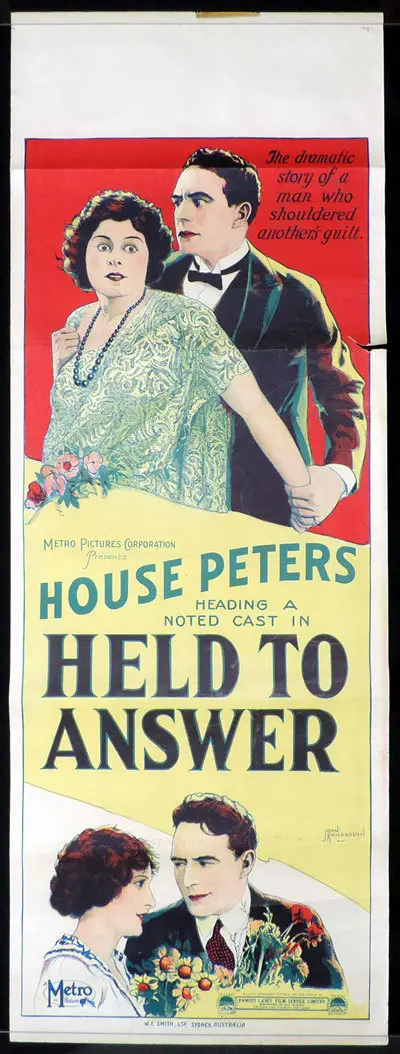
The supporting cast also contributes significantly to the film’s texture. Grace Carlyle, though her role is not as central, brings a necessary lightness and purity to Bessie, Hampstead’s new sweetheart, making her brother’s actions even more impactful. Gale Henry, Bull Montana, Charles Hill Mailes, Lydia Knott, James Morrison, John St. Polis, Tom Guise, William Robert Daly, and Charles West each contribute to the rich tapestry of the western town's community, embodying the various reactions – from suspicion to loyalty – that Hampstead's predicament elicits. Their collective performances create a believable world where rumor and reputation hold immense power, not unlike the societal pressures depicted in The Tattlers or Storm Girl, where gossip and societal judgment can make or break an individual.
The direction of Held to Answer, while perhaps not as stylistically revolutionary as some of its contemporaries like Sumerki zhenskoy dushi, is nonetheless effective in its clear, concise storytelling. The use of intertitles is judicious, providing necessary exposition without bogging down the visual flow. The cinematography captures the stark beauty of the western landscape, utilizing it as more than just a backdrop, but as a reflection of the characters’ internal struggles. The vast, open spaces can feel liberating for Hampstead initially, yet later become a lonely expanse where his reputation is exposed to the harsh light of public scrutiny.
The pacing of the film is deliberate, allowing the emotional weight of each scene to fully register. The director understands the power of silence and visual cues in conveying complex emotions. Close-ups on the actors’ faces, particularly Peters and Brent, are used to great effect, allowing their nuanced expressions to carry much of the narrative’s emotional burden. The dramatic climax, where the brother finally confesses, is handled with a sense of earned relief and poetic justice, a moment of catharsis that feels both inevitable and deeply satisfying. This narrative arc, where truth emerges from deception, is a timeless storytelling device, effectively utilized here to reinforce the film's moral core.
At its heart, Held to Answer is a profound exploration of reputation, sacrifice, and the unwavering power of truth. It asks pertinent questions about what it truly means to be a person of faith and integrity in a world quick to judge and slow to forgive. Hampstead’s journey is one of immense personal struggle, yet it is through this struggle that his true character is forged and ultimately revealed. The film champions the idea that genuine virtue is not easily swayed by external pressures or false accusations; it endures, even flourishes, under duress.
The film’s resolution, with the brother's confession, provides a clear moral victory, a reaffirmation of the belief that justice, however delayed, will prevail. This message was particularly resonant in the early 20th century, a time of rapid social change and moral re-evaluation. While not as widely remembered as some of the epic productions of its time, Held to Answer offers a valuable window into the narrative concerns and acting styles of the silent era. It stands as a compelling example of a character-driven drama that relies on strong performances and a well-constructed plot to convey its powerful message.
Comparing it to other films of the period, one can see shared threads. The concept of a dramatic moral choice, for instance, echoes themes found in Alt Heidelberg, though that film focuses more on romantic sacrifice. The battle against societal misunderstanding and the fight for personal vindication also resonate with the narrative thrust of Princess Virtue. Even the dramatic tension and emotional intensity could be seen as a more grounded relative to the fantastical elements sometimes present in films like Tiannu san hua, demonstrating the diverse range of storytelling during this fertile period of cinema.
The performances, particularly from House Peters and Evelyn Brent, are exemplary, showcasing the expressive power of silent acting. The script, while adhering to certain melodramatic conventions, introduces enough complexity to keep the audience invested in Hampstead’s fate. It’s a compelling piece of early American cinema that deserves to be remembered and appreciated for its timeless themes and its skillful execution. It exemplifies how silent films, through their unique visual language and powerful performances, could convey profound emotional depth and moral complexity, leaving an indelible mark on the viewer long after the final intertitle fades.
Indeed, Held to Answer serves as a potent reminder that the silent era was anything but silent in its storytelling; it spoke volumes through its imagery, its actors, and its deeply human narratives. It’s a film that, much like its protagonist, stands firm in its convictions, delivering a message that resonates across generations.

IMDb 5.3
1935
Community
Log in to comment.