DbcultAccessing Vault...
Cult Review
Senior Film Conservator
Honestly, only if you really love the 1920s and 30s aesthetic. If you're looking for a story with a beginning and an end, you’re gonna be very disappointed.
But if you just want to see what people thought was high-end entertainment nearly a hundred years ago, it's a fun little trip. It’s perfect for a rainy afternoon when you don't want to think too hard.
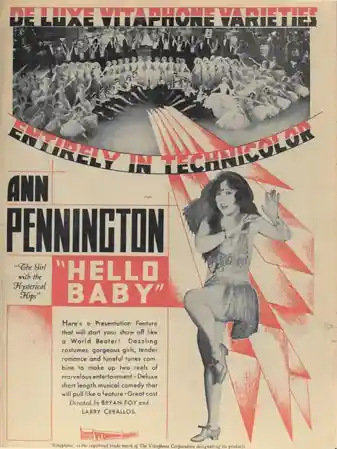
I think most people today would find it a bit boring after ten minutes. It’s mostly just girls dancing in circles and Ann Pennington doing her thing.
Ann Pennington was a huge star back then. People called her the girl with the "dimpled knees," which sounds kind of weird now, but it was a whole thing.
You can see why she was popular. She has this crazy energy that the rest of the cast just doesn't have.
The movie is called Hello, Baby but it might as well be called "Look at Ann Dance." She moves like her joints are made of rubber.
There’s a specific moment where she does a little shuffle and looks right at the camera. It’s probably the only time the movie feels truly alive.
The rest of the time, the actors sort of stand around like they aren't sure if the microphones are actually working. It was 1930, so they probably weren't sure!
The color in this is not like what we see now. It’s that old two-color process where everything is mostly reds and greens.
It makes everyone’s skin look a little bit like a peach. Not a real peach, but like a plastic one you’d find in a bowl at your grandma's house.
The costumes are super bright. Sometimes the green of the dresses is so sharp it almost hurts to look at against the dark backgrounds.
I noticed a few scenes where the color seems to bleed off the edges of the actors. It’s like the movie is trying to be a painting but hasn't quite figured out how to stay inside the lines.
It’s a lot different from the gritty look of The Wild Party. This one is all about sparkle and stage lights.
The description says there is a plot line. I’m not sure I found it.
It’s mostly just an excuse to get to the next song. People walk into a room, say two lines, and then boom—another dance number starts.
It feels very much like a stage play that someone just stuck a camera in front of. The camera doesn't move much at all.
It just sits there and watches. It’s like being in the front row of a theater but you can't get up to get popcorn.
I kept waiting for something to happen between the characters played by Wheeler Oakman and Phyllis Crane. It never really does.
They are just there to bridge the gap between the musical bits. They look a bit stiff, like they’re wearing too much starch in their collars.
There are so many chorus girls. They all have the same haircut and the same forced smiles.
At one point, they do this routine where they all link arms. It’s impressive because they stay in sync, but you can see one girl in the back who is a half-second behind everyone else.
I found myself just watching her for a while. She looked like she was thinking about what she was going to have for dinner later.
That’s the thing about these old revues. They feel very human because you can see the little mistakes.
It’s not polished like a modern music video. It’s raw and a little bit clunky.
The title song "Hello, Baby" is actually kind of catchy. I’ve had it stuck in my head for three hours and I’m starting to get annoyed by it.
It’s a short film, so it doesn't overstay its welcome. It gets in, shows you some legs, sings a few tunes, and leaves.
If you like stuff like Night Life or other early sound-era shorts, you’ll dig this. It’s got that same "we’re just happy to have sound" vibe.
Don't expect any deep meaning. It’s just 1930s fluff, and sometimes fluff is exactly what you need.
I wish there was more of a story, though. Even a simple one would have helped keep me focused.
Instead, it just feels like a series of postcards that happen to move. Pretty postcards, but still just postcards.
Anyway, go watch it if you want to see some vintage dancing. Just don't expect it to change your life or anything. 🎬
IMDb 6.2
1932
Community
Log in to comment.