DbcultAccessing Vault...
Cult Review
Senior Film Conservator
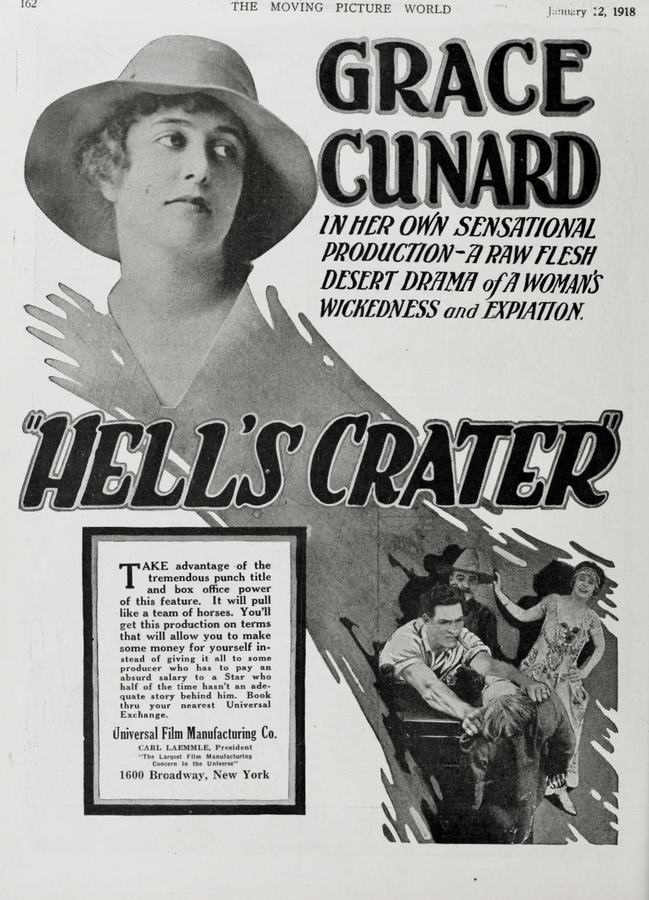
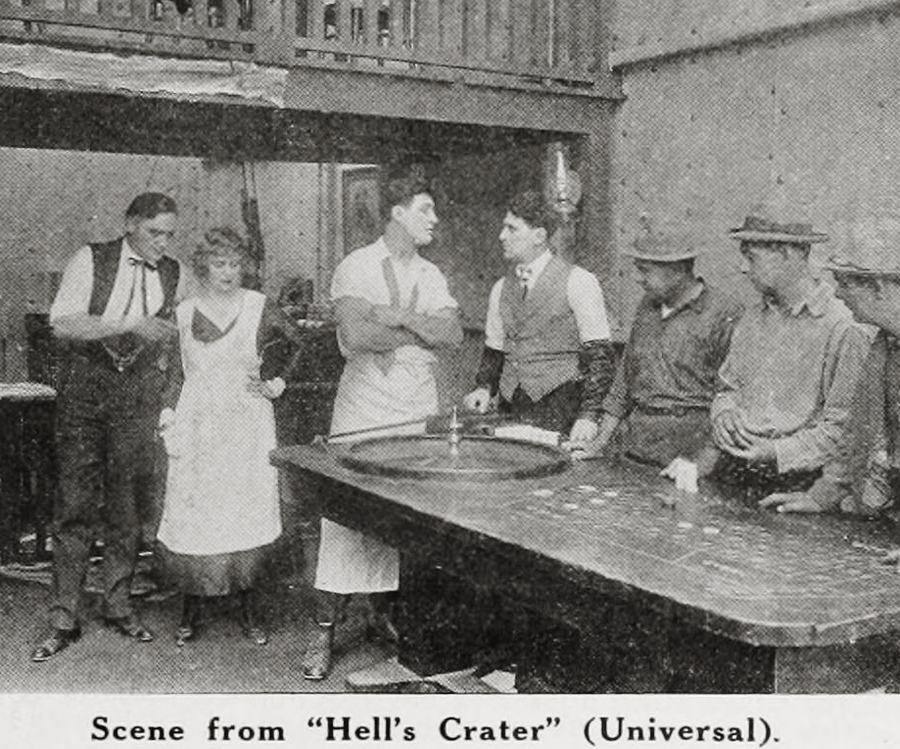
The title card erupts in sulphuric yellow lettering—Hell’s Crater—and already the film confesses its geological nihilism. The camera, a hand-cranked witness, pans across a lunar scar carved into California’s epidermis circa 1852. There is no John Ford grandeur here; the landscape is a hemorrhaging ulcer, framed under a sky the color of nicotine. Director W.B. Pearson, a name half-swallowed by the tar pit of lost cinema, composes each tableau as if chiseling obsidian: edges jagged, shadows bottomless.
Pearson’s cinematographer, likely the unsung Ray Hanford (pulling double duty as the venal deputy), bathes the negative in ferric ammonium that oxidizes highlights into bruised tangerine. The result? A daguerreotype fever dream. When Jim Shamrick, hewn from oak and Protestant guilt, descends into the mining camp’s dance hall, the image stutters between under-cranked frenzy and languid decadence. Lanterns smear into comet tails; women’s skirts become liquid tar. You can almost smell the kerosene and tubercular breath.
George A. McDaniel, saddled with a career of B-western caricatures, gifts Shamrick a granite stoicism that erodes by microscopic increments. Watch his pupils in the medium-close two-shot as Gordon pours him a third whiskey: the iris dilates—a black supernova—then contracts into a pinprick of vengeance. Silent-era acting too often flirts with kabuki; McDaniel opts for tectonic shifts.
Bill Gordon’s hall, a cathedral of perdition, deserves its own essay. Interior walls are papered with faded circus bills—elephants, bareback riders, clowns whose grins have bled into ochre ghosts. A metaphor for the Gold State itself: spectacle devoured by time. Gordon, played with oleaginous charm by an uncredited heavy, twirls his cane like a metronome keeping count of broken dreams. Beside him slinks Cherry Maurice, a femme fatale predating the term itself. Grace Cunard, better remembered for serials, here channels a venomous pathos. She doesn’t enter frames; she leaks into them, cigarette ember tracing a red sine wave.
The robbery sequence is a masterclass in ellipsis. Pearson cuts away from the actual theft to a shot of a moth immolating itself against a lamp-glass. When Shamrick awakens—head thundering, pockets hollow—the camera tilts downward to his boots caked with vomit and gilt mud. We infer the rest. Such visual discretion, rare in 1922 nickelodeons, bestows the narrative with bruised dignity.
Abduction scenes court ethical vertigo. Shamrick throws Cherry over a mule like a feed sack, her satin dress splitting at the seams to reveal knees freckled with cyanotic bruises. The intertitle reads: "To the pit that birthed my sorrow, you shall sow recompense." Modern viewers will flinch at the transactional cruelty, yet Pearson refuses to sandpaper the era’s gendered violence. Instead, he weaponizes the landscape as co-conspirator: every outcrop leers, each ravine exhales furnace heat. Misogyny becomes geological.
But it is here, within the crucible of forced labor, that the film shape-shifts. Cherry’s first task: hauling buckets along a foot-wide ledge above a 200-foot drop. The camera assumes a vertiginous high-angle; buckets swing like pendulums ticking toward nihilism. Eileen Sedgwick—stunt-doubling for Cunard—performs without a harness, her silhouette a trembling exclamation against a white sky. Risk transmutes into ritual; survival morphs into agency.
Pearson’s montage for the passing seasons borrows from Soviet avant-garde: superimposed calendars ignite, creek waters reverse, snowflakes melt upward. Cherry’s palms, once aristocratically pale, blister into topography of scabs. Yet her gaze—initially feral with hatred—softens into something luminous, as if the mine’s darkness has polished the whites of her eyes. A single iris close-up dissolves into a shot of dawn mist lifting off the gorge; love, we realize, is not spoken but exhaled.
Compare this incremental transformation with the moral whiplash of A Change of Heart, where contrition arrives via melodramatic thunderbolt. Hell’s Crater trusts geology more than theology; time, not sermons, redeems.
Archival evidence suggests the original score, now lost, featured a wheezing harmonium and Chinese gong struck off-screen. In contemporary revival houses, programmers default to Appalachian bluegrass, but I prefer the vacuum: let the creak of leather, the clink of pick on quartz, echo unadorned. Silence amplifies the film’s moral dissonance until it clangs like iron in a coffin.
By winter, Shamrick and Cherry share the same canvas tent, breath crystallizing into parallel nebulae. He teaches her to read ore samples; she teaches him the two-step shuffle on frozen gravel. Their union is never consecrated by soft-focus kisses—Pearson, ever the sadist, cuts to a blizzard swallowing the tent whole. Yet when spring’s thaw exposes the first yellow glint in the sluice box, they clasp not the gold but each other’s wrists, pulse recognizing pulse.
The finale—a shotgun sacrament officiated by a half-literate preacher—unfolds on a cliff overlooking the crater. Bridal veil: a moth-eaten lace curtain. Wedding band: a copper hoop beaten from a spent bullet. The camera tracks backward until the couple becomes a smudge against tectonic immensity. No iris-in, no sentimental cadence. The last intertitle: "Thus the earth reclaims its debt in love." Fade to obsidian.
Place Hell’s Crater beside The Girl from Frisco and you see how Pearson resists the era’s primitivist slapstick. Contrast it with The Prison Without Walls, where gender captivity is mere pretext for daring escapes; here, captivity is the slow kiln that fires the soul.
Nitrate deterioration has excised roughly nine minutes, including a rumored dream sequence where Cherry envisions herself as a phoenix rising from mercury pools. Yet absence feels curiously apt: Hell’s Crater is itself a lacuna, a hole in cinema’s memory where ethics tumble, only to crawl out transfigured.
For modern viewers drunk on redemption arcs, the film’s moral calculus will scan as radioactive. But Pearson’s triumph lies in refusing to sandblast the era’s cruelty into digestible myth. He lets the Sierra Nevada stand in judgment: indifferent, magnificent, and ultimately liberating. Hell’s Crater is not a love story; it is a geological confession that love—like gold—emerges only after everything else is stripped away.
Seek it out in any surviving 16 mm print, project it at 18 fps, and let the carbon arc hiss like a serpent. You will emerge blinking into daylight with dirt under your nails and sulphur in your lungs, unsure whether you have witnessed cinema or been buried alive by it. Either way, the crater remains.
IMDb 6.2
1933
Community
Log in to comment.