DbcultAccessing Vault...
Cult Review
Senior Film Conservator
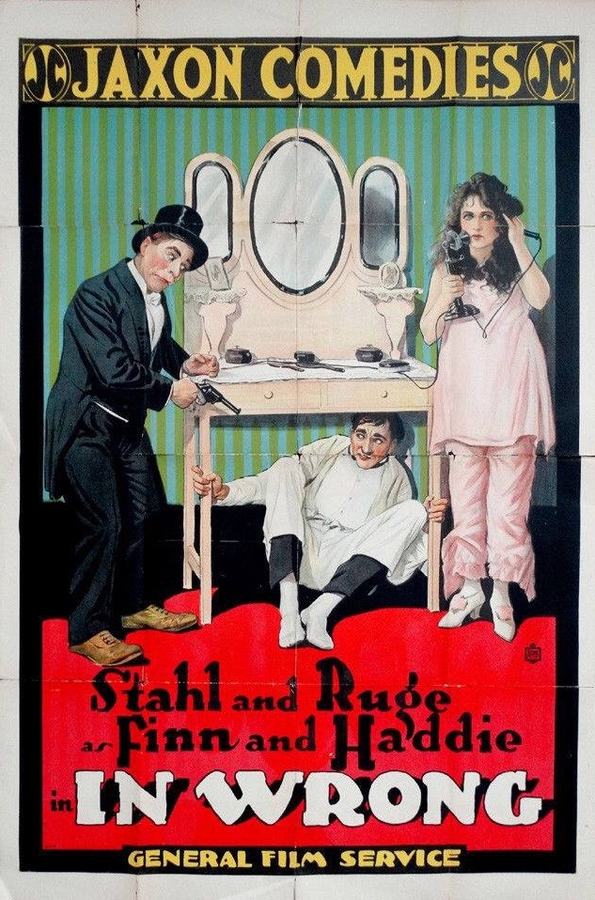
To watch In Wrong (1916) is to engage with a ghost of cinema’s most formative adolescence. In an era before the feature-length film had fully calcified into the dominant industry standard, the short-form comedy was the laboratory of the soul. Here, Walter R. Hall and Billy Ruge operate not merely as actors, but as kinetic architects. They build structures of tension and release that feel remarkably modern, despite the century of dust that has settled upon the celluloid. While films like Humanity sought to capture the grander moral struggles of the species, In Wrong is content to find the universal in the specific—specifically, in the spectacular failure of the human body to cooperate with its surroundings.
The year 1916 was a pivot point. The industry was moving away from the primitive 'cinema of attractions' toward a more sophisticated narrative grammar. Yet, in the realm of the short comedy, there remained a feral energy that refused to be tamed by the burgeoning rules of continuity. Hall and Ruge, often overshadowed by the giants like Chaplin or Keaton, brought a specific blue-collar desperation to their work. In In Wrong, this desperation is the engine. It isn't just that things go wrong; it’s that the characters are fundamentally 'in the wrong' relative to the world they inhabit. They are out of sync, a theme that resonates even today in our hyper-regulated digital lives.
Billy Ruge’s performance is a masterclass in the 'Runt' archetype. His movements are jagged, reactive, and perpetually on the verge of collapse. When we compare this to the more statuesque struggles found in Lydia Gilmore, the contrast is startling. Where Lydia Gilmore uses the frame to contain melodrama, In Wrong uses it as a cage for a frantic animal. The comedy arises from the friction between Ruge’s smallness and the oversized consequences of his actions. Walter R. Hall provides the necessary ballast, his larger frame acting as the immovable object against which Ruge’s irresistible force of clumsiness constantly collides.
There is a sequence involving a series of misinterpreted gestures that rivals the sophisticated social satire of The Slim Princess. However, where that film uses irony as a scalpel, In Wrong uses it as a sledgehammer. The humor is visceral, hitting the viewer in the gut before the brain has a chance to process the logic. It is a testament to the primal power of the silent image. You do not need intertitles to understand the mounting dread of a man who realizes his social standing is evaporating in real-time. This is the 'oldest law' of comedy—the higher the stakes of the situation, the funnier the pratfall becomes, a concept explored through a different lens in The Oldest Law.
To truly appreciate the nuance of In Wrong, one must look at its siblings in the 1916 release schedule. Consider She Hired a Husband, which deals with domestic artifice and the performance of gender. In Wrong strips away those societal roles and focuses on the raw, unvarnished incompetence of the male ego. While The Girl Angle explores the feminine perspective in a world of shifting dynamics, Hall and Ruge’s film is almost purely masculine in its idiocy. It is a celebration of the 'everyman' as a disaster artist.
Furthermore, the atmospheric tension in In Wrong—though played for laughs—shares a surprising amount of DNA with the darker, more mysterious The Flower of Doom. Both films rely on a sense of impending catastrophe. In the former, it’s a falling vase or a tripped-over rug; in the latter, it’s a more literal doom. But the cinematic language of 'the setup' is identical. The camera lingers on the object of destruction, creating a psychological link between the viewer and the inevitable crash. This is the same rhythm found in the suspenseful beats of Friday the 13th (the 1916 silent version), where superstition and reality blur.
While the director of In Wrong often remains in the shadow of the performers, the blocking is nothing short of surgical. Every frame is utilized. The way characters enter from the background to disrupt the foreground action suggests a sophisticated understanding of deep focus long before it was a codified term in film theory. It’s a visual density similar to The Firefly, though applied to the frantic pacing of a ten-minute short rather than an operatic narrative. The rhythm of the edits in In Wrong is percussive; each cut is a beat in a drum solo of escalating chaos.
This rhythmic precision is what elevates the film above mere historical curiosity. It is a living document of how early filmmakers learned to manipulate time. By speeding up the frame rate slightly, the directors created a 'hyper-reality' where the physics of the world no longer applied. This is the same sense of otherworldly momentum found in The Return of Helen Redmond, albeit used here for the purpose of a belly laugh rather than a dramatic reveal. The film understands that comedy is, at its heart, a matter of timing—a lesson also present in the professional-minded Our Mrs. McChesney.
One might not expect to find deep symbolism in a Hall and Ruge short, but In Wrong is replete with it. The repeated failures of the protagonists to master their environment reflect a broader cultural anxiety of the 1910s—the feeling that the world was moving too fast, that technology and social change were leaving the common man behind. In this sense, the film is a cousin to The Golden Rosary, which uses religious iconography to grapple with the same sense of displacement. Here, the 'rosary' is a set of dinner plates or a rickety chair, but the struggle for grace remains the same.
Even the more rugged, frontier-style narratives like The Daughter of MacGregor or the gritty Fighting Back share this DNA of resilience. The characters in In Wrong are constantly 'fighting back' against a world that wants them to fall. Their resilience is their comedy. No matter how many times Ruge is flattened, he pops back up with a grimace and a renewed sense of doomed purpose. It is the Sisyphus myth played out in a silent movie theater for five cents a ticket.
In the vast archive of silent cinema, it is easy to lose track of films like In Wrong. It doesn't have the high-brow aspirations of Sündige Liebe, nor the sweeping historical scope of the era's grander epics. But what it does have is a soul. It possesses an unpretentious desire to connect with an audience through the universal language of the body. It reminds us that before cinema was an art, before it was a business, it was a way to watch someone else fail so that we might feel a little better about our own clumsy lives.
The chemistry between Walter R. Hall and Billy Ruge is something that cannot be manufactured by a modern studio. It is the result of hundreds of hours on the vaudeville stage, distilled into a few precious minutes of film. In Wrong is a vibrant, shouting, falling piece of history that deserves more than a footnote. It is a reminder that being 'in wrong' is often the only way to eventually get things right in the eyes of an audience. For those looking to understand the roots of everything from The Three Stooges to modern physical comedy, this is essential viewing. It is a chaotic, beautiful mess that captures the heart of 1916 with every stumble and every fall.
IMDb 5.4
1933
Community
Log in to comment.