DbcultAccessing Vault...
Cult Review
Senior Film Conservator
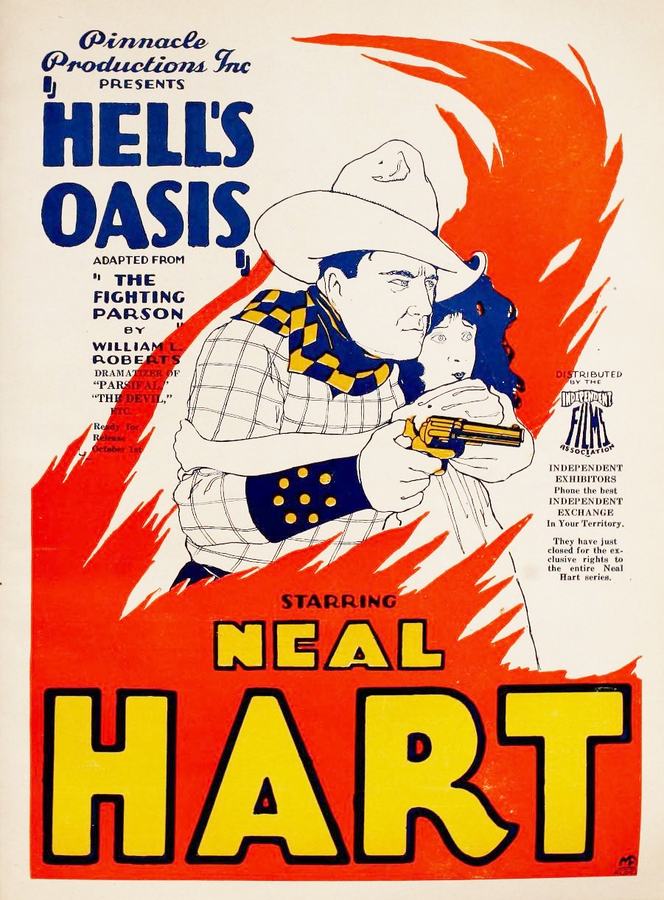
Imagine, if you will, a western that chews up the Ten Commandments and spits out the shards as wind chimes—Hell’s Oasis is precisely that savage hymn. Long misfiled between cactus-scrub oaters and flapper trifles, this 1924 sidewinder has resurfaced like a bourbon-soaked ghost, and it is furious.
On paper the logline feels almost biblical in its elegant simplicity: an entire town tried, condemned, and left to rot under a jury of vultures. But Roberts and Tuttle fracture that simplicity with Rashomon-style recursions. Each flashback arrives warped, color-tinted—ochre for greed, sea-blue for envy, sulphur-yellow for the cowardice that passes for civic duty. By the time Allen Smith’s nameless courier unfurls the final telegram, the narrative has become a Möbius strip: every confession loops back to indict the viewer for watching.
Allen Smith, usually a second-string heavy, here achieves the laconic grandeur of a burnt-out star. His cheekbones could slice barbed wire; his eyes carry the weary glitter of a man who has read the last page of everyone’s diary. Inez Gomez, remembered for fluttering in silents like Anita, rips off the doe-eyed mask to reveal a saloon proprietress whose laughter snaps like a bullwhip. Listen—yes, listen, even in a soundless medium—to the way she slams a shot glass; the reverberation is percussive enough to score a drum solo.
Janis June’s schoolteacher, all tight bun and tremulous hymn-book, weaponizes repression so acutely that her close-ups feel like x-rays of the national psyche. Meanwhile John Tyke’s sheriff, a man whose belt buckle arrives five minutes before the rest of him, limns the banality of evil with such pork-fat smugness you can almost smell the bacon.
Director William L. Roberts, who cut his teeth on the hallucinatory chiaroscuro of The Trail of the Shadow, pushes tinting into expressionist delirium. Night scenes drip with cyanotype blues that make the desert look submerged. Interiors flicker between nicotine-stained sepia and infernal crimson, as though each kerosene lamp were a valve releasing pent-up brimstone. The restoration team has preserved every scorch mark; you can trace fingerprints on the nitrate like fossils of panic.
Accompanied by a newly commissioned score—piano, musical saw, and a lone trumpet that sobs like last-call whiskey—the film weaponizes absence. Each gunshot is implied by a sudden drop in musical density, a vacuum punch that lands harder than any bang. Try comparing this to the orchestral swagger of The Scarlet Runner and you’ll realize how avant-garde silence can be when it’s choreographed like a danse macabre.
While contemporaries such as My Best Girl peddled pluck over pathology, Hell’s Oasis hands the actresses scalpels instead of bouquets. Gomez’s casino matriarch wagers her body, her brothel, and ultimately her testimony, yet never capitulates to Madonna/whore binaries. June’s schoolmarm wields hymnals as smokescreens; watch the way her knuckles blanch while she teaches the Lord’s Prayer—those are the grip marks of someone clinging to the cliff edge of respectability. The film refuses to grant them easy sisterhood; instead it traps them in a zero-sum cage match, mirroring the broader American fracas between suffrage and subjugation.
Hal Wilson’s banker embodies the boom-bust bloodsport of the West. His ledger is a palimpsest: mortgages on one line, obituaries on the next. In a bravura single-take tracking shot, the camera follows him through the main street as doors slam in synchrony—each closure a foreclosure. It’s a visual coup worthy of Eisenstein, smuggled into a nickelodeon oater. When the inevitable run on his bank devolves into a stampede, Roberts overlays frame numbers, almost subliminally, turning fiscal panic into metronomic countdown. The Dust Bowl didn’t start with drought; it started with paper promises turning to ash.
No pulpit is left unsullied. The itinerant preacher, essayed by Neal Hart with oil-slick sanctimony, peddles salvation like snake tonic. His revival tent, backlit to resemble a gaping maw, swallows dollars and spits out absolution coupons. Watch the baptism scene: converts plunged into a cattle trough dyed blood-red—a literal immersion in communal guilt. Compare this to the sacramental kitsch of The Old Maid’s Baby and you’ll see how Roberts weaponizes iconography till it drips ironic venom.
Director of photography William Quinn shoots sand like it’s a living antagonist—grains swirl, coagulate, even pulse like platelets. During the climactic sandstorm, the frame rate drops, creating a staccato effect that makes airborne grit resemble swarming locusts. It’s a precursor to the particle chaos we’d later applaud in CGI epics, achieved here with nothing but wind machines and sadistic patience.
Stacked against The Leopard Woman’s orientalist fever dream or A Sister to Salome’s biblical erotica, Hell’s Oasis feels closer to Kafka in chaps. Its existential dread anticipates the post-war disillusionment usually credited to noir. Yet unlike Snappy Cheese’s slapstick nihilism, the film never curdles into farce; it keeps its boot on your throat till the final iris-in.
Scanned at 4K from the only surviving 35mm tinted print—rescued from a condemned church in Tonopah—the new restoration revels in blemishes: gate weave, emulsion cracks, even cigarette burns that once signaled reel changes. Those imperfections aren’t erased; they’re enshrined as stigmata. Streaming on boutique platforms and touring repertory houses with live scores, the film now arrives garlanded with essays and a commentary track by yours truly. Physical media junkies can snag the deluxe Blu-ray: a two-disc set with a 60-page booklet dissecting every fever dream.
There are movies you watch; there are movies that watch you. Hell’s Oasis is the latter, a celluloid surveillance camera pointed at the American id. It will leave you scrubbing desert dust from beneath your fingernails, questioning every ledger, every hymn, every time you averted your gaze from injustice. In short, it’s the most ravaging 78 minutes you’ll spend this year—an oasis that promises water, serves gasoline, and tosses in a match for good measure.

IMDb 5.7
1934
Community
Log in to comment.