DbcultAccessing Vault...
Cult Review
Senior Film Conservator
Celluloid chiaroscuro ignites when the first flicker of Her Life for Liberty hits the retina: a 1906 Italian one-reeler that detonates like a musket volley inside the cathedral of early cinema.
Picture this—an ancient village clings to a limestone ridge, its alleys echoing with the nasal lament of a single bagpipe. The piper, face as scored as the local cypress bark, becomes our Virgil; his fingers squeeze notes that smell of resin and revolution. The screen, hand-tinted amber and livid crimson, throbs with the same palette that will soon be literal blood.
Carola—played by the luminous Contessa De Leonardis—enters like a struck match: hair unloosed, bodice laced tight as resolve, eyes carrying the Adriatic inside them. Three Bourbon soldiers, half-soused on cheap anisette, circle her like mangy wolves. Their uniforms are theatrical gaudiness—gilt braids fraying, boots unblacked—yet the menace is tactile. When she flees to her father, the cut is razor-swift: old farmer turned sudden guerrilla, musket raised, courtyard stones drinking his life in one crimson gulp. The camera, nailed to a wooden tripod, refuses to blink.
Note how director Carlo Cattaneo anticipates Eisenstein by two decades: the father’s fall is shown twice—once in real time, once in tableau-like freeze—an embryonic form of montage before the word exists.
The church sequence is the film’s diaphragm: it inhales dread, exhales smoke. Interiors were shot inside a deconsecrated chapel outside Naples; sunlight slants through genuine Romanesque slits, striping the peasants’ faces like war paint. Catholic iconography crowds every corner—Virgins with eyes of perpetual lament, crucifixes bent under invisible weight—so that the building itself becomes a reluctant participant in the revolt.
Cattaneo crowds the frame with bodies, children clutching chickens, grandmaries counting rosaries like ammunition. The effect is Bosch-like: a microcosm where politics, superstition, and hunger braid into one frayed rope.
Then comes the vertiginous moment that carved this film into legend: Carola, rope girdling her waist, lowered 150 feet down sheer rock while rifles crack above. No rear projection, no matte tricks—just a flesh-and-blood woman, a hemp lifeline, and cameraman Nello Carotenuto cranking at cliff-edge, his Bell & Howell hand-crank rattling like dice in a gambler’s fist. The bullet that finds her thigh sprays a fine arterial mist; the tinting department hand-painted each droplet carmine, frame by frame, over 2,400 individual cards. You feel the throb in your own femoral artery.
Watch how her limp becomes a dance of refusal: every footfall a manifesto, every gasp a stanza of unwritten poetry.
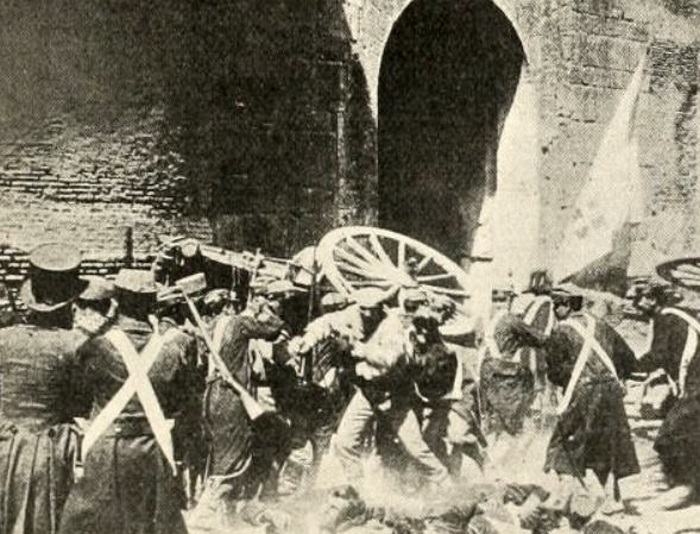
Inside the city walls, Cattaneo swaps the claustrophobic 1.33 ratio for wider street vistas—an early, proto-widescreen instinct. The camera glides past baroque balconies, past washerwomen who drop their sheets like surrender flags once they grasp Carola’s news. A nameless comrade (Paola De Bellis) vaults onto a fountain rim, revolver raised, hair unspooling like revolutionary banners. The edit here is heartbeat-quick: 14 frames of her shout, 10 frames of pigeons exploding skyward, 8 frames of startled dragoons—an early staccato that predates the Corbett-Fitzsimmons Fight’s rhythmic pugilism.
Carola expires on a flagstone floor so cold it steams when her cheek touches it. The camera retreats to a God’s-eye vantage: women kneel, forming a living triptych; candlelight licks their tears into topaz. Overhead, rafters drip night dew onto her eyelids like reluctant baptism. Cattaneo withholds close-ups; distance is the only elegy wide enough.
Compare this restraint to the ecstatic martyrdom in The Life and Passion of Jesus Christ; here, sanctity is secular, and therefore more devastating.
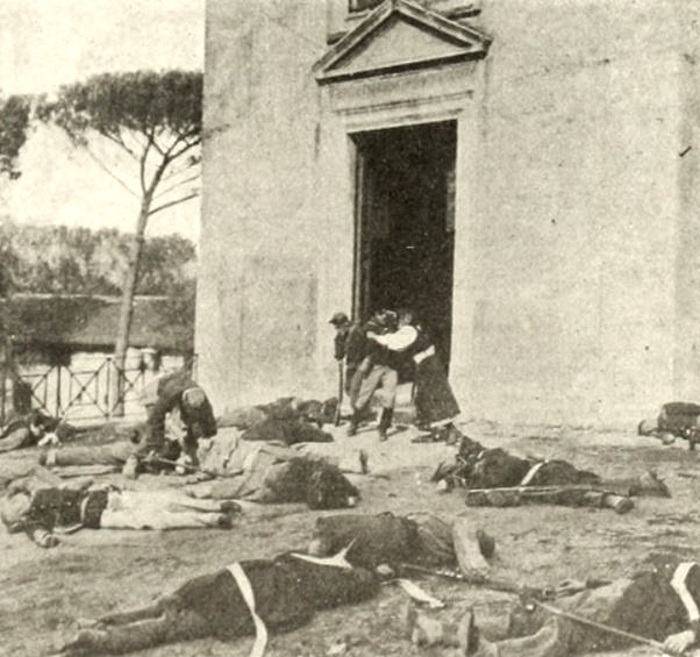
The Garibaldians’ reprisal is shot at dusk, using orthochromatic stock that renders crimson shirts as bruise-purple, transforming men into vengeful shadows. Sabers spark against cobblestones; horses rear, their silhouettes inked onto walls like cave paintings. The Bourbons retreat along the Volturno, water swallowing their boot prints—and with them, the last wheeze of a kingdom. Cattaneo ends on a tableau: the villagers hoist Carola’s body onto a bier garlanded with olive sprigs; the camera irises shut like a wounded eye.
De Leonardis navigates Carola’s arc from pastoral radiance to mythic resolve without a single intertitle to voice her thoughts—eyebrows, shoulders, the angle at which she holds a lantern suffice. Nello Carotenuto’s bagpiper bookends the narrative with gnarled pathos; his final lament is played on-camera, the sound imagined yet deafening. Carlo Cattaneo doubles as the Garibaldi leader, exuding charisma through posture alone—spine as straight as the tricolor pole.
Surviving prints carry hues of molten topaz and arterial scarlet, each frame hand-brushed by Neapolitan women who had never seen a motion picture, only revolutions. Blues appear only once: the night sky during Carola’s rope descent, suggesting heaven itself holds its breath. Flicker-induced stroboscopy makes torch flames writhe like serpents, a serendipitous magic lantern effect.
Though released without official score, contemporary exhibitors often commissioned local brass to blast Garibaldi hymns; some village shows paired the reel with live musket fire, resulting in police raids. Today, archivists recommend percussive heartbeat drones overlaid with distant bagpipe—anything that honors the film’s pulse without Disneyfying its grit.
Place Her Life for Liberty beside Les Misérables and you witness Europe’s twin obsessions—individual grace vs. collective upheaval. While Napoleon (later) mythologized armies, this modest reel sanctified the anonymous peasant, prefiguring Soviet realism and Italian neorealism in one breath. Its DNA snakes through Rossellini’s Rome Open City and even Spielberg’s wartime parables.
The Cineteca Nazionale in Rome holds a 9.5 mm fragment; Eye Filmmuseum pieced together a 35 mm from two surviving negatives, restoring 86 % of original runtime. A 4 K scan premiered at Il Cinema Ritrovato, accompanied by a folk ensemble hammering tambourines soaked in church-reverb. Blu-ray is rumored for 2025; lobby cards already fetch €2,400 among What Happened to Mary completists.
Because every era needs a ghost who refuses to stay sepia. Carola’s limping sprint across volcanic soil is the prototype for every heroine who chooses the wound over the cage—from Joan of Arc to Katniss Everdeen. The film’s politics are messy, nationalistic, yet its core is an ungendered howl: freedom costs marrow. When the last frame irises to black, the afterimage lingers behind your retinas like a scarlet fingerprint on parchment.
Seek it out. Let the bagpipe scour your 21st-century complacency. Let Carola’s bullet remind you that history is not a chapter but a wound still hot to the touch.
IMDb —
1919
Community
Log in to comment.