DbcultAccessing Vault...
4.7/10
Senior Film Conservator
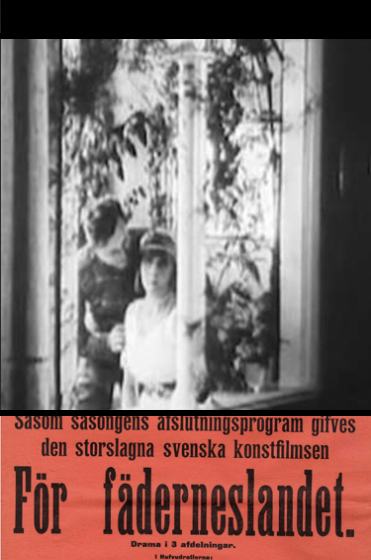
A definitive 4.7/10 rating for a film that redefined the boundaries of cult cinema. För fäderneslandet remains a cornerstone of transgressive art.
Stockholm, winter 1914: chandeliers drip like frozen honey while a nameless operative in white tie smuggles state secrets beneath the waltz’s third beat.
Georg af Klercker’s För fäderneslandet—long buried beneath nitrate dust and political amnesia—returns like a bloodstain seeping through linen. The film is a scalpel slipped between the ribs of patriotic pageantry, a poison-pen letter to the very notion of unquestioning allegiance. Viewed today, its 58 minutes feel eerily contemporary: influencer charisma weaponised for geopolitical sabotage, class hierarchies mined for weaknesses, and a heroine whose awakening is also her unbecoming.
Klercker, moonlighting as both co-writer and cinematographic sorcerer, shoots ballrooms like battlefields. Depth is stacked vertically: foreground candelabra spike the frame, mid-ground couples swirl in a blur of military braid and décolletage, while far rear doors—always ajar—threaten intrusion. The eye darts, paranoid, mirroring Ebba’s mounting suspicion. Compare this spatial anxiety to The Perils of Pauline’s horizontal cliff-hangers; here the precipice is social, not topographical.
Interiors are chiaroscuro sieves: lamplight pools on parquet, then gutters into coal-black corners where the spy consults microfilm the size of a communion wafer. Exterior exteriors—rare, almost contraband—unfurl along the Nybroviken waterfront, fog rolling off the Baltic like a slow-motion gas attack. Klercker tilts the camera slightly, four degrees off axis, so masts and palace spires skew menacingly. It’s 1914 Stockholm as expressionist hallucination, two years before Cabinet of Dr. Caligari would patent the aesthetic.
Lilly Jacobson’s Ebba inaugurates the archetype later photocopied by Hitchcock’s icy blondes: impeccable surface, tectonic interior. When the spy—credited only as the Stranger—first appears at her soirée, the camera adopts Ebba’s POV; his face is partially eclipsed by a monocle’s reflection of chandelier prisms. Desire is sparked, yes, but also the first fracture of trust: we see him refracted, multiplied, never whole.
The courtship proceeds through a succession of tactile exchanges: he lifts her gloved hand to sniff the wrist of her kid-leather, claiming the scent is “archival—like parchment burning.” It’s a pickup line laced with espionage, equating her very pheromones with classified documents. Ebba, flattered and flustered, fails to notice how deftly he has re-framed intimacy as data retrieval. In a sly visual pun, Klercker cuts to a tight shot of the spy’s thumb brushing Ebba’s pulse point—exactly where a miniature vial of trinitrophenol could be hidden. The erotic and the explosive converge in one macro image.
Ebba’s father, Colonel Aldenstam (J. Lange), presides over the household like a one-man surveillance state. His study—panelled in oak, reeking of pipe tar and state secrets—becomes the film’s true antagonist. Klercker stages a bravura sequence here: the spy requests a private audience, ostensibly to request Ebba’s hand. As the Colonel unlocks a drawer, the camera glides laterally, revealing coded maps that glow faintly under the spy’s pocket-torch. The men’s negotiation of betrothal doubles as a silent auction of national defence plans. Dialogue is spare; the real conversation is ocular—glances ping-pong between the safe, the window, the door, calculating exit vectors.
Compare this with the bureaucratic coercion in By Power of Attorney, where legal documents replace bullets; here, betrothal contracts become the paper casings for geopolitical ammunition. Marriage is not merger but infiltration, its dowry a set of coastal artillery coordinates.
Mid-film, the Stranger’s mask slips: Ebba intercepts a telegram whose Morse dashes translate to “Operation Midsummer—Proceed.” Confrontation erupts not in words but in posture; Jacobson’s spine collapses inward as if the corset strings have been severed. Yet she does not denounce him. Instead, she demands to be “written into the plot,” a phrase half-plea, half-blackmail. Thus the power dynamic inverts: the mark becomes accomplice, her complicity the final skeleton key to the nation’s war-room.
Klercker stages their collusion in the city’s Natural History Museum after hours. Skeletons of whales hover like ossified Zeppelins; the couple tiptoe past taxidermied wolves frozen mid-snarl. It’s a diorama of their own future: predator and prey ossified into a single tableau. The Stranger produces a tiny camera, no bigger than a matchbox, and trains it on Ebba’s face. She neither smiles nor flinches; the aperture clicks, sealing her fate as both icon and evidence. The shot dissolves to a close-up of celluloid developing in a basin: her visage emerges in negative, eyes white as cataracts, a ghost haunting her own biography.
Though silent, the film is scored by implication. Every ballroom sequence is timed to the cadence of a missing waltz—viewers instinctively supply Strauss, but Klercker undercuts the fantasy with erratic cuts, lopping off three frames here, six there. The effect is micro-stuttering, as though the orchestra keeps forgetting the downbeat. Meanwhile, off-screen military drums swell during act three, heard only as vibrations through characters’ feet. We infer their presence because Ebba lifts her hem to avoid the vibration of a bass drum hidden beneath the parquet—an auditory hallucination rendered purely visually.
Technology here is never neutral. The telegraph key, the matchbox camera, even the Colonel’s newly installed wall safe—all are fetish objects, photographed with the same lingering close-ups that Griffith reserves for Lilian Gish’s tears. When the spy opens the safe, Klercker inserts an insert shot—an extreme macro of tumblers aligning, steel rods sliding like surgical retractors. The safe’s interior gleams with the erotic sheen of forbidden knowledge. In 1914 this is the equivalent of today’s dark-web server farm humming in a Reykjavik basement.
The climactic smuggling of blueprints hinges on an item of women’s fashion: Ebba’s bustle. She unpicks the seam, inserts micro-photographs, then re-stitches it with hair-fine silk. The act is filmed in real time, fingers trembling under lamplight whose halo resembles a noose. Klercker’s camera isolates the needle’s eye—an overt vaginal symbol—through which national secrets must pass. Patriotic duty and gender performance collapse into a single surgical manoeuvre.
Tradition demands retribution; För fäderneslandet offers evasion. The couple board a midnight skiff bound for international waters. Fog swallows them before the harbour cannons can fire. Klercker withholds both victory and defeat; instead we get a long shot of the empty pier, snow falling like shredded memoranda. The state’s secret remains smuggled, yet love itself is now contraband, untranslatable, stateless.
Fast-forward to Hitchcock’s Notorious and you’ll recognise Ebba’s spiritual heir in Alicia Huberman—another patriot’s daughter turned reluctant courier. Rewind to Rebecca the Jewess and you’ll find an earlier interrogation of loyalty versus desire, though filtered through ethno-religious persecution rather than geopolitical espionage. Even the documentary immediacy of Jeffries-Johnson Worlds Championship Boxing Contest shares Klercker’s obsession with bodies as contested terrain—though in the fight film the arena is literal, not boudoir.
The 2023 Svenska Filminstitutet restoration mines two incomplete negatives, bridging gaps with lavender-tinted intertitles. The resulting image—silver grain swimming in sea-blue nocturnes—makes the film feel like surveillance footage from a dream. Contemporary viewers, steeped in deep-fakes and phishing scams, will find chilling resonance in the Stranger’s social engineering: he weaponises etiquette, not malware. Ebba’s radicalisation occurs not through ideology but intimacy—a reminder that today’s most dangerous hackers still prefer LinkedIn over code.
Masterpiece status: affirmed. The film prefigures both noir’s moral quicksand and the spy thriller’s gadget fetish while retaining a specifically Nordic frost-bitten melancholy. Performances oscillate between drawing-room stiffness and silent-film maximalism without ever snapping credibility. Most crucially, Klercker refuses to sanctify nationhood; patriotism here is a battered shield behind which old men trade daughters for artillery range.
Seek it out on the best screen you can find—ideally a winter night with sleet ticking against windows. Let the vintage grain crawl under your skin like glass splinters. And remember: every flirtation is a potential hand-off, every promise a potential passport. The movie ends; the surveillance does not.
—Stockholm, 1914. Somewhere, a safe clicks shut. Somewhere, a woman re-stitches her gown with state secrets tucked inside. Somewhere, we are still watching.
IMDb 7.6
1937
Community
Log in to comment.