DbcultAccessing Vault...
Cult Review
Senior Film Conservator
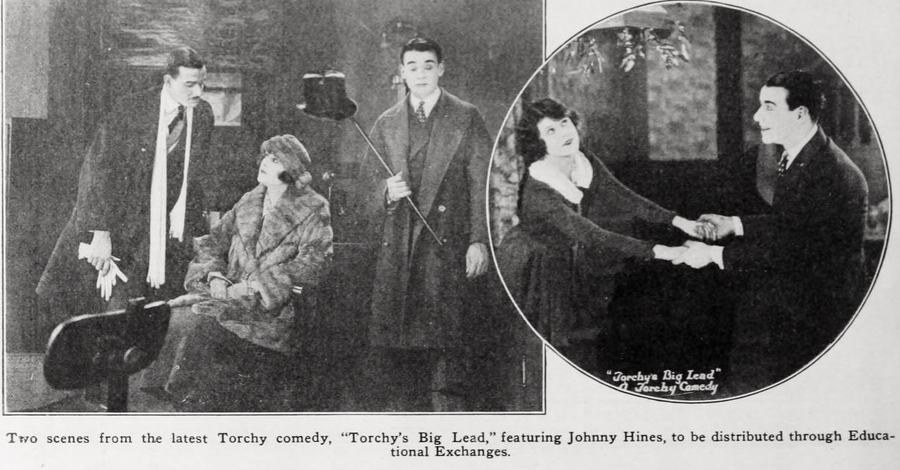
Imagine Ellis Island reimagined by Groucho Marx and you have the vertiginous premise of Torchy’s Big Lead, a 1920 one-reel marvel that treats the American city like a labyrinth whose only thread is a candy-striped walking stick. The film arrives as both immigration satire and espionage frolic, stitched together by the elastic mug of Johnny Hines, a silent clown whose kinetic eyebrows could semaphore a novella.
From the first iris-in, director Raymond L. Schrock weaponizes depth of field: a steamship funnels belch while, in the foreground, a customs officer’s white glove slices the air like a guillotine of bureaucracy. Into this crucible shuffles a polyglot chorus—bowler-hatted Armenians, kerchiefed Sicilian matriarchs, a Finnish giant who looks carved from pine. They share only one phrase of English: “Follow the cane.” The cane—banded crimson like a barber’s pole—becomes fetish, compass, and contract.
Cue Torchy, a fast-talking urbanite whose motoric gait seems powered by espresso and sheer gall. In a crowded chophouse he grabs the wrong coat check token, the wrong hat, and—fatally—the wrong cane. The immigrants, conditioned to obedience, pivot in perfect unison and trail him like ducklings. The camera, suddenly mobile, tracks backward through swinging kitchen doors, past flummoxed chefs cradling aspic, out into alleyways where laundry flaps like surrender flags. It’s Modern Times before Chaplin codified the gag.
Hines excels at the micro-beat: a double-take that metastasizes into a quadruple-take; a tip of the hat that snags a passing woman’s feather boa, yanking her into frame for an accidental kiss. Yet beneath the pratfalls lurks a sly political cartoon. The immigrants—nameless, voiceless—are shuffled around the chessboard by every native who grabs the stick. Authority is revealed as mere choreography: whoever owns the prop becomes the Pied Piper. One thinks of today’s algorithmic feeds, those invisible canes we follow through digital plazas.
Halfway through the reel the tone pivots from carnival to cloak-and-dagger. Intertitles—lettered like ransom notes—reveal that secret service agents shadow the crowd because someone smuggles aigrettes, those coveted heron feathers once worth their weight in diamonds. The contraband is hidden inside the hollow of the very cane now ricocheting through the city. Suddenly every laugh carries a barb: plume of beauty, instrument of exploitation, feather of empire.
Torchy, ever opportunistic, palms the cane onto a bumbling policeman (Dorothy Leeds in gender-bending greasepaint). The cop—his helmet comically too small—now inherits the Pied Piper mantle, leading the immigrants straight into a federal dragnet. Schrock crosscuts between the cop’s sweat-beaded temples and the agents’ narrowed eyes, creating proto-Hitchcockian tension inside 12 minutes.
Romance, never far, surfaces in the form of Vee, a cigarette girl whose moral calculus equals Torchy’s own. She demands proof of valor, so Torchy re-steals the cane and plants it on his silk-hatted rival, a stockbroker who reeks of old money. The final gag is a masterstroke of Eisensteinian montage: agents pounce, cane snaps, feathers explode into the air like white fireworks against the night sky. The immigrants scatter; the rival is cuffed; Torchy pockets both Vee and the remnants of our collective guilt.
Visually, the film revels in chiaroscuro. Streetlamps halo the fog; the cane’s red band glows like a cigarette cherry. Cinematographer Fred Jackman (borrowing techniques he’d honed on Sequel to the Diamond from the Sky) uses under-cranking to accelerate the chase, then switches to over-cranking for a surreal slow-motion featherfall—an effect later echoed in Speed’s final crash.
Compare the film’s urban anarchy to the pastoral knockabout of In the Wild West or the drawing-room intrigues of Our Mrs. McChesney. Where those narratives rely on dialogue (spoken or intertitled), Torchy’s Big Lead speaks through spatial geometry: every doorway becomes portal, every pedestrian potential pawn. It’s the cinematic equivalent of a New Yorker cartoon sprung to life.
Yet for all its kinetic invention, the film does not escape the prejudices of its era. The immigrants are caricatures: the swarthy, gesticulating other. Their linguistic babel is played for laughs, their aspirations reduced to the next hot meal. Modern viewers will wince, but the discomfort is instructive; the reel serves as a Rorschach test for American xenophobia, then and now.
Performances crackle. Hines channels Murnau’s Last Laugh doorman one moment, then pivots to the loose-limbed elasticity of Keaton. Leeds, though second-billed, steals sequences with micro-gestures: a single raised eyebrow when the cane changes hands communicates pages of subtext. Their chemistry anticipates the sparring duos of 1930s screwball, a decade before the Production Code would sand off such spiky banter.
The screenplay, adapted from Sewell Ford’s pulp stories, compresses an entire serial into 12 breathless minutes. Where Ford trafficked in dialect-heavy verbiage, Schrock prunes to the visual bone. The result is a haiku of narrative economy: every insert shot of a tram ticket, every close-up of a broken heel, propels both plot and theme.
Sound, though absent, is implied. You can almost hear the clatter of the El train, the hiss of soda siphons, the immigrant chorus murmuring “the cane, the cane.” The mind fills the aural gaps, making the experience oddly participatory—an ancestor to today’s ASMR.
Influence ripples outward. The feather-snow climax prefigures the rose-petal blizzard in American Beauty; the identity-swapping prop anticipates the suitcase MacGuffins of The Frame-Up. Even the wordless storytelling nods toward Ambrose and the Bathing Girls, where desire is conveyed through swim-suited semaphore.
Restoration efforts by the EYE Filmmuseum have salvaged a 35mm nitrate print, tinting night scenes a bruised cyan that accentuates the scarlet cane band. The digital 4K scan reveals textures previously lost: the herringbone of Torchy’s vest, the tiny cross-stitch on Vee’s garter. Such granularity reiterates that silent cinema, far from primitive, offers visual gluttony rivaling today’s HDR blockbusters.
In the end, Torchy’s Big Lead is both time capsule and mirror. It mocks bureaucratic ineptitude, lampoons love’s transactional farce, and indicts the American appetite for disposable exotica—feathers, people, stories. The cane, that slender axis of chaos, ultimately points at us, the audience, complicit in every shuffle of the power stick. Watch it for the laughs; rewatch it for the shiver of recognition.
IMDb 5.6
1934
Community
Log in to comment.