DbcultAccessing Vault...
Cult Review
Senior Film Conservator
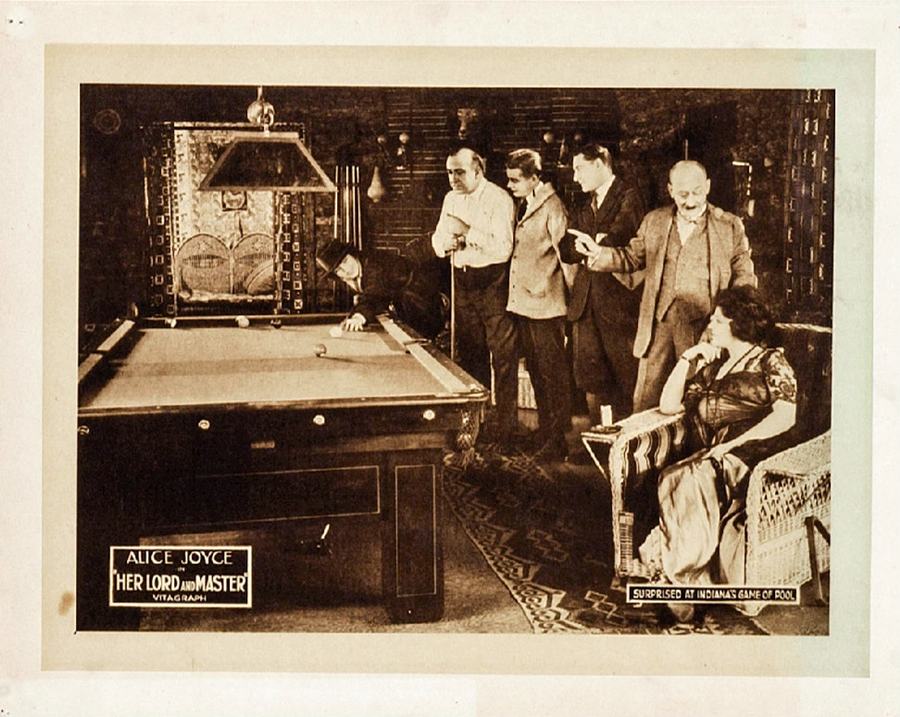
A marriage certificate as battlefield
One of the film’s earliest intertitles brands Indiana Stillwater “the railroad king’s uncontainable daughter,” and for the next hour Alice Joyce lets that epithet vibrate through every frame. Watch the way she enters a room: shoulders forward, chin tilted as if sniffing for new territory to lay track upon. Beside her, Holmes Herbert’s Viscount Canning is all backward momentum—weight on the heels, hands clasped behind as though guarding the family crest stitched into his suspenders. The camera, timid by 1920 standards, still manages to carve negative space between them: two continents of body language separated by an unbridgeable gulf of salt water and ideology.
Director J. Sutherland, better known for two-reel Westerns, here borrows the grammar of Rex Ingram’s The Four Horsemen: lingering close-ups on gloved hands, cigarette smoke used as visual ellipsis, mirrors that double faces until identity itself seems negotiable. The result is a curio—neither fish-nor-fowl, neither drawing-room comedy nor tragedy of manners, but a brittle snapshot of the exact moment when American capital began purchasing British heritage wholesale.
The dowager’s dilemma
Ida Waterman, as Lady Canning, delivers the film’s most quietly radical performance. With only a fan and an eyebrow she sketches an entire caste in twilight: women who once governed empires via breakfast seating charts now reduced to auctioning their sons to whatever heiress can keep the roof from leaking. In one exquisite tableau she stands before a Van Dyck portrait of a forebear, her own reflection superimposed by double exposure; the ancestor’s ruff becomes her widow’s collar, centuries collapsing into a single anxious exhale.
The dinner that detonated a dynasty
The pivotal Sunday invitation arrives on stationery so thick it could stop a bullet. Indiana reads it aloud, voiceover via intertitle in a curling Art-Nouveau font: “Mother and Father request the pleasure of their daughter’s company—no titles, no footmen, just fried chicken and a phonograph.” To the Viscount, this is treason against the very concept of coronet. He issues his prohibition in a single line that flashes across the screen like a gauntlet: “A Canning does not parade her appetite in a public chop-house.”
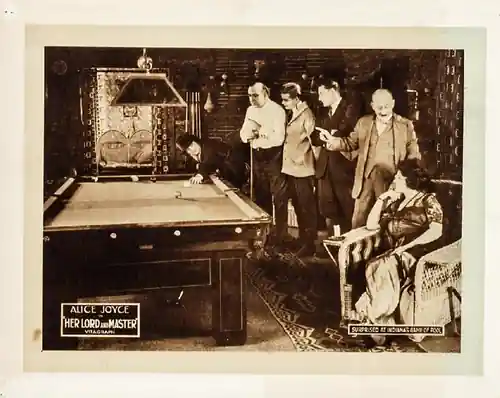
What follows is a masterclass in micro-rebellion. Indiana descends the back stair wearing a cloak the color of dried blood—Cecil B. DeMille would have made it scarlet, but Sutherland opts for ox-blood, something that could pass in bad gaslight for mourning. She leaves behind a note on translucent paper; the camera watches through the sheet as the Viscount reads, his face refracted into a cubist smear. The marriage is over before the ink dries.
Silent voices, loud silences
Because the film is mute, every emotion must be telegraphed through textile. Costume designer Louise Beaudet drapes Indiana in progressively stiffer fabrics—voile, taffeta, finally a metallic brocade that creaks when she breathes—mirroring the corseting of her spirit. Conversely, the English women’s gowns grow looser, almost sloppy, as if the American contagion has slackened their laces. By the final reel, Indiana strides across a foggy quay in a man’s ulster, hair unpinned, the ultimate sartorial insult.
Comparative DNA: cousins across the Atlantic
If you place The Judgment House beside Her Lord and Master, you’ll notice both films stage their moral climax in a single, charged interior: a library, a dining hall, a courtroom of domesticity. Yet where The Judgment House finds redemption in Christian forgiveness, the 1920 picture offers no olive branch—only the steamer’s whistle, a soundless shriek that swallows futures whole.
Similarly, An Amateur Orphan toys with class inversion, but its waif heroine ultimately craves the very armorial security Indiana flees. The difference is capital—literal and figurative. Indiana arrives armed with railroad stocks instead of a sob story; she can afford to walk away, and that solvency gives the ending its rare, sulfurous spark.
Performances under the magnifying glass
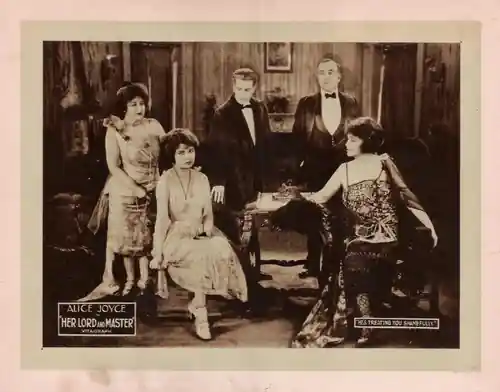
Alice Joyce was often dismissed by Variety as “the porcelain blonde,” yet here she weaponizes that fragility. Watch her eyes in the shot-reverse-shot sequence outside the House of Lords: she blinks once—tic—a shutter that releases a cataract of unshed tears. The blink is timed to the splice itself, so the audience feels the film itself stutter with her heartbreak.
Holmes Herbert has the harder task: making aristocratic pig-headedness almost sympathetic. He does it by clinging to objects—gloves, a cane, the tassel of a curtain—as though touching the physical world might moor him against the tide of modernity. When Indiana finally boards her ship, he remains on the pier clutching her forgotten scarf, a silk banner of defeat whipping against his cheek like a slap.
Screenwriters: the invisible duelists
Martha Morton, America’s answer to Pinero, adapted her own 1902 stage hit. She and J. Clarkson Miller excise the play’s comic footman, replacing his bawdy asides with vignettes of servants gossiping in jump-cuts—proto-Eisensteinian montage that anticipates October’s dialectical collisions. One insert shows a scullery maid ironing a newspaper so the master can read without ink on his fingers; the next cut reveals Indiana’s father in New York folding stock reports around a breakfast chop. The parallelism is subtle, but it sutures continents more economically than any subtitle.
Cinematographic footnotes
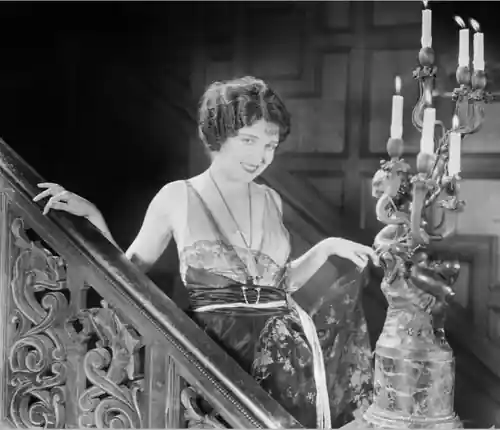
Cinematographer Eugene Gaudio (yes, kin to the more famous William) shot the exteriors in Staten Island mansions doubling for Kentish estates. He uses early panchromatic stock that renders foliage almost white, turning garden walks into lunar voyages. Inside, he rigs a primitive crane—essentially a pulley nailed to a baby-grand piano—to achieve the film’s lone descending shot: the camera drifts down the balustrade like a ghost, discovering Indiana’s farewell note before any character does. It’s a whisper of Hitchcockian suspense a full decade before The Lodger.
What hisses through the cracks: race, labor, empire
Modern viewers will bristle at the racial semaphore humming in the margins. Indiana’s railroad fortune is, of course, gouged out of land recently cleansed of Lakota and Cheyenne; the film never mentions this, yet the guilt steams up through the visual cracks—particularly in a nightmare insert where Indiana dreams of locomotive wheels that morph into war-bonneted eagles. Meanwhile, the English estate teeters on Irish tenantry that never appears onscreen, though a battered tin of shamrocks incongruously sits on the butler’s pantry shelf, a silent accusation.
Labor unrest flickers, too. A subplot involving a dismissed groom hints at post-war union agitation; his parting shot—“Your lordship’s horses eat better than my kids”—is the single overt political statement the movie allows itself. The line appears as an intertitle superimposed over a shot of untouched oats in a silver manger, Sargent’s Lady Macbeth rewritten by Marx.
The ending: open sea, open questions
The final tableau refuses catharsis. Indiana stands at the rail of the SS Majestic, hair unmoored in the Atlantic wind. Gaudio overcranks the camera so the strands lash like signal flags. Behind her, through double exposure, the ghostly outline of Canning Court materializes, then dissolves into spray. No intertitle announces her destination—New York? Paris? A Reno divorce ranch? The ambiguity is the point. Marriage, the film suggests, is but one border crossing; identity itself is an ocean without a far shore.
Legacy: a negative space in film history
Because prints were vaulted rather than reissued, Her Lord and Master never entered the television package that introduced 1950s kids to silent cinema. It survives in a single 35mm element at the Library of Congress, gate-scratched and magenta-faded, like a love letter left in the rain. Yet its DNA reappears in later transatlantic sagas: The Earrings of Madame de…, The Innocents, even The Wings of the Dove. The notion that marriage is a hostile corporate takeover, not a fairy-tale merger, finds its first brittle articulation here.
If you crave velocir pacing or swashbuckling set pieces, sail on. But if you savor the slow corrosion of social pretense—if you like your melodrama cut with arsenic—then this 63-minute morsel will leave a film of rust on your tongue. Approach it as you would a daguerreotype: still, silvery, apt to warp if held too close to modern light. In its tarnished reflection you may glimpse the first tremor of the 20th century: the moment when capital, not lineage, became the final aristocracy.
IMDb 5.4
1918
Community
Log in to comment.