DbcultAccessing Vault...
7.6/10
Senior Film Conservator
A definitive 7.6/10 rating for a film that redefined the boundaries of cult cinema. Ready Money remains a cornerstone of transgressive art.
The first time you see Steve Baird’s silhouette flicker against the cracked celluloid, you realize this is not the West of John Ford’s cathedrals but a more feral, flea-bitten frontier—a place where even the coyotes budget their howls. Ready Money survives only in fragmentary prints, yet what remains is a kaleidoscope of desperation gilded by dumb luck, a comedy that laughs hardest at its own sermon on value.
Director James Montgomery stages the mine as a gaping maw, a vertiginous negative space that swallows optimism whole. The camera—static by modern measure—finds dynamism in juxtaposition: close-ups of Steve’s trembling hands counting dust against wide shots of cavernous black. Each iris-in feels like a banker’s monocle inspecting a mortgaged soul.
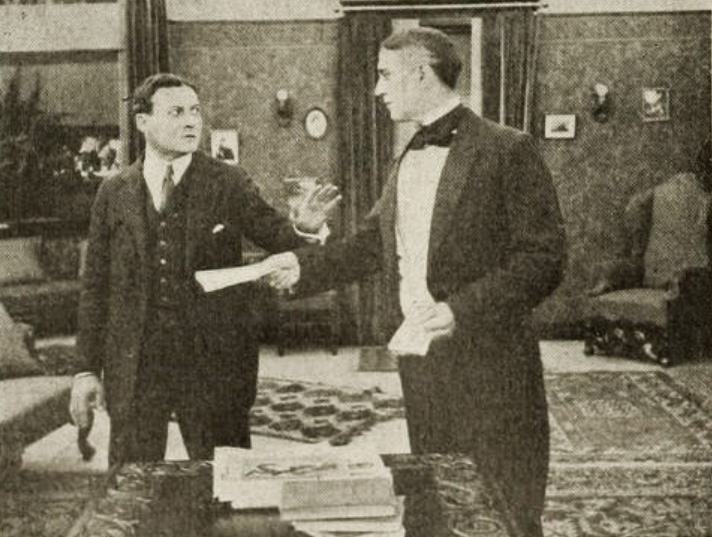
Jackson Ives, played with pencil-mustached panache by Edward Abeles, is the film’s roaming thesis statement. He embodies the moment when capitalism learns to photocopy itself, replicating value without the inconvenience of labor. His printing press clicks like a metronome for the Roaring Twenties, promising that representation can outrun reality if the paper is convincing enough. The script refuses to moralize; instead it allows the forged notes to pollinate genuine prosperity, implying that trust—however misplaced—might be the true tender.
Consider the montage of Grace’s friends fondling the cash: gloved fingers stroking ink that still smells of wet dreams. Their faces glow with the same rapture medieval pilgrims wore upon touching fragments of the One True Cross. Montgomery crosscuts these tableaux with Ives in his garret, cigarette smoke haloing his head like incense before a false idol. The parallel action is editorializing without sermons: belief itself is the alchemy.
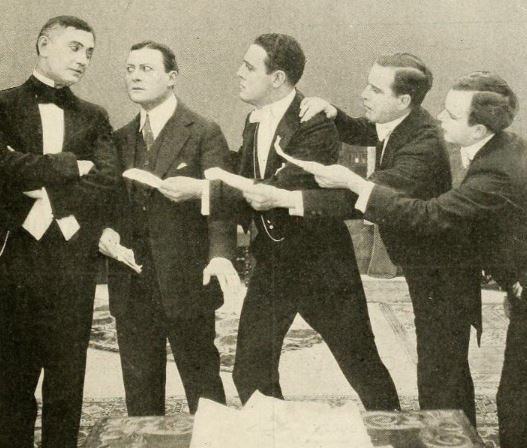
When Morgan’s dynamite cleaves the mountainside, the resulting geyser of gold functions as both punch line and resurrection. Cinema history is lousy with last-act treasure troves—A Princess of Bagdad conjures jewels from sorcery, Dødsklippen unearths cursed ore—but Ready Money treats the strike as cosmic affirmation of forgery. The earth itself authenticates the counterfeit by releasing enough genuine metal to back the phantom bills. It’s as if the universe operates on deficit spending and needs a timely injection of liquidity.
Mike Reardon—magnificently weathered by Art Acord—limps out of the rubble caked in dust that glitters like stardust. His laughter is half-mad, half-prophetic, the chortle of a man who learns that survival is just another accounting trick. The explosion’s practical effects rely on chalky detonations that predate modern pyrotechnics; clouds billow like bruised cotton, and the nitrate shimmer renders each fleck of gold as a comet against the night.
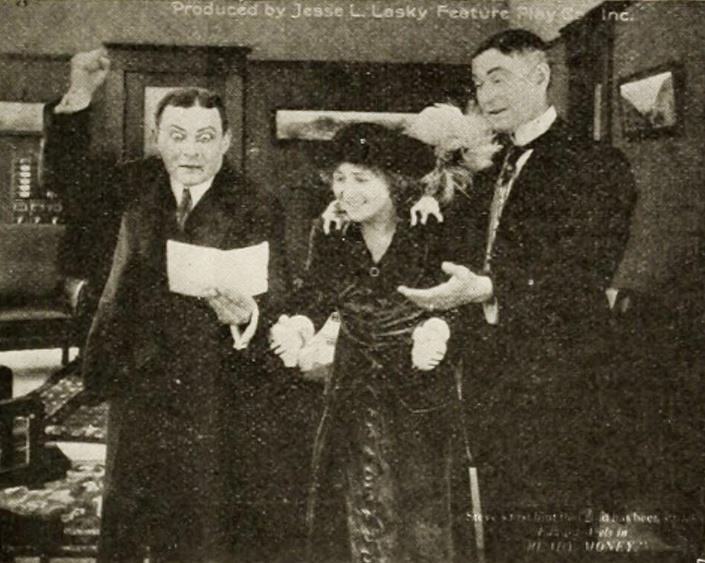
Jode Mullally’s Steve Baird carries the weight of every silent-era romantic drifter, yet his eyes hold a twitch of awareness, a recognition that fortune is a rigged roulette wheel. Watch the way his shoulders slacken when he first palpates the counterfeit wad: the gesture is half ecstasy, half surrender. Opposite him, Florence Dagmar’s Grace Tyler glides through soirées like a panther wearing pearls, her close-ups revealing pupils dilated not by love but by the narcotic of upward mobility.
Among the supporting ensemble, Theodore Roberts essays James Morgan as a robber baron carved from mahogany—his vowels as round as coins, his glare a foreclosure notice. In a 1922 interview with Motion Picture Magazine Roberts admitted he based the performance on railway tycoon E. H. Harriman, claiming he wanted to smell of “coal smoke and litigation.” The anachronistic touch prefigures Daniel Day-Lewis’s oil-man in There Will Be Blood by eighty-five years.
Cinematographer Fred W. Jackman, fresh from shooting desert vistas for The Remittance Man, bathes The Skyrocket’s exteriors in bleached ochre, allowing rock formations to resemble topographical skulls. Interiors, by contrast, are chiaroscuro chambers where candlelight carves gargoyles into banker’s faces. The transition from frontier to Manhattan is signaled not by locale intertitles but by palette shift: the New York sequences glow with amber tinting, evoking a city perpetually soaked in whiskey.
One surviving reel includes a double-exposure dream sequence: Steve imagines banknotes sprouting wings only to morph into golden canaries that dissolve into dust upon contact. Such proto-surrealist flourishes align Ready Money closer to Fantomas: The Mysterious Finger Print than to traditional oaters, revealing that early audiences craved not just nickelodeon thrills but also visual poetry about capital’s ephemerality.
Grace Tyler’s arc critiques the era’s limited fiscal avenues for women of means. She cannot prospect, cannot vote at shareholder meetings, cannot even sign for the loan Steve desperately needs. Her only leverage is the power of example—her purchase of stock transforms the mine from pariah to paragon. The film quietly underlines how feminized capital operates through spectacle rather than statute. When she finally clasps Steve’s hand in the closing shot, the marriage doubles as merger, a horizontal integration of tarnished names into gilt lineage.
Contrast this with Jane Darwell’s smaller role as a boarding-house matron who spends the entire runtime darning socks while men gamble empires. Darwell’s earth-mother stoicism anticipates her iconic turn as Ma Joad a dozen years later, reminding viewers that every ledger of fortune contains invisible female labor.
Though released two years before the talkie tsunami, Ready Money toured with a commissioned score for pit orchestra: muted trumpets mimicking pickaxes, violin glissandos suggesting the rustle of banknotes, timpani rolls that detonate in sync with Morgan’s sabotage. Contemporary reviewers in Variety praised the “syncopated clink of imaginary coins” that hovered over certain reels. Today, in archival screenings, accompanists often interpolate Scott Joplin rags, turning the narrative into a merry-go-round where solvency and insolvency waltz inseparably.
Film historians sometimes lump Ready Money with the glut of boom-and-bust westerns that crowded the early twenties, yet its obsession with representational value feels startlingly contemporary. In an age where NFTs sell for millions and meme stocks moon on Reddit, the movie’s thesis—that collective hallucination can mint wealth—seems prophetic. One could screen it as a double feature with One Hundred Years Ago, another meditation on capital and time, and leave the theater convinced that history trades on the same Ponji schemes, merely swapping paper for pixels.
Unfortunately, five of the original seven reels remain missing, likely dissolved in the acidic afterthought of studio storage. The extant fragments—water-marked, spliced, scarred—run approximately 47 minutes, requiring curators to interpolate explanatory slides. Even in its mutilated state, the film pulses with a ragged vitality, like a half-buried nugget glinting enough to promise a mother-lode just beyond the next splice.
To watch Ready Money is to witness the American Dream photocopy itself before your eyes, each generation running off fresh duplicates until the original is lost behind a palimpsest of promises. It is both artifact and oracle, a brittle strip of nitrate that foretells crypto-bros, SPACs, and social-media influencers. Yet within its cynical circuitry beats an odd optimism: people, however gullible, can will prosperity into existence if they agree on the dream’s outline. Maybe that is why the closing wedding feels earned rather than absurd; the couple exits the frame not into reality but into consensus, pockets heavy with metal that began as ink.
Seek out any archive screening you can. Sit close enough to see the scratches dance like embers. Listen to the piano bleed ragtime into the auditorium’s rafters. And when the counterfeit bills flutter across the screen, try not to blink—you might glimpse the moment when fiction becomes fiduciary, when cinema itself mints value out of thin, flickering light.
IMDb 5.9
1925
Community
Log in to comment.