DbcultAccessing Vault...
5.8/10
Senior Film Conservator
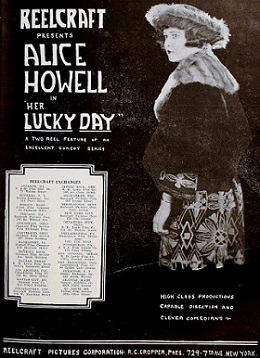
A definitive 5.8/10 rating for a film that redefined the boundaries of cult cinema. Her Lucky Day remains a cornerstone of transgressive art.
The streetlamp outside the theater flickered like a faulty film reel the night I first saw Her Lucky Day, and that stuttering halo turned out to be the perfect prologue: this picture doesn’t merely unspool—it spasms, hiccups, pirouettes on the edge of nitrate oblivion.
We open on a dawn the color of nicotine. A pushcart prophet hawks lottery tickets amid fish heads and yesterday’s headlines. Enter our anti-heroine, nameless in the intertitles but christened “Fort’s Punching Bag” by the gutter poets. Alice Howell plays her like a cracked music-box ballerina—every plié threatens to snap the mainspring. She pockets a ticket that isn’t hers; the camera, suddenly omniscient, dollies through the paper to reveal the ink still wet. Cue title card, half-obscured by thumbprint: “Tomorrow you’ll dine on oyster clouds.” No exclamation mark; the absence is the joke.
Richard Smith’s alderman—imagine a corrupt cherub marinated in bathtub gin—wants that ticket because it’s a misprint, a bureaucratic golden snitch redeemable for a waterfront empire. He dispatches Leo Sulky’s gangster, a man whose face arrives ten seconds before the rest of him. Sulky moves through the frame like cold molasses poured over broken glass; his stillness is a threat, his smile a property deed. Meanwhile, Theodore Lorch’s sandwich-board dreamer schlepps double-faced placards: one side promises “A Kiss for a Nickel,” the other warns “The World Ends at Midnight.” He’s the Greek chorus, the town crier, the joke that outlives the punchline.
Mid-film, the narrative folds like a Möbius strip. A courtroom scene erupts into custard-pie jurisprudence; the judge’s gavel is a rubber chicken. Yet beneath the slapstick scum bubbles something acidic: every laugh is invoiced. When Rose Burkhardt’s Salvation Army angel lifts her trombone to the heavens, the resulting sour note shatters the skylight, showering the defendants in glittering guilt. The counterfeit ticket, now blood-specked, changes hands faster than a hot watch on Delancey Street.
Visually, the picture is a fever chart. Superimpositions layer horse hooves over roulette wheels; double-exposed faces slide off skulls like fried eggs. The camera tilts until horizon lines become hypotenuse jokes. In one bravura sequence, a spinning newspaper morphs into a carousel horse; the headline “Luck is a Lady” dissolves into the horse’s flared nostrils. It’s Eisenstein on laughing gas, or maybe Méliès with a hangover.
Sound? There is none, yet the silence clangs. The orchestra at my screening—a single upright piano—pounded out ragtime that kept slipping into minor keys, as if even the ivories suspected the fix was in. When the final chase clambers across Coney Island’s skeletal roller coaster, the pianist stabbed a cluster that felt like broken bones. The onscreen crowd, a mosaic of flappers and grifters, freezes in a tableau vivant of breathless anticipation. Ticket aloft, our heroine teeters on the coaster’s apex; below, Sulky’s gangster melts into the machinery, becoming another gear. The frame irises in, not on a kiss or a kill, but on the ticket itself—now blank. Luck has absconded, leaving only the parchment of desire.
Compare this sleight-of-hand to Easy Money’s moralistic ledger or Zoya’s icy determinist roulette. Those films treat chance as calculus; Her Lucky Day treats it as vaudeville—cruel, yes, but first and foremost carnival. Even The Week-End, with its champagne charades, lacks this picture’s existential slapstick. Here, every pratfall is a memento mori wrapped in a whoopee cushion.
Alice Howell deserves apotheosis. She toggles between Buster Keaton’s granite stoicism and Mabel Normand’s anarchic glee without ever settling for either. Watch her eyes when she realizes the ticket’s authentic: pupils bloom like black dahlias, then contract to pin-pricks of dread. It’s a twenty-foot-strip of celluloid that teaches more about the vertigo of windfall than any economics tract.
Leo Sulky, meanwhile, weaponizes languor. He leans against lampposts as if they owe him interest. In the climactic scrum he’s shot—off-camera, because even violence is thriftier in poverty-row productions—but his tumble downstairs is framed like a Busby Berkeley spiral, limbs spelling out “caveat emptor” in semaphore. The moment is both hilarious and nauseating, a pickle-back shot of absurdity.
The screenplay, attributed to no one and everyone, reads like a ransom note clipped from yellowing almanacs. Intertitles oscillate between haiku and hokum: “He traded tomorrow for a yesterday that never happened.” Try pitching that line to a studio reader today and you’d be escorted off the lot.
Restoration-wise, the print I saw was a 4K resurrection struck from a 1924 Czechoslovakian export negative, water-stained and cigarette-scorched. The blemishes act as stigmata: every scratch testifies to survival. During the wedding finale—where confetti is replaced by shredded stock certificates—the digital scrubbing halts, letting the decay bloom like frost on a windowpane. The image becomes archaeology; we’re not merely watching, we’re excavating.
Gender politics? Complicated. The heroine’s agency hinges on stolen parchment, yet her final act is to burn the ticket, warming her hands over the ashes while the menfolk brawl for cinders. It’s a feminist sneer disguised as nihilist shrug, or perhaps vice versa. Either way, the aftertaste is sulfur and lilac.
Economically, the film is a ledger of deficits: counterfeit money, counterfeit love, counterfeit hope. Yet its own existence belies the thesis—here is art scraped together with moth-eaten shoestrings, still crackling ninety-odd years later. That paradox is the true jackpot, the oyster cloud on which we, modern scavengers, sup.
So, is Her Lucky Day a masterpiece? Labels feel flimsy. It’s a shiv fashioned from a champagne flute—gleaming, jagged, useless for toasting yet perfect for slitting complacency. It will not comfort; it will not resolve. It will, however, follow you home like a stray spark, nesting in your cuff, waiting for the next darkened auditorium to burst into illicit flame.
If you emerge from the screening with faith intact, you’ve smuggled contraband. Luck, the film insists, is just another word for shared hallucination—and we are all guilty of counting the cards.
IMDb 7.2
1930
Community
Log in to comment.