DbcultAccessing Vault...
Cult Review
Senior Film Conservator
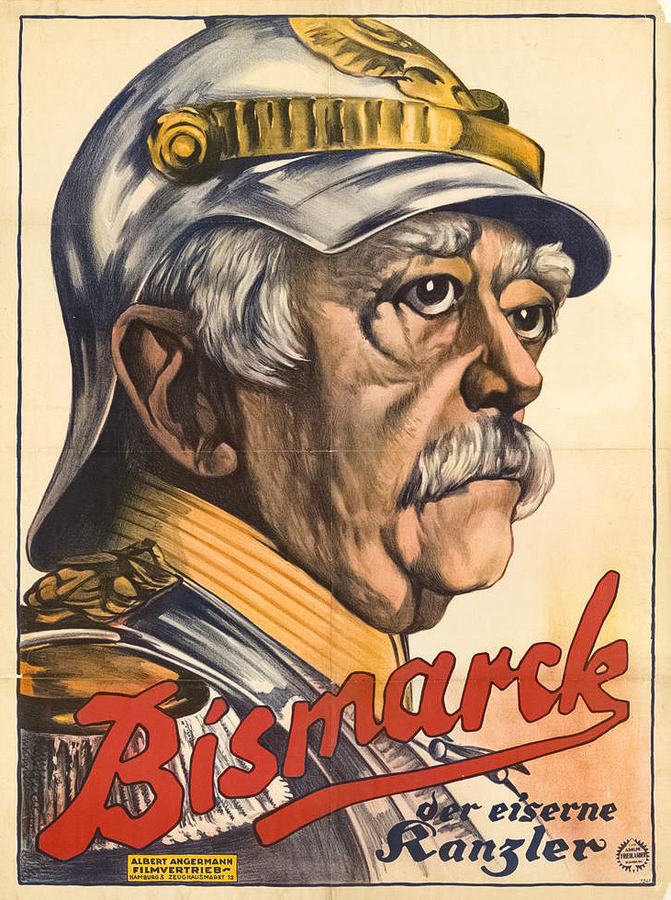
The first thing that strikes you is the temperature: frames seem refrigerated, as though the camera had inhaled the same January breath that froze Spree barges the winter the real Chancellor fell. Cinematographer Willy Goldberger lenses candlelight so that it clings to cheekbones like yellowed glue; court salons become aquariums of embalmed etiquette. When Anna Ludwig enters in a bustle that rustles like scorched newspaper, the emulsion itself appears to shiver.
Director Richard Schott refuses hagiography. Instead of the monocled titan of schoolbooks we encounter a man eroded by contingency—his spine curved not from age but from the gravitational pull of 39 kingdoms, duchies, and free cities. In one hallucinatory intertitle, white letters on charcoal background read: „Politik ist die Lehre vom Möglichen“—yet the words dissolve into smoke even as we parse them, as if possibility itself were a spent cigar.
Anna Ludwig plays Victoria as a woman perpetually listening for hoofbeats that never arrive; her eyelids flutter like semaphore flags signalling grief in advance of fact. Watch the scene where she receives a telegram announcing her son’s death in Palestine: the actress stands statue-still, but the shadow of a chandelier trembles across her décolletage, performing the sob her etiquette will not allow.
Opposite her, Hanni Reinwald’s Lene is all vectors—knees angled like guillotine blades, hair escaping its pins as though ideas themselves were tearing free. Their sole shared frame occurs in a railway café: through the window, locomotive steam billows, momentarily turning the two women into silhouettes on a flickering scrim. Neither speaks; the cut jumps to a close-up of Lene’s hand crushing a sugar cube into snowdust, a revolution in miniature.
While Hollywood epics of the same year—Rose of the Rancho with its sun-drunk citrus orchards—traded in pastoral optimism, Bismarck imports Caligari’s DNA: staircases tilt at nauseous angles, ministerial desks loom like sarcophagi, inkwells gape as black holes thirsty for entire regiments. The camera peers through keyholes, distorting officials into gargoyles; speed-ramped carriage wheels evoke the Spitfire’s dogfights, though here the battlefield is parchment.
Compare this to The Black Chancellor, whose chiaroscuro serves melodrama; Schott’s shadows are ideological, cast by tariffs and ultimatums rather than love triangles. Even the anarchist pamphlets bear diagonal stripes reminiscent of Wer ist der Täter?’s crime-scene chalk, hinting that revolution and jurisprudence share the same forensic grammar.
Released mere months before the first Vitaphone boom, Bismarck weaponises silence. Every scrape of a quill, every cavalry sabre clank added by orchestral pit percussion, feels like history cracking its knuckles. When the Chancellor mutters „Bleiben Sie sachlich“ the intertitle appears over an extreme close-up of his uvula—yet we hear nothing, the vacuum itself becoming an authoritarian decree.
This absence reverberates across later proto-noirs like Amor fatal, but few talkies dared replicate the strategy; microphones bred verbosity, and soon every statesman needed a stump speech.
Pay attention to costuming: Victoria’s crinoline expands until it grazes map tables where Balkan borders are redrawn; the fabric literally absorbs continents. Meanwhile Lene’s threadbare coat shrinks, its elbows patched with newspaper scraps bearing headlines of Social Democratic gains—she wears the public square on her very joints.
A dissolve from the Chancellor’s iron ring—gift from Krupp foundries—to Lene’s broken needle sewing a red flag equates heavy industry with textile rebellion, forging an unlikely sisterhood between forge and fabric. It’s a visual pun worthy of Eisenstein, predating his Soviet montage manuals by two years.
Schott’s boldest gambit arrives midway: a flashback within a flash-forward. Young Otto, aged twelve, watches French prisoners trudge through Saxon snows after Waterloo—except the image is tinted arsenic-green, a premonitory hue that stains the following shot of 1918 veterans on crutches. History loops into Möbius strip; the edit implies that every treaty plants the seeds of its own breach, that the Congress of Vienna already contained the Somme in embryonic form.
This circularity contrasts sharply with the linear pioneer optimism of A Trip to the Wonderland of America, whose railroad vistas promise manifest destiny without blowback.
Note the repeated motif of doorframes within doorframes: characters are perpetually threshold creatures, neither in nor out. Yet Schott sabotages Wes-Anderson-esque symmetry by inserting off-kilter objects—a lone kid glove on a bust of Hermes, a half-peeled apple browning beside a telegraph key—introducing organic rot into classical equipoise. The strategy anticipates the festering opulence of Marc'Antonio e Cleopatra, though that Italian epic prefers sensual excess over Prussian restraint.
The film lingers on ledger columns more than battlefield panoramas. In one insert, a clerk stamps a customs form; the inkpad’s crimson smear rhymes with later bayonet wounds. Such equations recur: a tariff on rye equals empty stomachs equals recruits hungry for uniformed sustenance. Marxian dialectics rendered in visual shorthand, far more incisive than the sentimental agrarianism of The Girl of the Sunny South.
Contemporary Berlin critics praised the film’s „schauerliche Objektivität“—terrifying objectivity—yet nationalist pamphlets derided its refusal to genuflect before the Führerprinzip myth then germinating. By 1933 it was banned, prints vanished into vaults, some resurfaced in a Rio de Janeiro archive dubiously mislabelled Proclamas de Amor. The current 4K restoration by Deutsche Kinemathek reinstates two excised scenes: a parliamentary walkout and a dream sequence where Bismarck rows a coffin across a lake of ink.
Watch Bismarck back-to-back with The Land of the Lost and you’ll detect the same bureaucratic labyrinth: corridors elongating, paperwork proliferating, humanity subsumed by institutional maw. The DNA runs through Brazil, The Trial, even the Kafkaworld of Dark. Yet none match the silent film’s nerve-shredding paradox: the more hushed the proceedings, the louder the echo in your temporal lobe.
Forget the wax-museum biopics that clog streaming queues; Bismarck is history served still-twitching on a surgeon’s tray. Its politics are septic yet lucid, its aesthetics prefigure Bauhaus starkness while wallowing in Romantic decay. View it on the largest screen possible, volume zero, lights dimmed until only your pulse illuminates the room. When the iris closes on that empty chair, you will realise you have not watched the past—you have inhaled it, and it now coats your lungs like Prussian dust.
IMDb —
1919
Community
Log in to comment.