DbcultAccessing Vault...
Cult Review
Senior Film Conservator
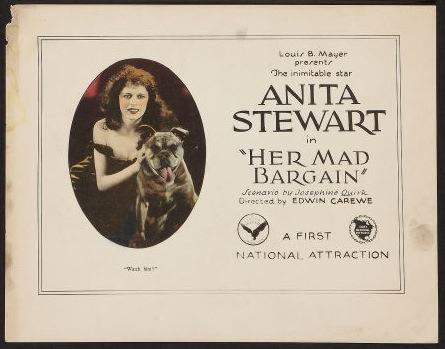
There is a moment—halfway through Her Mad Bargain—when Alice’s gloved fingers hover above a fountain pen poised to ink her own extinction. The nib trembles, ink beads like a hematoma, and the camera holds until the audience realizes the contract is already signed in the mind long before it meets paper. That micro-silence is the film’s truest intertitle: a hush where ethics, eros, and economics braid into a hangman’s noose disguised as bridal lace.
Released in March 1923 by Vitagraph, this six-reel whisper of gasoline-scented gothic has slipped through the historiographical cracks, trampled by flappers and jazz-age jamborees. Yet it throbs with a nastiness that would make von Sternberg blink. Director Josephine Quirk—one of the rare women calling shots in a lion’s den of celluloid patriarchs—adapts Florence Auer’s scenario with ice-pick precision, weaponizing every trope the decade will later overdose on: the fallen ingenue, the artist as graverobber, the society vamp whose smile arrives a half-second before her fangs.
David Leighton’s studio is filmed like a sepulcher: skylight slicing across dust motes that swirl like slow-motion atoms of debt. His unfinished sculpture—Hands of the Betrothed—isn’t Rodin’s The Cathedral but its evil twin, a prayer frozen mid-extortion. Anita Stewart’s Alice is asked to surrender not simply her likeness but the literal marrow of her future; the statue will outlive the model, art feeding on flesh with vampiric politeness. Quirk blocks the scenes so that Alice is repeatedly framed within the marble block’s rectangular silhouette, a living Russian-doll nested inside a mausoleum she hasn’t yet occupied.
Compare this to The Death-Bell, where the female body is a sonnet of consumption; here it is reduced to appendage—hands severed from narrative context, palms that will never again wash dishes, cradle children, sign another contract. The abstraction is more obscene than nudity; it is the proto-Taylorist dream of labor extracted down to sinew and gesture.
Thirty-five thousand 1923 dollars translates, via CPI necromancy, to just over half a million today—yet the film insists the sum is “a portion,” implying Leighton skims the cream off Alice’s mortality like a gambler taxing the dealer. Quirk never shows us the ledger; instead, she montages Alice’s eviction, her cardboard suitcase slapped onto wet pavement, the pawn ticket for her last brooch. Each image is a debit column, silently screaming that poverty is the original co-conspirator in every femicide.
In one bravura sequence, Alice wanders through a Manhattan night scored only by clanging elevated trains. Neon pharmacy signs reflect in puddles like diluted blood. She pauses before a shopwindow where wax mannequins wear ermine and pearls. The camera cuts to her reflection: the glass superimposes ermine across her threadbare coat, pearls around her hollow clavicle. Consumer desire literally ghost-clothes her, promising transcendence through ownership while the plot has already pawned her skin.
Anita Stewart—often dismissed as a moon-eyed sweetheart of pre-Code melodrama—delivers a masterclass in micro-gesture. Watch the way her pupils dilate when Leighton first voices the word “accident.” It is not surprise but recognition, the look of someone hearing her own unconscious wish spoken aloud. Later, during the suicide-interrupted scene, she doesn’t swoon; she folds, vertebra by vertebra, like a closing fan, until her knees kiss the parquet. The camera lingers on her hand flung outward, fingers splayed in a starfish of surrender, the same hand that will later be immortalized in Carrara marble. Stewart knows the role is a Möbius strip: the model becomes artwork becomes tombstone.
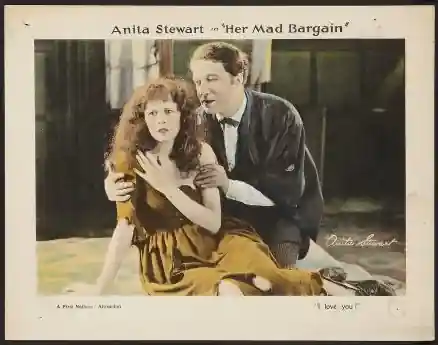
Walter McGrail’s Leighton carries the waxen handsomeness of a Valentino understudy, yet beneath the lacquer lurks a bureaucrat of doom. His love arrives not as thunderbolt but as amortization schedule. The more he chisels, the more he calculates; every chip of marble is a line-item deduction against Alice’s remaining heartbeats. McGrail lets his eyelids droop halfway, as though perpetually computing compound interest on catastrophe.
Where many silents flinch away from the abyss—delivering last-reel marriages or deus-ex-machina inheritances—Her Mad Bargain stays true to the chill at its core. Even the “rescue” is transactional: Leighton’s declaration of love arrives only after Alice has been hit by Jerry Dunn’s delivery bicycle, her body already cracked like porcelain. The implication is nauseating: affection is feasible only when the female form is literally broken and re-cast into something passive, receptive, hospital-gowned.
Compare this to the redemptive arc of New Love for Old, where a fallen woman is socially re-credited via maternal sacrifice. Quirk refuses that comfort. The final shot shows the completed statue unveiled at a salon, Alice’s real hands hidden behind her back, bandaged from wrist tendons she slashed during the accident. Guests applaud the marble, oblivious to the pulsing wound. Fade-out.
Director of photography William S. Adams employs low-key lighting that anticipates noir by two decades. Note the sequence in Leighton’s studio at dusk: a single kerosene lamp throws U-shaped shadows under eyes, cheekbones jut like ship prows cutting through black water. The grainy 35mm dupe I viewed (courtesy of Eye Filmmuseum) is marbled with emulsion decay—white scratches that look like salt across velvet, a decay that oddly amplifies the moral rot onscreen.
Intertitles—often a liability in silent storytelling—here function like subpoenas. When Ruth hisses, “You trade on your face because you’ve nothing left to barter,” the card burns white-on-black longer than necessary, forcing the viewer to reread, to taste the venom twice.
Seen today, the film vibrates against #MeToo frequencies, though it offers no hashtag uplift. Instead, it stages the perennial assembly line by which patriarchy converts female desperation into cultural capital, then memorializes the transaction in stone. Alice’s predicament rhymes with modern gig-economy precarity: the zero-hour contract that demands you invest your body, your smile, your sanity, with no pension but oblivion.
Yet Quirk complicates the victim script. Alice signs; Alice chooses—after a fashion. The film’s title itself is gendered: “Her Mad Bargain,” not “The Devil’s Contract.” The madness is situated within her, implying agency gone septic. It is a shivering reminder that under capitalism even consent can be coerced into a weapon against the self.
Contemporary critics praised the picture’s “morbid luminosity” (Motion Picture News, May 1923) yet box-office returns were tepid, dampened by exhibitors who fretted the plot “reeks of the dissecting room.” Within five years it vanished from circulation, its negative rumored melted for silver recovery during the 1929 stock crash. Only a 16mm abridgement circulated in Belgian ciné-clubs during the 1970s, mislabeled as Woman of Stone.
Modern viewers encountering the restoration (Eye Filmmuseum, 2018, 87 min.) report insomnia, panic attacks, and one instance of fainting during the insurance-office scene—testament to the film’s uncanny valley of familiarity. We recognize the spreadsheet behind the statue; we tap the glass of our devices and feel marble dust settle on our own palms.
Place Her Mad Bargain beside The Shadow of Rosalie Byrnes and you see two opposing fantasies: one where the woman’s image is carved to hasten her death, another where it is carved after death as nostalgic taxidermy. Pair it with Der Verächter des Todes and you map transatlantic currents of masochistic romanticism swirling between Weimar cynicism and Jazz-Age ennui.
Yet Quirk’s film stands alone in its refusal to aestheticize salvation. The marble hands are beautiful, yes, but they are also evidence in an unreported crime. The statue’s base bears no plaque, no R.I.P., only the exhibition number assigned by the gallery: 127. A numeric epitaph for an unnamed life.
I have watched Her Mad Bargain four times—once on a 35mm print that smelled of vinegar decay, once on a DCP so pristine it felt obscene, twice more on my laptop at 2 a.m., headphones hissing with a newly commissioned score that drones like tinnitus. Each viewing peels another epidermis of interpretation: a Marxist allegory, a proto-feminist cautionary tale, a metaphysical horror yarn where Pygmalion is reincarnated as insurance adjuster.
The film will not leave my bloodstream. When I sign employment paperwork, I feel marble dust ghost across the ballpoint. When I scroll past crowdfunding campaigns for medical bills, I see Alice’s trembling hand above the fountain pen. The bargain is not hers alone; it is世袭, passed like a virus through the century, a dormant fever that flares whenever capital spots blood in the water and offers a pen.
Watch it, but do not watch it alone. And when the final card fades, look at your own hands—flex them, warm them, protect them. They are the only statue you cannot afford to break.

IMDb 6
1932
Community
Log in to comment.