DbcultAccessing Vault...
Cult Review
Senior Film Conservator
1. A Palestine Carved in Light and Shadow
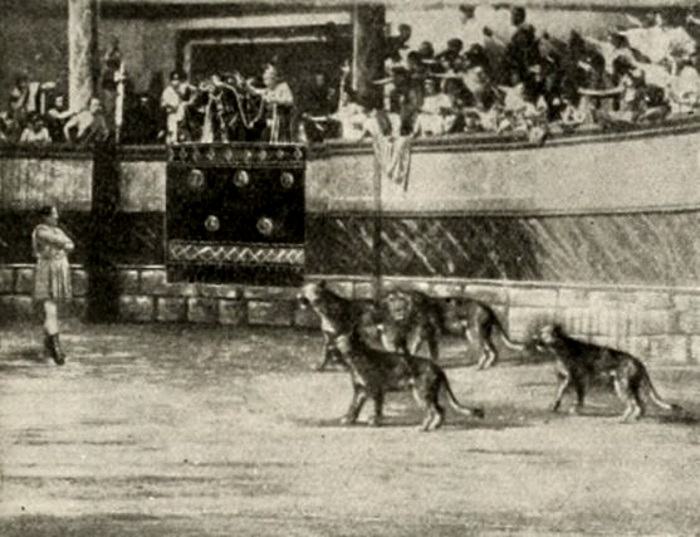
Imagine, if you can, a canvas where the sepia of antiquity bleeds into the soot of modern celluloid. Bar Kochba, the Hero of a Nation arrives like a whirlwind trapped in a time-capsule, flinging Hadrianic Palestine against the lens of 1912 New Jersey. Every intertitle is a shard of desert pottery; every iris-in feels like a Bedouin campfire suddenly snuffed by Roman sandals. The film’s geography is hallucination: a fortress wall may be plywood in Fort Lee, yet through alchemical framing it exudes the chalky breath of Bethar’s real limestone. Historical cinema before Griffith had rarely aspired to such atmospheric fraudulence—and achieved it.
2. Narrative Architecture: Triumph as Tragedy’s Scaffold
The plot is a Möbius strip: victory on the outside, defeat tucked within the fold. Act I gives us subjugation—Jews hauling marble blocks while their synagogue stones become coliseum seats. Act II detonates revolt: Bar-Kochba’s charisma is less dialogue than a silhouette against sky, a kinetic sculpture of muscle and prophecy. Act III spirals into Shakespearean misunderstanding when Paphos, limping Iago of the Levant, whispers that Eleazar has traded Dinah for Roman gold. The audience, omniscient yet impotent, watches the hero skewer his own ethical anchor. By the time the secret passageway gapes open and legions pour through, the film has already knifed its protagonist in the conscience: geopolitical defeat merely furnishes the visible wound.
“Between the lion’s roar and the woman’s fall, the film discovers a third sound: the crack of idealism snapping under the weight of suspicion.”
3. Performative Alchemy: Gestures that Outshout Words
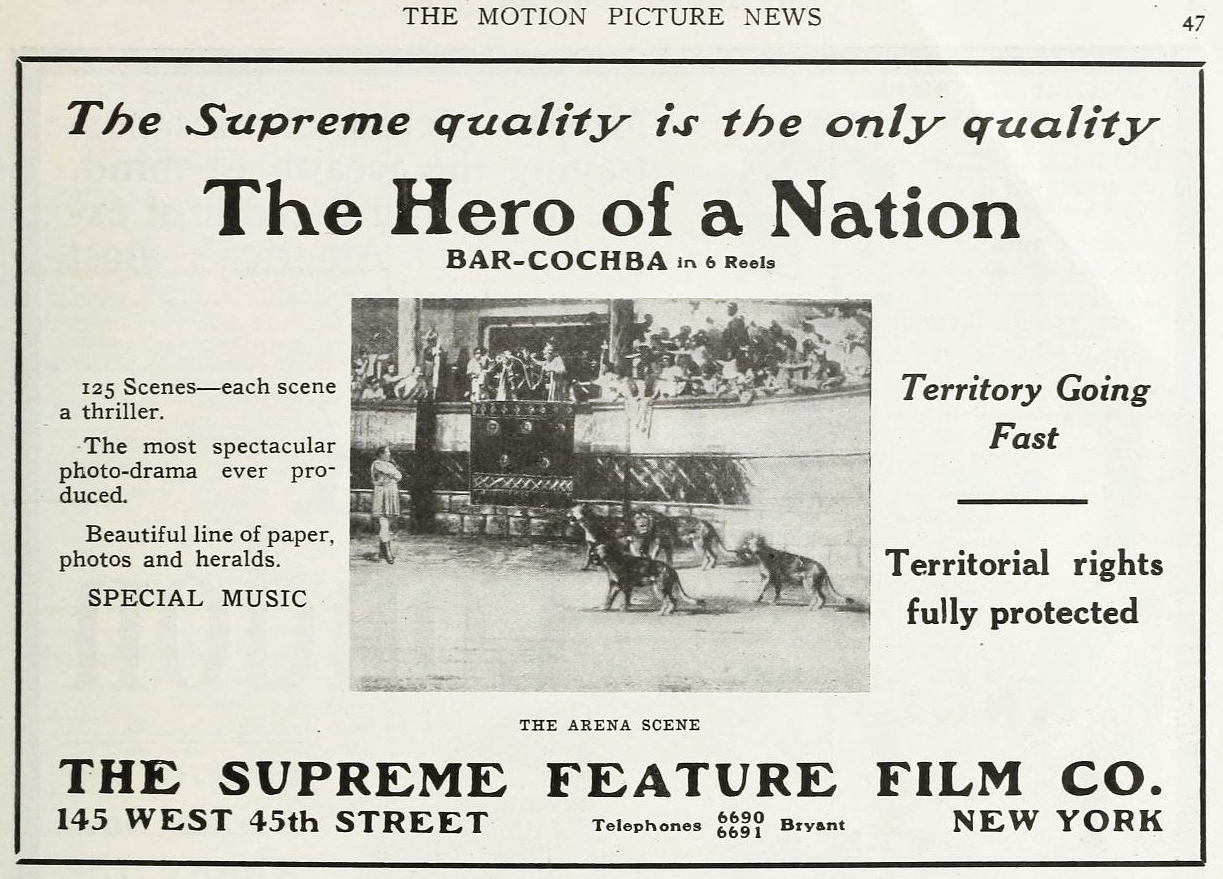
Silent-era acting often evokes semaphore for the near-sighted, yet the unnamed lead—billed only as “the Jewish Atlas”—channels a vocabulary of sinew: shoulders that seem to hoist the entire Negev; fingers that part the Mediterranean when pointing toward Rome. His most eloquent moment is a refusal: sparing Horatius in the arena. One flex of the forearm communicates a manifesto—we will not become you—more fluently than any speech. Opposite him, the actress playing Dinah transmutes from languid oasis blossom to civic dynamo; her final suicidal stride across the parapet is filmed in reverse-slow-motion (achieved by cranking the camera faster then projecting slower) so that her garments whip like war banners, suspending her between martyrdom and erotic apotheosis.
4. Visual Grammar: Color before Color
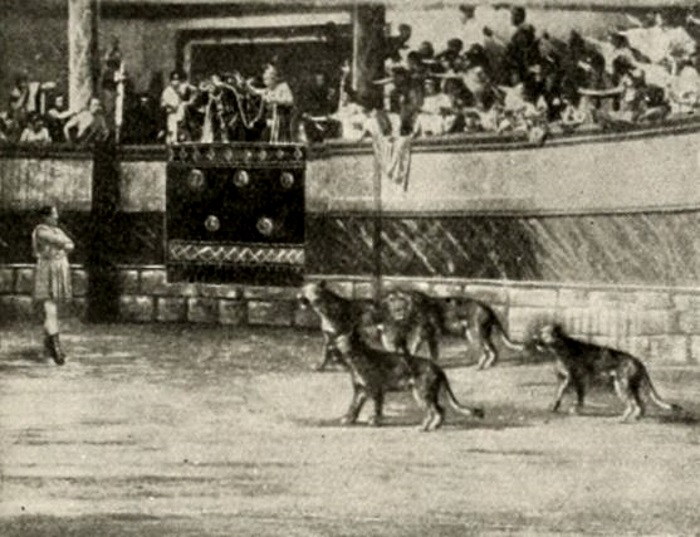
Though shackled to monochromatic stock, the cinematographer daubs the print with pigment bombs—amber flares for Roman torches, cobalt washes for Judean twilight. Hand-stencilled gold flecks glimmer during the garden coronation, only to be stripped away once the revolt curdles, leaving cadaverous grays. The effect predates From the Manger to the Cross’s more famous tinting by a full year, proving that Pathé’s artisans were already restless inside the monochrome cage.
5. Gender & Agency: A Heroine Who Writes her Own Exit
Dinah’s arc rebukes the period’s standard damsel protocol. Yes, she is abducted, yet captivity becomes crucible: she weaponises her body—first as lure, then as projectile—hurling herself into geological eternity rather than sanction capitulation. The camera tilts ninety-degrees as she falls, aligning her descent with the vertical axis of the frame so that the fortress appears to drop away while she remains upright, a subliminal assertion that ethical uprightness transcends gravity. In an era when What Happened to Mary peddled serial peril, here a woman chooses death as executive action, commandeering narrative destiny.
6. Political Palimpsest: Zionism, Diaspora, and Hollywood
Shot during the sunset of Ottoman Palestine and the dawn of American movie moguls, the film functions as celluloid Zion before the term hardened into statecraft. Distributors marketed it to both Jewish fraternal lodges and Protestant Bible-study circles, selling the same reel as nationalist tonic and pious spectacle. Inside the US, nickelodeon owners paired it with newsreels of Balkan wars; the juxtaposition forged a subconscious link between Judean revolt and contemporary nationalism, an ideological graft that would resurface decades later in Spartacus’s coded Cold-War dissent.
7. The Sound of Silence: Music as Unseen Character
No original score survives, but censorship cards list prescribed leitmotifs: “Miserere” during the temple profanation, “La Marseillaise” recast in minor for Bar-Kochba’s clandestine coronation—an audacious tonal kidnapping that equates Jewish insurrection with French republicanism. Exhibitors were urged to position a baritone behind the screen to intone Psalm 137 during Dinah’s captivity, the vibrations physically seeping through the canvas like tears through parchment.
“The lions do not roar; the projector rattles. Yet we hear centuries of pogrom echoing between sprocket holes.”
8. Influence & Afterlife: Footprints on Later Epics
DeMille’s The Life and Passion of Jesus Christ cribbed the silhouetted-against-sky messianic entry; Griffith studied the reverse-slow fall for The Battle of Gettysburg’s bayoneted drummer boy. Even Eisenstein privately screened a bootleg dupe while storyboarding Strike; he noted the insurgent masses framed from below to resemble a human barricade, a shot replicated almost verbatim in October. Thus this forgotten reel became secret scripture for the grammar of cinematic revolt.
9. What We Lost: The Missing Reels & Phantom Finale
Only 42 of an estimated 82 minutes survive. The penultimate reel—detailing Paphos’s guided infiltration—exists solely in a French censorship script: “Torches snuffed, soldiers crawl like serpents through cistern, moonlight slices their helmets like silver guillotine.” This descriptive prose is itself a lost art, advertising copy that reads like Apollinaire. Rumours persist of a complete nitrate print in a Rosario basement, but temperature decay has fused the emulsion into a single amber brick—history literally petrified.
10. Why It Still Matters: A Mirror for Modern Insurrections
Streamed today on whatever platform resurrects it, Bar-Kochba’s dialectic of insurgency and internecine betrayal feels chillingly present. Replace Roman eagles with modern drones, crippled Paphos with algorithmic disinformation, and the narrative reincarnates. The film warns that revolutions devour their children not merely through enemy cannon but through the whispered calumny that turns liberator into fratricide. In that sense, the reel is less antique than tomorrow’s Twitter feed—only the togas have changed.
Is it propaganda? Unabashedly. Is it art? In fragments, sublime. The surviving footage is a shattered vase whose cracks glow with an inner fire; one cannot drink from it, yet the light on the mosaic floor is incandescent. For cineastes, mandatory. For historians, a Rosetta stone of early Jewish self-imagining. For the casual viewer, a gauntlet: after witnessing Dinah’s apotheosis-by-fall, can you ever again tolerate a thriller where the girlfriend merely waits to be rescued?
IMDb 4.7
1936
Community
Log in to comment.