DbcultAccessing Vault...
Cult Review
Senior Film Conservator
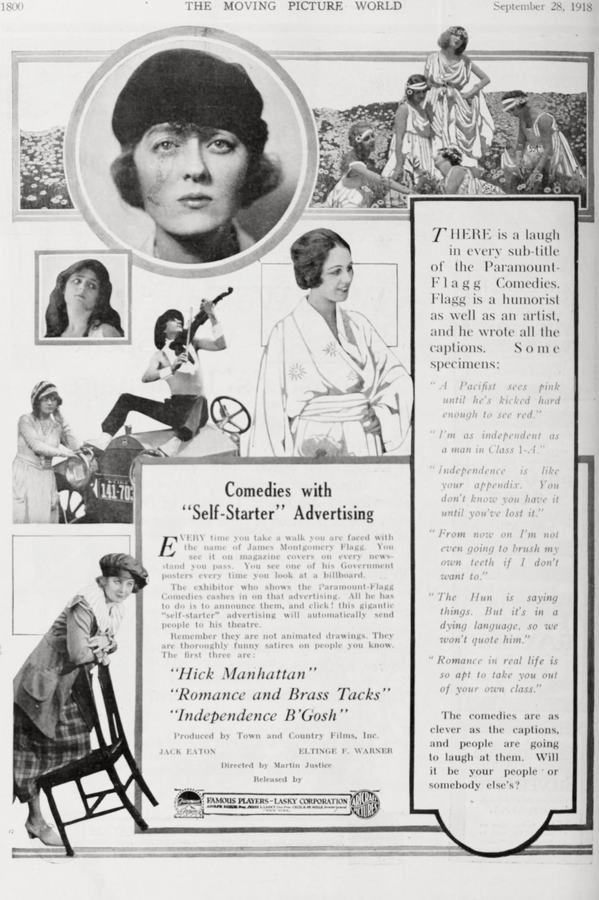
In the annals of silent cinema, where grand gestures and melodramatic arcs often held sway, Hick Manhattan emerges as a surprisingly prescient commentary on the mechanisms of fame, artifice, and the sheer audacity of human ambition. It's a delightful, if cynical, romp through the burgeoning media landscape of its era, charting a course from destitution to dazzling celebrity through a series of events so improbable they could only be true in the realm of early Hollywood. The film, penned by the insightful James Montgomery Flagg, a man whose artistic eye extended beyond illustration to the very fabric of popular culture, captures a moment when the line between genuine talent and manufactured spectacle was gloriously, and profitably, blurred.
The narrative's genesis is rooted in a familiar tableau of urban struggle. We are introduced to a young woman, whose name, for much of the initial machinations, seems secondary to her circumstances. She finds herself abruptly dispossessed of her employment, a common enough plight in the unforgiving metropolis. Her world, already teetering, is then quite literally set ablaze as a fire engulfs her lodgings. This sudden, visceral displacement flings her onto the bustling thoroughfare in a state of profound dishabille, a raw, unvarnished vision of vulnerability amidst the indifferent churn of city life. This moment, however, is not merely a tragedy; it is the crucial pivot, the serendipitous alignment of misfortune and opportunity that sets the entire audacious plot into motion. It is here that the film, even without spoken dialogue, whispers a truth about the spectacular nature of human hardship when viewed through a certain lens.
Enter our male protagonist, a young man whose artistic aspirations as a photographer have, thus far, been met with a resounding lack of success. He is the quintessential struggling artist, adrift in a city that rewards notoriety as much as, if not more than, genuine talent. His encounter with the disheveled woman is less a chance meeting and more an epiphany. In her exposed vulnerability, he sees not merely a victim, but a canvas, a muse, a potential goldmine. This isn't the romanticized vision of an artist discovering beauty; it's a shrewd, almost predatory, assessment of market potential. He immediately conjures visions of a fortune, a grand scheme born of desperation and an acute understanding of public fascination. This cynical yet brilliant stroke of entrepreneurial artistry forms the core of the film's commentary on the nascent culture of celebrity.
The proposal he extends to her is audacious: to shed her identity as an unfortunate, unemployed woman and embrace the persona of a 'wild Greek girl.' This transformation is not about uncovering her true self, but about fabricating an alluring, exotic otherness designed to capture the public imagination. It's a masterclass in branding, long before the term became ubiquitous. The choice of 'Greek girl' is particularly telling, tapping into a prevailing fascination with classical antiquity and exoticism, but stripping it down to a raw, untamed essence. Peggy Hopkins Joyce, known for her vibrant personality and captivating screen presence, would have been an ideal choice for embodying this dual role, lending both vulnerability and a certain theatrical flair to the character. Her ability to convey this metamorphosis, from a woman in distress to a captivating enigma, would have been central to the film's success, relying on the visual storytelling prowess inherent to the silent era.
The photographer's plan unfolds with a calculated precision that is both shocking and ingenious. He orchestrates her arrest for performing 'Grecian dances' in the street in her scanty attire. This isn't an act of malice, but a strategic move designed to generate maximum publicity. The scandal, the perceived impropriety, the sheer audacity of the public display – these are the ingredients for a media firestorm. The legal system, far from being a deterrent, becomes an unwitting accomplice in the elevation of this manufactured celebrity. One might draw a conceptual parallel to the cunning of antagonists in serials like Fantomas: The Mysterious Finger Print or Zigomar contre Nick Carter, where grand schemes are executed with audacious precision, though here, the 'crime' is merely a theatrical stunt for public consumption. The genius lies in understanding that controversy, even fabricated, sells newspapers and captivates a public hungry for novelty.
Following her release, the stage is set for the second act of this grand performance. Her appearance in a prominent restaurant is not a quiet meal but a meticulously planned event, designed to cause a sensation. And sensation she causes. The details of this scene, though perhaps lost to time, would have relied on the expressive power of silent film acting and the reactions of the extras to convey the ripple effect of her presence. The whispers, the stares, the palpable shift in the room's atmosphere would have built to a crescendo, cementing her status as an intriguing, perhaps scandalous, figure. This rapid ascent from obscurity to notoriety is a theme that resonates across cinematic history, often explored in films about ambition and social climbing, such as The Love Thief, which similarly delves into characters navigating complex social landscapes for personal gain.
By the next day, the meticulously crafted charade has paid off handsomely. The city's newspapers are ablaze with headlines, heralding the arrival of this mysterious 'wild Greek girl.' The power of the press, even in its nascent tabloid form, is showcased as an unstoppable engine of celebrity creation. The public, fed a carefully curated narrative, devours every detail, transforming a staged event into a cultural phenomenon. This rapid dissemination of information and the subsequent public frenzy highlight a timeless aspect of media: its ability to shape perception and dictate trends. The triumph of the photographer is complete: he successfully secures a lucrative contract for his 'star' at a substantial salary, validating his artistic vision not through traditional merit, but through sheer, unadulterated spectacle. This cynical yet effective manipulation of public opinion makes Hick Manhattan a fascinating precursor to contemporary discussions about viral marketing and manufactured fame.
The film, through its audacious plot, subtly critiques the very foundations of artistic success and societal acceptance. Is the 'art' of the photographer truly about capturing beauty, or is it about creating a marketable product? Does the woman's transformation into a 'wild Greek girl' elevate her, or merely exploit her? These questions, though perhaps not explicitly answered, linger long after the credits roll. The dynamic between Olin Howland's character (the photographer) and Peggy Hopkins Joyce's character (the woman) is central to this exploration. Howland, a seasoned character actor, would have brought a nuanced blend of desperation and cunning to his role, while Joyce, with her real-life reputation as a socialite and a figure of public fascination, would have embodied the 'wild girl' persona with an almost meta-awareness, blurring the lines between actress and character.
Beyond the thrilling plot mechanics, Hick Manhattan delves into profound themes relevant to its era and ours. The concept of transformation, both forced and embraced, is paramount. The woman is stripped of her old life, then given a new, albeit artificial, identity. This fluidity of self, particularly in the bustling anonymity of a city like Manhattan, is a recurring motif in cinema. The urban landscape itself becomes a character, a crucible where identities are forged and fortunes are made, often through unconventional means. This urban tapestry, vibrant with opportunity and fraught with peril, is a recurring motif in cinema, seen in the struggles and aspirations depicted in films such as The Dawn of Understanding, where individuals navigate complex social landscapes to find their place. The film, in its own way, is a testament to the American Dream, albeit one twisted by the forces of publicity and manufactured scandal.
The role of women in this narrative is also noteworthy. While she is initially a victim of circumstance, she quickly becomes an active, if guided, participant in her own rise to fame. Is she merely a pawn in the photographer's game, or does she find a form of agency within this fabricated persona? The film invites us to consider the complexities of female identity in a society that often dictated narrow roles. Her 'wild Greek girl' act, while a construct, is also a rebellion against the demure expectations of the time, allowing her a freedom of expression, however theatrical, that might otherwise have been denied. This exploration of identity and societal expectations can be seen in other contemporary films, such as Playthings or When We Were Twenty-One, which often explored the challenges and opportunities facing young women in a rapidly modernizing world.
As a product of the silent era, Hick Manhattan would have relied heavily on visual storytelling, exaggerated expressions, and the power of intertitles to convey its intricate plot and emotional beats. The presumed theatricality of the performances, common in the early days of cinema, would have perfectly suited the film's premise of a staged spectacle. The stark contrasts—between the woman's initial destitution and her eventual glamour, between the photographer's failure and his ultimate success—would have been visually striking, amplified by the black and white cinematography. The pacing, likely brisk and dynamic, would have mirrored the rapid-fire nature of the news cycle it depicts, drawing the audience into the whirlwind of events.
In retrospect, Hick Manhattan stands as more than just an entertaining silent film; it's a fascinating cultural artifact. It offers a window into an era grappling with the burgeoning power of mass media, the intoxicating allure of celebrity, and the increasingly blurred lines between reality and performance. The film's themes—of manufactured fame, the exploitation of vulnerability, and the cynical pursuit of success—remain remarkably relevant even today. We continue to witness similar narratives unfold in our own hyper-connected world, where viral moments and carefully constructed personas can catapult individuals from obscurity to global recognition overnight. The film's brilliance lies not just in its engaging plot, but in its almost prophetic understanding of the human desire for spectacle and the lengths to which individuals will go to achieve, or create, it. It's a testament to the enduring power of storytelling, particularly when it holds a mirror up to society's more audacious tendencies.
While it might not share the epic scale of a Spartacus or the profound social commentary of a The Law That Failed, Hick Manhattan carves its own niche as a sharp, witty, and surprisingly modern take on the mechanics of fame. It reminds us that sometimes, the most successful art isn't about capturing truth, but about crafting a compelling illusion. A true gem that deserves to be rediscovered, not just for its historical value, but for its timeless insights into the human condition and the enduring allure of a well-played trick.
IMDb 5
1925
Community
Log in to comment.