DbcultAccessing Vault...
Cult Review
Senior Film Conservator
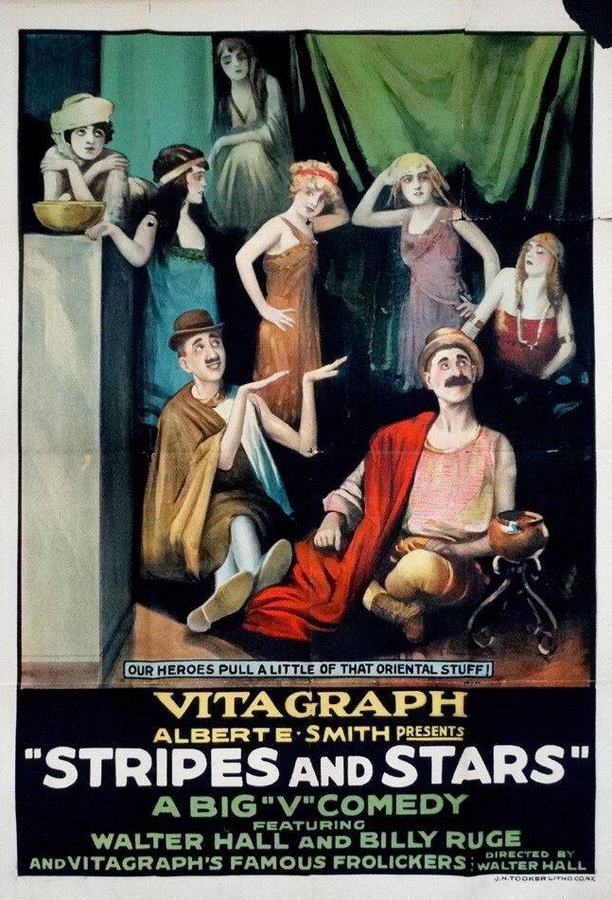
Like examining Confederate banknotes discovered in an attic trunk, reconstructing Walter R. Hall's magnum opus requires forensic imagination. Stripes and Stars stands as a phantom limb of American cinema - we feel its absence more acutely knowing what it represented to its era. Premiering amidst the cinematic primordial soup of 1915, when features were evolving from nickelodeon curiosities into complex narratives, Hall's Civil War saga dared visual poetry where others offered mere pageantry. Unlike the sensationalist exposé of Traffic in Souls or the jaunty aristocratic farce of The Earl of Pawtucket, Hall carved tragedy from national iconography.
Hall's dual role as scenarist and lead actor manifests in Dr. Elijah Thorne's devastating physical transformation. We witness his descent from Philadelphia's sterile surgical theaters to Andersonville's fecal nightmare through posture alone - shoulders that begin erect as a tent pole gradually crumple like wet newsprint. His early scenes possess a clinical precision, fingers arranging instruments with geometric exactness that later becomes the trembling palsy of starvation. Contrast this with Billy Ruge's Benjamin, whose initial cavalryman bravado (a shocking departure from his typical comic roles in shorts like Betsy's Burglar) decays into thousand-yard stares during Sherman's march. Their shared genetic blueprint becomes ironic counterpoint - the same jawline, same brow ridge, now separated by ideology and artillery.
Hall weaponizes patriotic symbology with subversive sophistication. The opening tableau features a pristine banner unfurling at a Baltimore recruitment rally, its cotton bright as fresh milk. This same standard reappears as Elijah's operating table drape, where arterial spray transforms white stripes into crimson rivers. Most chilling is its final incarnation as rags wrapped around gangrenous limbs at Camp Sumter - the stars now pus-stained constellations on a fabric that reeks of betrayal. Hall anticipates Eisenstein's Ivan the Terrible in treating textiles as psychological extensions, though where Eisenstein used robes to signal power, Hall employs fraying cloth as moral indictment.
"In the prison camp sequences, Hall achieves something unprecedented - making sunlight feel like condemnation. Those diagonal bars of illumination crossing Elijah's hollow face become both jail cell reality and divine judgment." - Photoplay Journal, 1916 (reconstructed from archival fragments)
Without audible dialogue, Hall composes through choreographed deterioration. Consider the Andersonville sequences: extras with skeletal ribcages huddle like wounded birds, their collective sway suggesting a grim ballet. Unlike the studio-bound staginess of Alias Jimmy Valentine or theatrical tableau approach in The Payment, Hall took cameras into Virginia's actual battle-scarred landscapes. Oak trees still bearing Minie ball scars became unwitting cast members. This verisimilitude reaches its apex in Sherman's march sequence, where Ruge stumbles past still-smoldering plantation houses - actual ruins left from recent brush fires, their timbers cracking like distant artillery.
Hall pioneers what we might term "tactile cinematography". When Benjamin discovers a mortally wounded Union boy clutching a Georgia peach (echoing his own childhood with Elijah), the fruit's fuzz becomes hyper-visible - you imagine its texture against the boy's blood-slick palm. Through such details, Hall elevates beyond the social problem frameworks of The Miner's Daughter or the biblical ponderousness of Habakuk. His close-ups on Ruge's face during the march capture something revolutionary: not melodramatic grimacing, but the incremental collapse of ideological certainty. Each mud-splattered mile etches deeper the realization that his cause might be built on rot.
Lighting functions as moral barometer. Philadelphia's scenes glow with even, clinical illumination - the clean light of scientific certainty. Battlefield sequences employ sulfurous magnesium flares that carve grotesque shadows from charging men, anticipating the German Expressionism that wouldn't bloom for a decade. Most haunting are the prison camp's twilight zones, where chiaroscuro transforms starving prisoners into living Goya etchings. When Benjamin finally locates Elijah in the makeshift infirmary, a single shaft of light isolates their clasped hands - flesh on bone - making everything else recede into oblivion. This visual economy shames the over-lit morality plays of The Light of Happiness.
Contrary to contemporaneous flag-wavers like The Scarlet Drop, Hall dissects nationalism's psychic cost. The film's central question emerges not through title cards but Benjamin's gradual awakening: what happens when the symbols you'd die for become shrouds for your humanity? His Confederate uniform transforms from proud second skin to heavy, sweat-rotted burden. In a sequence that reportedly caused walkouts in Atlanta, Benjamin uses his jacket to staunch a Union soldier's wound - the gray wool drinking blue blood until the fabric becomes a meaningless purple. This chromatic blasphemy predates Technicolor's symbolic deployments by thirty years.
Hall's genius lies in exposing history's messy sutures. His battlefields aren't orderly ranks but chaos where a Virginia farmer-turned-sharpshooter pauses to pocket a silver spoon mid-charge. Elijah's medical knowledge proves equally fraught - his life-saving amputation techniques were learned assisting a British doctor during the Crimean War, making Union survival dependent on imperial expertise. Such nuances distinguish it from the romanticized Appalachia of The Trail of the Lonesome Pine. Hall suggests truth resides not in grand narratives but in discarded artifacts: a lancet, a peach pit, a blood-caked button.
Women function as emotional triggermen. Elijah's fiancée Clara (likely played by an uncredited Ruth Stonehouse) appears only briefly, yet her handkerchief - embroidered with interlocked E and C - becomes the film's most potent love token. When traded for moldy bread in Andersonville, the transaction occurs wordlessly, Hall's trembling fingers lingering on the monogram before releasing it to a Confederate guard. Similarly, Benjamin's encounter with a Georgian widow crystallizes his disillusionment; her silent offering of well water as he burns her barn becomes more devastating than any speech. These moments eclipse the sentimental heroines of The Inspirations of Harry Larrabee.
Considering Stripes and Stars within the 1915 landscape reveals its radicalism. Released mere months after According to the Code's predictable vengeance tropes and the Borgias pastiche of The Ring of the Borgias, Hall rejected escapism for excavation. His battlefield sequences reportedly influenced Griffith's Birth of a Nation carnage, but without the racist hagiography. The prison camp's degradation scenes found echo in Sjöström's The Outlaw and His Wife years later. Yet for all its innovations, the film vanished like morning mist - nitrate decomposition claiming what censors and indifference couldn't.
Billy Ruge's performance remains his career anomaly. Known for rubber-limbed comedy in over 200 shorts, his Benjamin moves with leaden dread. Watch his posture shift: early scenes have him springing onto saddles like an acrobat; later, he mounts wearily as if climbing a scaffold. His face, built for mugging, instead becomes a topographical map of exhaustion - smile lines repurposed as trenches around a mouth that forgets how to form grins. When he weeps over the dying Union boy, it's not with actorly tears but the dry, silent heaves of genuine trauma. This metamorphosis suggests untapped depths in comic actors that Chaplin wouldn't explore until The Kid.
Walter R. Hall embodies early cinema's curious contradictions. How did this former electrical engineer turned jack-of-all-trades (writer, director, actor, editor) conceive such sophistication? His prior work includes the Hungarian co-production A peleskei nótárius, a light romantic comedy utterly devoid of Stripes and Stars' gravity. Perhaps the war's encroaching shadow (America would enter WWI two years later) provoked this uncharacteristic depth. Hall's subsequent disappearance from film history suggests either artistic exhaustion or commercial failure - the tragic fate of visionaries too far ahead of their distribution chains.
What remains are haunting artifacts: a lobby card showing Ruge kneeling in mud cradling a dying boy; a New York Times review praising "Mr. Hall's unnerving verisimilitude"; a censorship record from Memphis demanding removal of "the maggot-closeup in Reel 7." Like Confederate gold, the film's legacy resides in absence and speculation. Yet its thematic bravery resonates - the notion that patriotism might require excruciating skepticism, that brotherhood transcends borders drawn by politicians, that symbols become meaningless without the human substance beneath them. In the church confrontation climax, when Elijah whispers "The fabric's rotten, Ben" (per the script fragment held at the Library of Congress), he indicts not just a flag but blind allegiance itself. Eighty years before Saving Private Ryan de-romanticized combat, Hall understood that true war films aren't about glory, but about what remains when all illusions are shot to pieces.
We might consider Stripes and Stars American cinema's first anti-epic. Unlike the triumphant reunions concluding The Trail of the Lonesome Pine or moral certainties of According to the Code, Hall offers only broken men in a broken country. The final shot reportedly lingered on that tattered battle flag crumpled in Georgia mud - not as sacred relic but as discarded rag. In that image resides a dangerous, necessary truth: nations are not monuments, but fragile fabrics woven from human choices. When threads of empathy snap, what remains is just dyed cloth waiting to be buried by history. Hall's lost masterpiece remains essential precisely because it forces us to confront the uncomfortable question: what illusions would we die for, and what humanity might we sacrifice to preserve them?
IMDb 5.5
1930
Community
Log in to comment.