DbcultAccessing Vault...
Cult Review
Senior Film Conservator
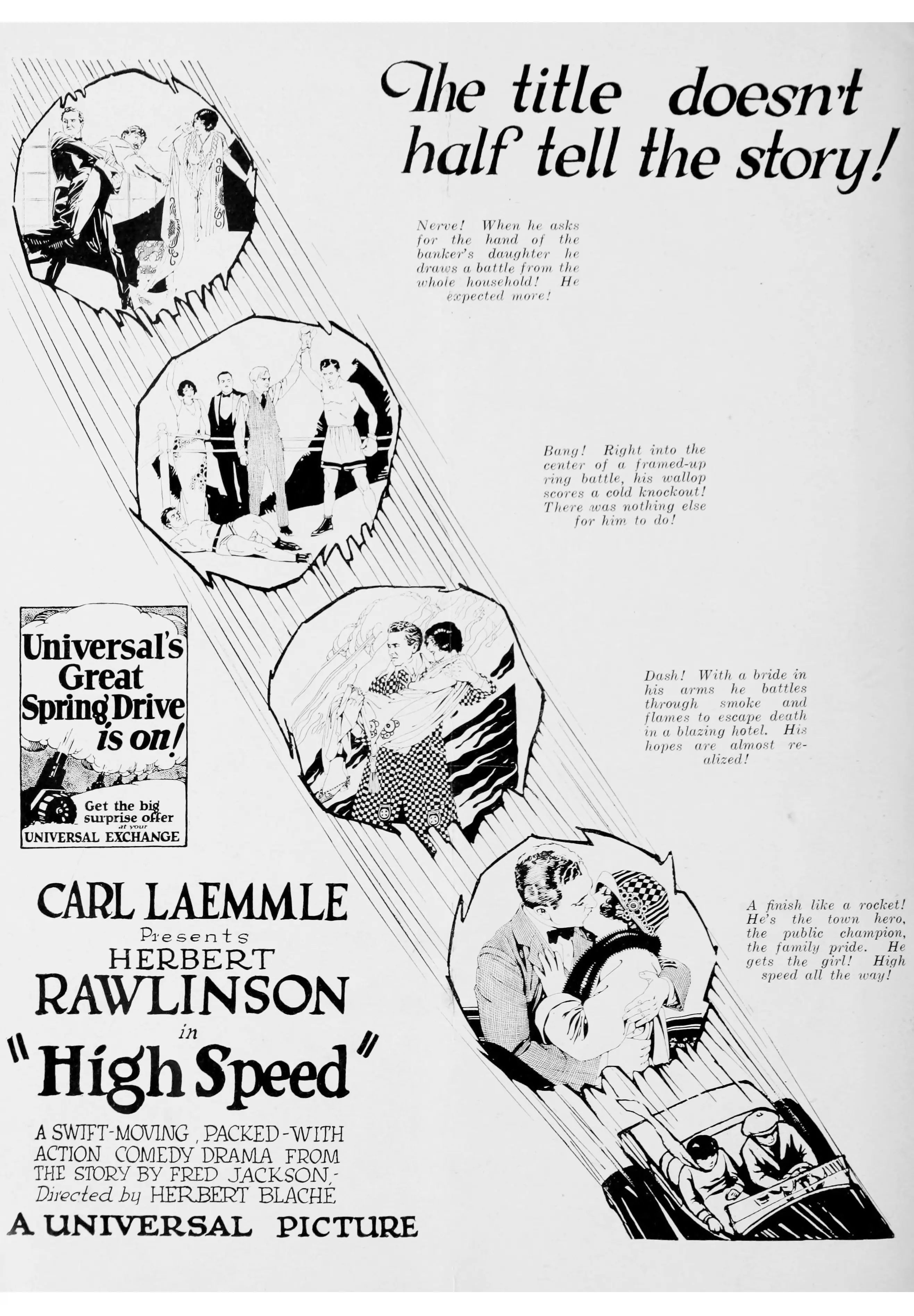
Herbert Rawlinson stars as Hi Moreland, a handsome and athletic young man entangled in a complex web of love and rivalry with 'High Speed' (1924). The film opens with Moreland’s initial charm and vigor as he attempts to win the heart of Marjory Holbrook, the daughter of a respected bank president, Carmelita Geraghty.
Marjory is being courted by a wealthy rival, a character played by Otto Hoffman, who has the financial leverage to sway her father’s opinion. The plot thickens as Moreland navigates a series of challenges to maintain his status as a viable suitor. These obstacles are meticulously crafted to test Moreland’s wit, resilience, and resourcefulness.
The narrative is a classic of its era, blending elements of romance, drama, and intrigue. Moreland’s journey involves evading various schemes designed to implicate him and undermine his relationship with Marjory. His ability to outmaneuver his adversaries is a testament to his character, showcasing a blend of charm and strategic thinking.
Key moments in the film include a climactic confrontation where Moreland must prove his integrity and loyalty to Marjory and her father. This pivotal scene is a turning point that resolves the tension and sets the stage for the ultimate resolution of the love story.
The cast, including Herbert Rawlinson, Otto Hoffman, and Carmelita Geraghty, delivers performances that are both nuanced and engaging. The chemistry between Moreland and Marjory is palpable, making their relationship the emotional core of the film. Supporting actors, such as Buck Russell, Cleo Bartlett, and Jules Cowles, add depth to the ensemble, contributing to the film’s overall impact.
The screenplay, penned by Frederick J. Jackson and Helen Broderick, is a masterclass in plot construction. The script is rich with dialogue that not only advances the narrative but also provides insight into the characters’ motivations and desires. The dialogue is crisp and to the point, reflecting the dialogue style of silent films while maintaining a level of sophistication that resonates with modern audiences.
'High Speed' exemplifies the golden age of silent cinema, offering a glimpse into a bygone era of filmmaking. Its technical merits are noteworthy, with a visually appealing production that captures the essence of romance and drama. The film’s use of expressionist elements and a sense of stylized storytelling adds to its charm and appeal.
Comparatively, 'High Speed' stands alongside other classic films of the era, such as 'The Wood Nymph' (1923), 'The Garden of Weeds' (1924), and 'The Arrival of Perpetua' (1924). These films share a similar thematic focus on love, rivalry, and the challenges of the upper class, but 'High Speed' distinguishes itself with its more dynamic plot and engaging characters.
While 'High Speed' may not be as widely known as some of its contemporaries, it is a gem that deserves recognition. Its blend of romance, intrigue, and technical proficiency makes it a must-see for film enthusiasts and a valuable artifact of early cinema. The film's enduring appeal lies in its timeless themes and the skillful execution of its narrative.
In conclusion, 'High Speed' is a captivating exploration of love and rivalry, set against the backdrop of early 20th-century society. It is a film that not only entertains but also provides a window into a fascinating period of cinematic history.
IMDb —
1923
Community
Log in to comment.