DbcultAccessing Vault...
Cult Review
Senior Film Conservator
Fortune is a fickle dowager; she hands you emeralds with one palm and slips a noose of obligation into the other.
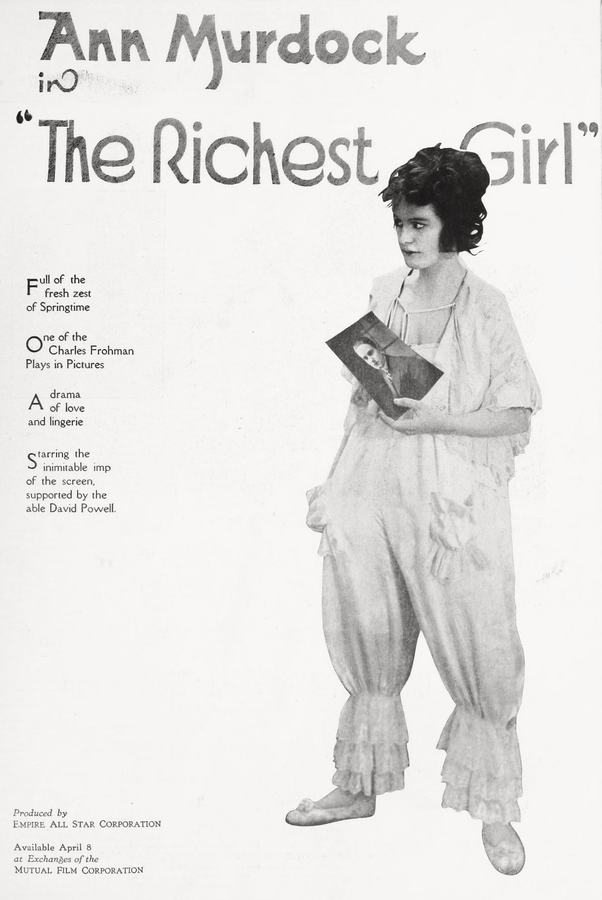
Shot in the bruised twilight of 1917, The Richest Girl arrives like a monogrammed handkerchief dabbed at the lip of a society already hemorrhaging from war and influenza. Director Paul Gavault, together with scenarists Michael Morton and Harry R. Durant, distills the acrid perfume of Edith Wharton’s world into a brisk five-reel fever dream. The result is an artifact that feels less like escapism and more like a mirror held up to a gilded cage—its bars fashioned from stock certificates and wedding bands.
Anna Murdock, all clavicles and composure, plays the eponymous heiress with the brittle hauteur of someone who has never been denied a yacht but has never been offered an unqualified embrace. Her guardian, Herbert Ayling, prowls the periphery in impeccably tailored moral ambiguity—half surrogate father, half boardroom shark. When the absentee fiancé (a deliciously feckless Cyril Chadwick) decamps for the continent, the film tilts into a caper of contractual loopholes. The godfather’s permission for a nominal marriage becomes the Trojan horse through which repressed desire gallops.
Cinematographer David Powell—also doubling as the rakish second suitor—bathes drawing rooms in chiaroscuro that anticipates German Expressionism by a full five years. Observe the sequence where Murdock, veiled in widow-white, signs the marriage contract: the quill’s shadow on parchment resembles a scalpel poised over an anatomical diagram of the heart. It is silent cinema’s answer to pointillism; each frame accumulates emotional pigment until, from a distance, the viewer beholds a bruise.
Murdock’s micro-gestures—a tremor at the corner of the mouth when the godfather straightens her pearl choker—carry more dramatic weight than pages of intertitles. Ayling counters with the languid cruelty of a man who has monetized every human interaction; his smile arrives a half-second late, like a stock dividend posted after the market has crashed. Together they enact a pas de deux of mutually assured emotional destruction, recalling the fraught electricity between Her Sister’s siblings, yet steeped here in the incestuous undertow of guardianship.
Gladys Wilson, as the acid-tongued cousin who leaks gossip like a faulty fountain pen, supplies comic relief that never degrades into slapstick. Watch her deflate the pretensions of Paul Capellani’s French artist—an expatriate who mistakes every salon for a boudoir—with a single arched eyebrow. The ensemble feels plucked from a John Singer Sargent canvas, then ushered into a boardroom where love must show quarterly earnings.
Production designer Charles Wellesley swaps Versailles excess for proto-Art-Deco austerity; the final act’s seaside villa—all right angles and sea-blue stucco—foreshadows the geometric fatalism of Bluff and the angular ennui of Redemption. The tonal shift from gilt parlors to salt-stung terraces literalizes the heroine’s emotional decoupling from wealth. When she strips off her diamond wristlet and lets it sink into the foam, the moment lands with the mythic resonance of a maiden casting a sword into a lake—only here, the blade was always made of credit.
Composer (for the 2018 restoration) threads Debussy-esque arpeggios beneath the courtship scenes, then detonates dissonant brass when the godfather recognizes his own reflection in the girl’s dilated pupils. The score becomes an unseen character, whispering what the Hays Office would soon excise: that sometimes the most obscene transactions happen under legally binding signatures.
The film’s midpoint hinge—a clandestine boat ride where moonlight behaves like liquid mercury—owes less to Griffith’s melodramas and more to the cynical erotics of Schnitzler. Dialogue intertitles shrink to haiku: “A kiss is a promise that accrues interest.” In that laconic economy, the movie anticipates the brittle cynicism of Lubitsch’s I Don’t Want to Be a Man while never abandoning the sentimental marrow that fuels mass appeal.
Yet the screenplay refuses the deus-ex-machina pardon common to the era. When the final reel reveals the godfather’s prior, undisclosed marriage—an elegant narrative short-sell—the heroine’s downfall feels less like tragic contrivance than the logical dividend of treating human beings as portfolio assets. The closing iris shot lands on Murdock’s face, half-shadowed by a sailor’s cap she has impulsively purchased: an image of a woman who has liquidated everything except the currency of self-possession.
Place The Richest Girl adjacent to A Fight for Freedom; or, Exiled to Siberia and you gauge how private despair can eclipse geopolitical upheaval. Pair it with War Is Hell and you perceive that the trenches of class warfare run through boudoirs as well as battlefields. The film’s true contemporaries are not always its chronological peers; its DNA resurfaces in the predatory boardrooms of Stolen Goods and the matrimonial shell games of According to the Code.
Even the Danish melodrama Bryggerens datter, with its brewery fortunes and filial duty, cannot match the clinical precision with which The Richest Girl dissects the commodification of femininity. Where Pigen fra Klubben flirts with flapper rebellion, this American mutation wallows in the transactional chill beneath the Jazz-Age glitter.
Modern viewers, weaned on algorithmic dating and NFT prenups, will recognize the heroine’s predicament as an analog ancestor of contemporary intimacy contracts. The godfather’s fiduciary guardianship rhymes with the venture-capital patronage that today bankrolls relationships via joint Instagram sponsorships. When Murdock hesitates at the altar, she prefigures every influencer who must monetize affection while safeguarding brand equity.
Restoration efforts reveal nitrate scars that resemble hairline cracks on a porcelain doll—blemishes that only amplify the film’s thematic obsession with fractured surfaces. The 4K scan exposes the lace of Murdock’s corset as a topological map of constriction; every thread is a clause in an indenture she never read. Cinephiles who revere The Warrior for its sculptural battle vistas will find here a quieter combat, fought with contract clauses and ocular glances.
Verdict: Buy, hold, and weep. This is silent-era arbitrage on the soul’s futures market.
In the end, The Richest Girl offers neither catharsis nor comfort. Instead, it dispenses the cold clarity of a brokerage statement: every dividend of desire compounds into liability. The closing shot—sirens wailing off-screen as the heiress boards a trans-Atlantic steamer—feels eerily predictive of 1929’s crash. She departs with nothing but a cabin trunk and a name no longer lashed to any fortune, her silhouette shrinking against an ocean that does not appear on any stock exchange. The film fades to black not on moral comeuppance but on the sobering realization that when love is collateral, foreclosure is inevitable.
IMDb 7.1
1925
Community
Log in to comment.