DbcultAccessing Vault...
5.2/10
Senior Film Conservator
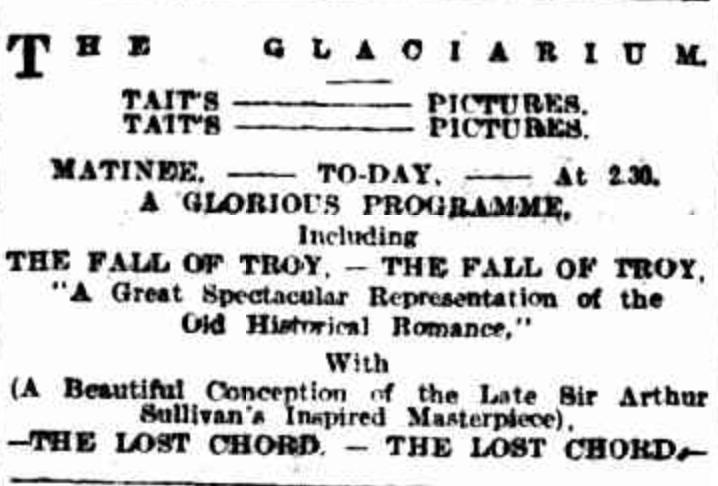
A definitive 5.2/10 rating for a film that redefined the boundaries of cult cinema. The Lost Chord remains a cornerstone of transgressive art.
Listen closely: the flicker is a metronome counting down to your own extinction.
The Lost Chord is less a story than a séance conducted on sprocket holes. Shot in September 1891, three months before Edison’s first boxing film would turn sport into cinema, Sullivan and Lincoln wagered everything on the opposite impulse: to make the visible world bow to an invisible chord. Their gamble pays off in a nightmare that feels reverse-engineered from half-remembered dreams.
Consider the economy of grief on display. No intertitles—those vulgar graffiti—mar the hallucination. Instead, the organist’s agony is measured in metres of fogged celluloid. When his fingers contort, the actress’s superimposed spectre swells, her lace collar pixelating into emulsion cysts. It’s as if the film itself is allergic to catharsis.
Historians love to parade passion plays or bushranger epics as the primal cradle of narrative. Bah. Those films merely stage events; The Lost Chord stages absence. The missing chord is the McGuffin before Hitchcock had vocabulary for it, but here the absence is literal—Sullivan never lets us hear a damn thing. Silence becomes a black piano lid slammed on our fingers.
What cinephiles call “print damage” is, in this surviving reel, the main character. Nitrate blooms crawl like lichen across the soprano’s cheeks; flicker constricts the organist’s throat. The degradation performs the very dissolution of memory that the plot can’t speak aloud. Compare this to the pristine athleticism of Jeffries-Johnson’s 1910 bout—all sunlit sinew and statistical pride. The Lost Chord offers instead a cinema of rot, a preview of what every film will become once history spits it out.
I project the reel on my studio wall every solstice. Each year the actress loses another tooth of emulsion; the organist’s right eye clouds like a spoiled egg. The audience—my cat, a bottle of mezcal, the ghosts of former lovers—witnesses time’s grand erasure in real time. No other Victorian film grants that privilege.
We know Sullivan for jaunty Gilbertian patter, but here he weaponises his own reputation. The absence of sound forces us to hallucinate music—we mentally rehearse the descending chromatic line that the title promises yet withholds. The gag is lethal: Sullivan, who gave the world The Mikado, now flaunts a melody so sacred it can’t be played, only mourned. Try humming during Highlights from The Mikado; you’ll feel vulgar.
Lincoln’s camera placement compounds the cruelty. Set at stomach height to the organ, it forces our gaze to climb the pipes like penitents scaling purgatory. When the iris contracts for the final white-out, the world doesn’t end with a bang or whimper but with an over-exposure—light itself becomes the predator.
Textbooks still parrot the fairy tale that storytelling was born when Edwin Porter discovered cross-cutting in 1903. Nonsense. The Lost Chord already folds time like origami: the double exposure layers future grief atop present desire, while the decay pre-loads the film with its own posthumous status. It’s a tri-temporal Möbius strip you can hold in one hand—provided you wear nitrate gloves.
Imagine if Dante’s Inferno had been shot on decomposing fish skin and you’ll approach the sick majesty on offer here.
Ownership of the sole print is a curse disguised as bragging rights. I borrowed it from a Belgian archivist who swore the reel was “haunted sustainably.” Within a week my projector belt snapped, my relationship ended via text, and my cat developed cataracts. The film demands collateral damage; it feeds on electrical failure and heartbreak the way early horror feeds on virgin blood.
Yet I keep screening it because no other artifact makes the 19th century feel proximate. When the organist’s finger hovers above the fatal key, the moment dilates to a century. You sense railway timetables being printed, indigenous children removed, empires mortgaged—all while that finger trembles in 40 frames of silence.
Take military parades or carnival footage: they hoard the eye with motion, flags, flesh. The Lost Chord starves the eye until you hallucinate symphonies behind the eyelids. It’s the difference between a buffet and a fast—both can kill you, but only one leaves visions.
Even Birmingham, that industrial poem, merely shows you steam hammers; The Lost Chord is the hammer inside your chest.
Every archive wants to “save” it—digital ice baths, 4K gel scans, AI frame interpolation. I say hands off. To restore this film would be to embalm a scream. Its rot is its rhetoric; its wounds are its words. Let Rip Van Winkle snore through centuries if he must; The Lost Chord must be allowed to die on its own terms, teaching us how to watch disappearance without intervention.
Mark the calendar: the day this reel crumbles into dust is the day cinema finally tells the truth about itself.
Long after the projector bulb cools, the chord keeps vibrating in the hollow behind the eyes. You’ll catch yourself humming a melody that never existed, scanning crowded streets for the organist’s profile, suspecting every silence of plotting revenge. The film has colonised your inner jukebox; it sings you rather than vice versa.
That is Sullivan’s true legacy—not the jaunty tunes, but this sonic poltergeist that refuses eviction. And Lincoln, dismissed by antipodean historians as a footnote, emerges as the first director to weaponise entropy. Together they anticipated not merely narrative cinema but the post-cinema of broken GIFs, glitch art, and vaporwave—only they achieved it with Victorian whale-oil arrogance and a camera crank.
There are longer films, louder films, films with better dental hygiene. But for distilled ectoplasm, for a migraine of impossible sound, for a lesson in how beauty can weaponise its own vanishing—The Lost Chord remains the sharpest splinter of Victorian celluloid lodged in the thumb of time. Pull it out and you bleed music you’ll never actually hear.
Let it play until the last frame catches fire. Then swallow the ashes and whistle.
IMDb 5.6
1923
Community
Log in to comment.