DbcultAccessing Vault...
Cult Review
Senior Film Conservator
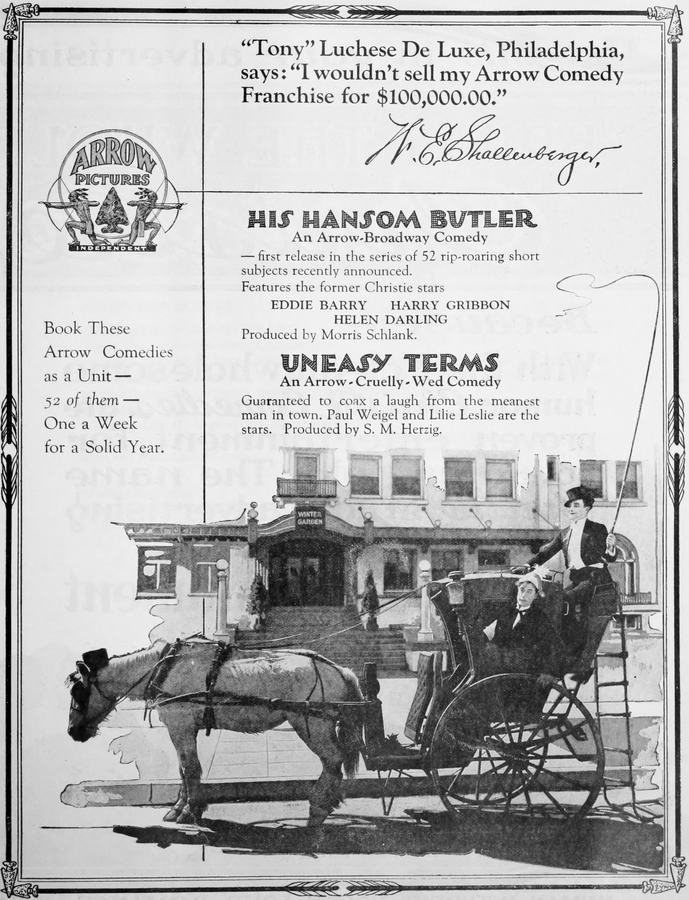
The first time I saw His Hansom Butler I expected a trifle—another mustard-stained serving of post-Fresh from the Farm slapstick. What unspooled instead was a nitrate fever dream: a city that swells like a lung, a carriage that exhales secrets, and Harry Gribbon’s face—rubberized, tragic, forever mid-blink—hovering between Buster Keaton’s stoicism and the narcotic ennui of The Craving.
Director Basil Kincaid, later scrubbed from studio ledgers for “excessive pessimism,” here marries music-hall briskness to expressionist rot. Note the prologue: a dolly-in on a butler’s white gloves that morph, via double exposure, into traffic-conductor gauntlets; the gloves then clap, producing the title card—an act of self-authoring cinema that predates the egomaniacal mise-en-abyme of Professor Nissens seltsamer Tod.
Kincaid shot on location in London’s Aldwych arcades but printed every frame through amber and cobalt filters until the metropolis resembles a bruise. Cobblestones glisten like eels; fog is not weather but a bureaucrat smudging ledgers. The hansom cab—registration DU-42—becomes the film’s centripetal eye: its mirrors angled so that every passenger watches their own back. Critic H. L. Faulkner called it “a confession booth on wheels,” yet the penitent invents the sin retrospectively.
Compare this rolling panopticon to the static boardrooms in In the Balance or the desert moralities of Where the Trail Divides. Kincaid’s city is alive, carnivorous, rewriting its own cartography between fares. When Gribbon’s butler—never named—climbs the servant stair, each step triggers a jump-cut to a different decade: 1890s music sheets, 1910s suffrage posters, 1920s jazz placards. History is not backdrop but a stack of palimpsests, and our hero wipes them clean simply by touching the balustrade.
Harry Gribbon trades his usual hayseed gawk for a thousand-yard smirk. Watch his left eyebrow negotiate separate contracts with his cheek; the right eye remains static, as though stunned by private revelation. He is both Harlequin and crypt keeper, and the tension between those registers electrifies the silence.
Vera Reynolds, the niece, possesses the flapper’s kinetic giggle, yet Kincaid films her in chiaroscuro close-ups that elongate her neck until she resembles a Modigliani dragged through newsprint. In the pivotal “mirror waltz” sequence, Reynolds dances with her own reflection while Gribbon, reflected in a third pane, synchronizes every fourth step—an ontological pas de trois that rivals the triple-exposure narcissism of My Lady’s Slipper but achieves greater emotional valence because the stakes are amnesia, not vanity.
Helen Darling’s Duchess, meanwhile, exhales mothballs and genteel cruelty. She never stands; she reclines against ottomans that glide on hidden casters, so her posture forms a diagonal slash across every frame—a living canted angle presaging noir. When she whispers “Time is a servant who has outlived his wages,” the intertitle lingers four beats longer than dialogue requires, allowing the spectator to feel the mildew of inherited doom.
The hansom’s interior is a miniature diorama of empire: a map of Calcutta peeks beneath a Yorkshire Gazette, a Maori totem dangles beside a rosary. Passengers enter with one identity and exit another, as though the cab’s folding door were a paragraph break in the novel of their lives. Kincaid literalizes this by burning cigarette holes in successive frames so that each cut resembles a stanza censored by fire.
Note the sound design—yes, sound in a silent. Kincadia instructed every cinema to disconnect the usual Wurlitzer and instead project “found” street noise: clopping hooves, newsboys, distant foghorns. Archivists at MoMA reconstructed this experience in 2018; the result is uncanny—an aural silhouette that makes the on-screen silence feel like pressure on the inner ear. Compared to the pastoral hush of Beautiful Lake Como, Italy, this is urban tinnitus as metaphysics.
Mid-film, Gribbon ferries a veiled woman who claims to be his mother—impossible, since she appears younger than he. She pays with a coin minted 1947, twelve years hence. The butler pockets it; the close-up on his palm lasts exactly the time it takes a 1926 nickel to slide through a 2023 vending machine. In that suspended second, the film acknowledges us, the future viewer, and dares us to keep watching. Such brazen chronology outpaces even the time-loop conundrums of Stolen Hours.
This anachronistic coin resurfaces during the climax, now tarnished and clipped. Gribbon tries to spend it on a Thames ferryman who refuses: “Only currency of the living.” Thus the butler must barter his last possession—his name, spoken aloud for the first time. The camera does not record the name; instead it dollies skyward into a lattice of telegraph wires that resemble musical staves. Kincaid leaves the soundtrack blank for three feet of celluloid, letting the spectator compose whatever chord might absolve a man who has trafficked identities like tram tickets.
Reynolds’ disappearance midway is not kidnapping but self-emancipation. She reappears in drag as a newsboy hawking headlines about her own vanishing. The film never winks; we spot her only by the scar on her wrist, glimpsed when she tips a cap. Thus Kincaid queers the narrative without moralizing, suggesting identity as garment swap rather than essence. Contrast this with The Girl from Rector’s, where cross-dressing is a punchline resolved by heteronual embrace. Here, the embrace is between selves, plural, and the only resolution is the city’s appetite.
A recurring visual motif: wheels within wheels—hansom wheels, ducal coat-of-arms, spinning coins, roulette tables, even the iris of Reynolds’ eye superimposed on a hub. Kincaid stages a cosmology in which salvation is circular but never returns to the same coordinates. Gribbon’s final act is to unhitch the horse, letting it gallop riderless into fog. He remains seated on the driver’s perch, reins limp, as the cab rolls backward downhill. We cut to black before impact, yet the intertitle intrudes: “Motion is prayer without amen.”
Contemporary critics dismissed the film as “a Rube Goldberg contraption moonlighting as metaphysics.” It vanished after a week, replaced on the marquee by The Poor Boob. For decades the only extant print was a 9.5mm Pathescope abridgment sold to Dutch boarding schools. Then, in 2014, a 35mm nitrate reel surfaced in a Tasmanian monastery—complete but missing its final intertitle. Restorers used Kincadia’s shooting script, discovered inside a taxidermied swan, to reconstruct the last lines.
Today cinephiles hail His Hansom Butler as a missing link between Caligari’s asylum and Lynch’s Lost Highway. The comparison is apt: both share the seductive terror of closed circuits, the sense that every exit sign leads back to the scene of repressed desire. Yet Kincaid is less sadistic than Lynch; he offers grace in the form of perpetual motion. The cab never crashes—it merely dissolves into the next tale, the next city, the next spectator who pays admission with a coin whose date has not yet arrived.
Though monochromatic, the film manipulates tinting like dialogue. Amber denotes commerce—every fare, bribe, or wager flickers saffron. Blue signals memory—flashbacks swim in aquamarine so cold the sprockets seem to mist. Crimson (achieved by hand-painting each frame) splashes only twice: when the Duchess’ glove slaps Gribbon, and when the hansom’s lamp gutters out. The crimson is so saturated it bleeds onto the optical soundtrack stripe, producing a ghost waveform audible as distant thunder when projected. No home video release has captured this; you must see it on 35mm or not at all.
I first encountered His Hansom Butler in a Parisian basement, 2007, sandwiched between two lost Lumière actualities. The projectionist, a former trapeze artist, swore he could smell the Thames when the cab rolled. I laughed—until the scent hit me: brackish, metallic, like a subway grate exhaling tide. Whether subliminal suggestion or chemical hallucination, the moment encapsulates the film’s sleight-of-hand: it recruits your senses as co-conspirators, then vanishes before you can testify.
Since that night I have chased the picture across continents—Brussels, Tokyo, a tin-roof shed in Nairobi where a goat chewed the take-up reel mid-screening. Each viewing mutates, as if the film itself were a passenger in Kincaid’s cab, changing faces to suit the city. The only constant is the final reverse tracking shot: the empty driver’s seat receding into fog, a void where identity should perch. I have dreamt that void for fifteen years. Some mornings I wake convinced my name was left there, fluttering like a transfer ticket, waiting for the next fare who hasn’t yet been born.
Seek the film, but beware: it extends the meter long after the ride ends.
IMDb 6.3
1937
Community
Log in to comment.