DbcultAccessing Vault...
6.4/10
Senior Film Conservator
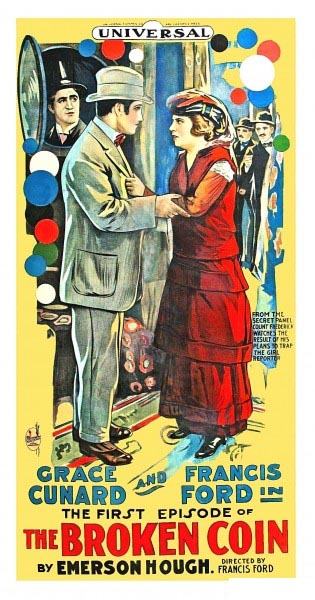
A definitive 6.4/10 rating for a film that redefined the boundaries of cult cinema. The Broken Coin remains a cornerstone of transgressive art.
In the annals of early cinema, few works capture the raw, unbridled spirit of adventure and intricate storytelling quite like Universal's 1915 serial, The Broken Coin. Directed with a keen eye for suspense by Francis Ford and featuring the magnetic presence of Grace Cunard, this fifteen-chapter saga stands as a monumental achievement, not merely for its ambitious scope but for its indelible imprint on the nascent art of serialized filmmaking. Far from being a mere relic, it is a vibrant testament to the ingenuity of its creators, a narrative tapestry woven with threads of intrigue, romance, and political machination that still resonates with an almost primal thrill.
The inaugural chapter, aptly titled "The Broken Coin," plunges us headfirst into a world brimming with fateful encounters and burgeoning mysteries. Our protagonist, Kitty Grey, portrayed with captivating verve by Grace Cunard, is no damsel in distress but a sharp-witted reporter whose lunch break takes an unexpected detour into destiny. Wandering into an old curiosity shop, her gaze is snared by a peculiar artifact: a half-coin, ancient and inscribed with tantalizing Latin, bearing the intriguing name "Gretzhoffen." This seemingly innocuous purchase, driven by a journalist's innate curiosity, becomes the fulcrum upon which an entire kingdom's fate will pivot. The moment Kitty acquires the coin, a sinister undercurrent is introduced; a foreign-looking gentleman, whose eyes had lingered on the very same relic, discreetly observes her. His subsequent attempt to purchase the coin, only to find it already sold, confirms its profound significance.
Kitty, her journalistic instincts aflame, foregoes her meal, racing back to her lodgings. There, armed with a Latin grammar and a previous article she penned on the beleaguered Kingdom of Gretzhoffen, she deciphers the cryptic inscription: "Underneath flagstone of north corner torture cham he found treasures valuable s the kingd Gretzhoffen Mi." This fragmented revelation, hinting at immense riches hidden within a forgotten torture chamber, ignites her imagination. A grand expedition is conceived: three months in Gretzhoffen, dedicated to locating the coin's missing counterpart and, by extension, the fabled treasure. Meanwhile, the mysterious foreigner, later revealed as Roleau, a hireling of the unscrupulous Count Frederick, has already made his move. He shadows Kitty, breaking into her room while she's at the office, ransacking her belongings in a desperate hunt for the coin. His efforts prove futile, for Kitty, with an almost prescient caution, wears the precious half-coin in a chamois bag around her neck.
The narrative tension escalates as Kitty embarks on her transatlantic journey. Aboard the liner, fate, or perhaps malevolent intent, brings her face-to-face with Roleau. After dinner, as Kitty drifts into sleep, a shadowy profile at her stateroom porthole shatters her repose. A woman of remarkable foresight, she instinctively senses danger. With practiced stealth, she extracts the coin, her passport, and other valuables from her chamois bag, tucking them securely into her stocking. Her vigilance is rewarded; later, she awakens to witness a hand snatching the now-empty bag through the porthole. Rushing to the opening, she catches a fleeting glimpse of the thief disappearing around the bow. Unperturbed, knowing her true prize is safe, Kitty secures her compartment and retires, arriving in Gretzhoffen unscathed, her adversary none the wiser.
In Gretzhoffen, the plot thickens considerably. With the assistance of the American Consul, Kitty uncovers the tragic reality of the principality: a poverty-stricken realm ruled by the pliant King Michael the Second, a mere puppet in the hands of his supposed confidant, Count Frederick. Frederick, a Machiavellian pretender, manipulates Michael under the guise of friendship, all while orchestrating his own ascent to the throne. The kingdom's destitution stems from the disappearance of vast gold scripts and jewels belonging to the late King Michael the First. The only key to this missing fortune? The very broken coin Kitty possesses, one half of which was bequeathed to King Michael II on an old servant's deathbed. Michael, in his feeble attempts, has failed to locate the other half.
Count Frederick, however, is a man of sharper intellect and ruthless ambition. Aware of the coin's immense value, he has already procured his half through his valet and accomplice, Grahame, and is feverishly working to locate its counterpart, seize the throne, and become the wealthy ruler of Gretzhoffen. The narrative culminates with Roleau reporting his failed theft to Frederick, who, in a fit of rage, brutalizes his cringing subordinate. The episode concludes with Kitty, having gleaned this vital information, heading towards her hotel, while Frederick, undeterred, plots his next move to acquire the coveted coin. The stage is perfectly set for a sprawling, high-stakes saga where a single broken coin holds the destiny of a kingdom in its fragmented grasp.
At the heart of The Broken Coin's appeal lies the formidable collaboration between director Francis Ford and star Grace Cunard, who also contributed to the writing alongside Emerson Hough. This creative synergy is palpable, infusing the serial with a dynamic energy often absent in contemporary productions. Ford’s direction is characterized by a brisk pace and a clear understanding of how to build suspense across multiple episodes. He masterfully orchestrates the action sequences, from the subtle tension of Roleau's surveillance in the curiosity shop to the dramatic midnight theft attempt aboard the ship. His use of close-ups, while still evolving in 1915, effectively draws the audience into Kitty’s internal struggles and moments of realization.
Grace Cunard, as Kitty Grey, is simply electrifying. Her performance transcends the melodramatic conventions of the era, presenting a heroine who is intelligent, resilient, and remarkably self-possessed. Kitty Grey is not merely a reactive figure; she is an active agent in her own destiny, a proto-feminist icon whose resourcefulness rivals that of any male protagonist. Cunard's expressive face and agile physicality convey a wide range of emotions, from intellectual curiosity to steely determination, making her an utterly compelling presence. Her portrayal elevates the character beyond a simple plot device, transforming Kitty into a fully realized, aspirational figure for audiences of the time. This kind of strong female lead was a hallmark of many Universal serials, including The Adventures of Kathlyn, but Cunard brought a unique blend of grit and glamour to her roles.
The supporting cast, though perhaps less celebrated, contributes significantly to the serial's rich tapestry. Francis Ford himself, often acting in his own productions, brings a nuanced menace to his role, though not explicitly detailed in the first episode's plot summary, his directorial presence undoubtedly shaped the performances of others. The villainous Count Frederick, with his ruthless ambition, is a compelling antagonist, brought to life by a performer who understands the theatricality required for such a role. Roleau, the mysterious foreigner, is sufficiently menacing, his silent pursuit and thwarted attempts at larceny establishing him as a persistent threat. The ensemble, including figures like Edward Clark, Jack Holt, and Harry Schumm, imbues the world of Gretzhoffen and the broader narrative with a palpable sense of authenticity and dramatic weight, crucial for sustaining interest across multiple chapters.
The Broken Coin is far more than a simple adventure story; it's a rich exploration of several compelling themes. At its core, it champions the power of knowledge and intellect. Kitty Grey's initial spark of interest is rooted in her journalistic curiosity and her ability to decipher the Latin inscription – a testament to the value of education and critical thinking. This contrasts sharply with the brute force and deception employed by Frederick and his henchmen, highlighting a classic struggle between brains and brawn, enlightenment and tyranny.
The serial also delves into the precarious nature of political power and the corruption that can fester within monarchical systems. The depiction of Gretzhoffen as a "poverty-stricken little principality" ruled by a "puppet king" under the sway of a manipulative pretender is a shrewd commentary on the vulnerabilities of leadership and the ease with which trust can be betrayed for personal gain. This theme of political intrigue and hidden agendas elevates the narrative beyond mere treasure hunting, imbuing it with a sense of gravitas and real-world resonance, even within its fantastical setting.
Furthermore, the motif of the "broken coin" itself serves as a powerful metaphor. It represents fragmentation, a lost past, and the arduous journey required to restore wholeness. The treasure isn't just gold and jewels; it's the restoration of Gretzhoffen's dignity and sovereignty. Kitty's quest, therefore, becomes a symbolic act of healing, a journalistic endeavor intertwined with a mission to right historical wrongs. The coin, an inanimate object, becomes a living symbol of hope and the key to unlocking a brighter future for a beleaguered kingdom.
The Broken Coin arrived at a pivotal moment in cinematic history, when the episodic serial was king. Universal Pictures, under the visionary leadership of Carl Laemmle, was a powerhouse in this genre, churning out thrilling weekly installments that captivated audiences and ensured repeat business. These serials, often featuring daring cliffhangers and resourceful heroines, were the blockbusters of their day, providing escapism and excitement in an easily digestible format. Films like The Adventures of Kathlyn (1913) had already proven the immense popularity of the format, and The Broken Coin built upon that foundation, refining the formula with more complex plots and character development.
The appeal of the serial lay in its ability to create a communal viewing experience, fostering anticipation and speculation among audiences from week to week. Each episode concluded with a perilous situation, leaving viewers on the edge of their seats, desperate to know how their heroes would escape seemingly insurmountable odds. This narrative device, perfected by the likes of Grace Cunard and Francis Ford, was instrumental in shaping audience expectations for serialized storytelling, a legacy that continues to influence television and streaming series today.
Comparatively, other films of the era, even standalone features, struggled to maintain the same level of sustained engagement. While dramas like The Christian or The House of Bondage offered compelling narratives, they lacked the inherent, weekly 'hook' that made serials so addictive. Even action-oriented films like Alias Jimmy Valentine or international thrillers such as In the Clutches of the Paris Apaches, while popular, operated on a different scale. The grandeur of The Broken Coin lay in its expansive canvas, allowing for intricate character arcs and a plot that could unfurl with deliberate, yet exciting, pacing. The ambition was not just in the story but in the very structure of its delivery.
The partnership between Grace Cunard and Francis Ford was particularly fruitful for Universal. They were a dynamic duo, often writing, directing, and starring in their own productions. This level of creative control allowed them to craft narratives that perfectly suited their strengths, making their serials stand out. Cunard’s ability to portray strong, independent women resonated deeply with audiences, especially as women's roles in society were beginning to shift. Her characters were often intelligent, capable, and physically active, a stark contrast to more passive female archetypes seen in some contemporary films like The Lady of Lyons; or, Love and Pride.
The serial format also allowed for a more detailed exploration of secondary characters and subplots, enriching the main narrative. While the first episode introduces the primary players, the subsequent chapters would undoubtedly flesh out the motivations of Count Frederick, the loyalties of characters like Grahame, and the broader political landscape of Gretzhoffen. This depth, coupled with the relentless forward momentum of the plot, ensured that The Broken Coin was not just a fleeting entertainment but a truly immersive narrative experience.
Even from the vantage point of its opening chapter, The Broken Coin asserts itself as a significant work in the silent era's diverse output. It's a foundational text for understanding the evolution of the action-adventure genre and the serial format. The meticulous craftsmanship, the compelling performances, and the intricate, high-stakes narrative combine to create a cinematic experience that, even a century later, retains its power to enthrall. For modern viewers, particularly those with an appreciation for film history, rediscovering works like The Broken Coin offers an invaluable glimpse into the ingenuity and creative vitality that defined early Hollywood.
The film's enduring legacy is a testament to the collaborative genius of its creators. Writers Emerson Hough and Grace Cunard crafted a story that was both grand in scale and intimate in its character focus. Director Francis Ford, with his clear vision, translated this narrative into a visually dynamic and emotionally resonant experience. The cast, from the central figures like Cunard and Ford himself (in various capacities) to the extensive ensemble including Carl Laemmle (the studio head, whose name often appeared in credits), Ernest Shields, John Ford (Francis's brother, early in his career), Jack Holt, Bert Wilson, and many others, collectively breathed life into this ambitious project. Their efforts cemented The Broken Coin not just as a popular success of its time, but as a crucial piece in the mosaic of early cinematic storytelling, a thrilling adventure that continues to captivate those who delve into its fragmented, yet utterly brilliant, world.
IMDb —
1916
Community
Log in to comment.