Summary
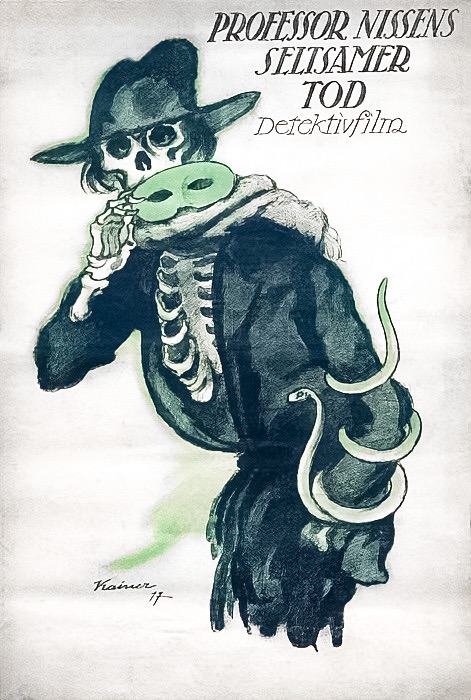
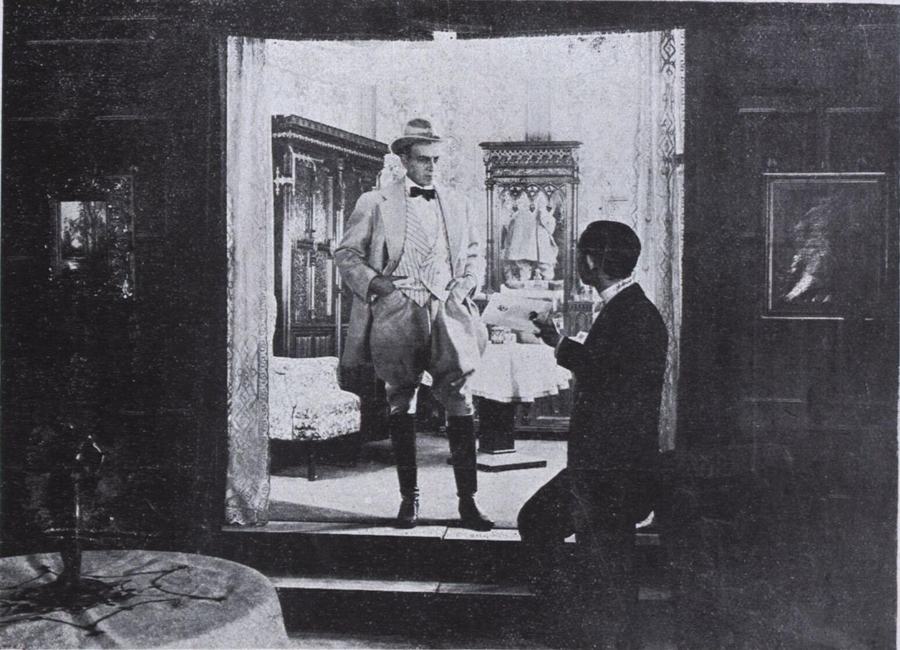
A cadaverous hush settles over the port city’s crooked alleys when Professor Nissen, spectral antiquarian and collector of occult bric-à-brac, is discovered in his study, eyes frozen wide as if still negotiating with death itself. The corpse’s left hand clutches a page torn from a forbidden codex; inked on it, a sigil that seems to crawl when candlelight flickers. From this macabre still-life, the film spirals into a fever-dream investigation led by Nissen’s estranged protégé, the gaunt mathematician Dr. Arno Klausing, whose own pulse is already syncopating with guilt—years earlier he had mocked his mentor’s “superstitious numerology.” Klausing is joined by the professor’s taciturn housekeeper, Frau Lüdiger, whose veiled glances conceal both devotion and a blood-stained handkerchief, and by the frosty inspector Brede, a man convinced that every riddle is merely algebra in disguise. Together they exhume family vaults, séance parlors, and candle-lit docks where smugglers trade in living shadows. Each interrogation peels back another layer of Nissen’s secret biography: a clandestine patron of anarchist pamphleteers, a failed alchemist who mortgaged his soul for a single gram of “lightning gold,” and, most damning, the guardian of an encrypted ledger that maps the city’s subterranean flood tunnels—passages now buzzing with a new, nocturnal industry of contraband cadavers. Maria Forescu’s performance as the widowed medium Irma Valesco electrifies the celluloid: she drifts through fog like a moth in mourning, her contralto voice summoning the dead while her eyes betray a hunger for the living. Einar Zangenberg’s Klausing, all cheekbones and trembling intellect, oscillates between empirical arrogance and spiritual panic until the two states collapse into one shuddering epiphany: Nissen orchestrated his own extinction to trap an ancient entity that feeds on certainty itself. The climax unfurls inside a flooded crypt where arithmetic graffiti glows phosphorescent on wet stone; here, Klausing must solve an equation whose answer is literally death—his own—unless he can re-write the theorem mid-heartbeat. Aruth Wartan’s Brede arrives too late, pistol drawn, only to witness the sigil detonate into silent azure fire that devours guilt, memory, and finally the celluloid itself, leaving the audience staring at a white-hot afterimage that lingers like a scar on the retina.
Review Excerpt
"
The first time I saw Professor Nissens seltsamer Tod I walked out convinced the screen itself had been embalmed. There is a texture to Edmund Edel’s 1920 nitrate fever—half mildew, half halo—that no digital archive can fully domesticate. Even now, when I close my laptop at 3 a.m., the sigil from Nissen’s death-page re-inks itself on the inside of my eyelids, a twitching lattice the color of arterial blood under blacklight.
A Corpse Painted by Candleflame
Let us dispense with plot regurgitatio..."