DbcultAccessing Vault...
Cult Review
Senior Film Conservator
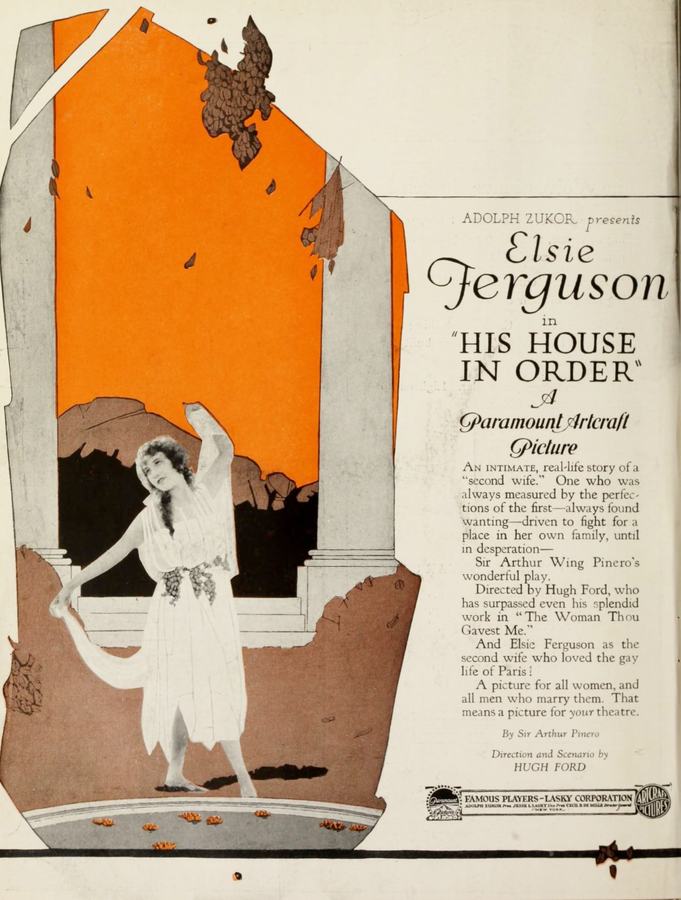
There is a moment—halfway through His House in Order—when Elsie Ferguson’s tear-bright eyes lock onto the camera as if to ask the audience whether love can survive archival preservation. The film, distilled from Pinero’s Edwardian stage success, is essentially a chamber piece about a man who curates his dead wife like a museum piece, then wonders why the living woman warming his bed remains chronically insufficient. Yet within that thumbnail lurks a kaleidoscope of quieter horrors: the commodification of grief, the soft tyranny of nostalgia, the lethal algebra by which a memory plus lace curtains can outrank warm flesh.
Director Hugh Ford translates Pinero’s West-End drawing-room acid to the screen with a restraint that feels almost modern. He stages domestic discord in cavernous spaces—oak wainscoting swallowing whispers, chandeliers dangling like interrogation lamps—so that every declamation ricochets. The camera seldom moves, but when it does—gliding past a hat-stand where the first wife’s silk scarf still hangs—it is as if the lens itself exhales stale perfume. Ford’s austerity anticipates later chamber tragedies such as Die Ratte, yet he lacks that film’s expressionist abrasiveness, opting instead for a suffocating verité.
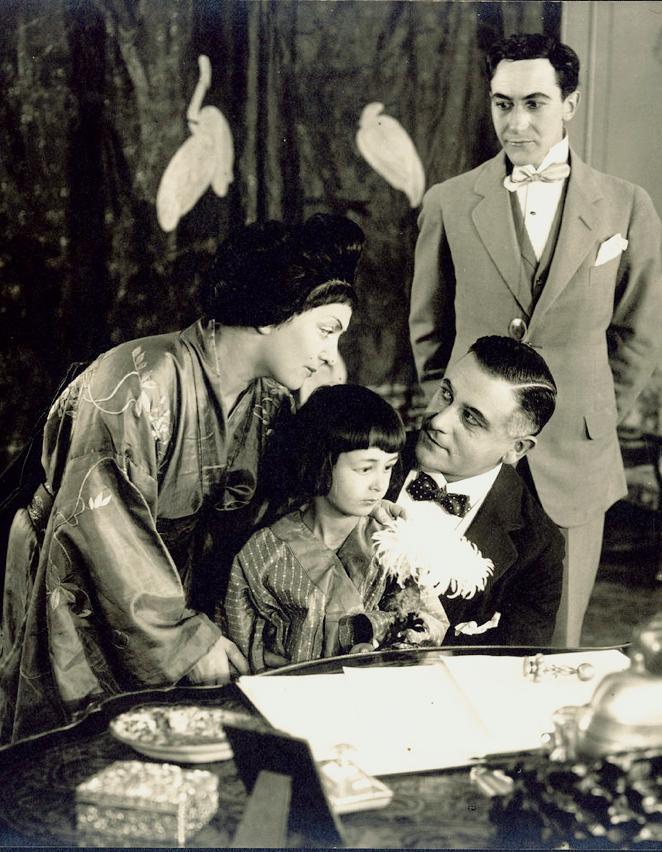
Elsie Ferguson, a Broadway luminary whose screen appearances are tragically sparse, operates at a frequency of trembling containment. She modulates between brittle smiles and sudden death-of-voice silences, letting us glimpse the heroine’s calculation: if she cannot dislodge the sainted predecessor, perhaps she can cauterize her own longing and survive on residue. Notice how she handles a teacup: fingers splayed just enough to suggest she might hurl it, yet always returning it demurely to saucer—an entire marriage in porcelain microcosm.
As the husband, William P. Carleton exudes the bland cruelty of a man who believes grief entitles him to veto another’s happiness. Watch the way he fingers the deceased’s correspondence, reverting his gaze to Ferguson as if to say: see how this woman wrote my name, see how you fail to. His line readings carry the punitive chill of a sermon; even compliments arrive pre-ruined by subtext. Yet Carleton never tips into villainous caricature—he is, in his mind, the wronged keeper of a flame, and that self-pity is terrifyingly recognizable.
Around them, the supporting cast functions like architectural gargoyles: Vernon Steele’s languid cousin dispensing cynical bons mots; Inez Borrero’s housekeeper whose loyalty to the first wife manifests in passive-aggressive polishing of her silver; Holmes Herbert’s family lawyer brandishing wills like scalpels. Each embodies a social prism through which the marital deadlock is refracted—reminding us that a household is never merely two people but a parliament of heirlooms and opinions.
Cinematographer Hal Young shoots interiors in low-key chiaroscuro, so shadows pool like split ink across ancestral crests. Note the recurrent motif of open doorways framing closed ones: Ferguson will stand at threshold while, deep within the composition, Carleton contemplates a portrait half-lit, as though the house were a set of Russian dolls nesting grief. The first wife’s image—never seen full-face—appears only as reflection or silhouette, a photographic negative haunting the positive of the new union.
Color, though monochromatic, is implied through texture: Ferguson’s velvet gown drinks light, while the dead wife’s garments—kept in camphor—seem to emit their own anaemic glow. When Ferguson finally strips them from the armoire and scatters them like albino leaves, the gesture feels almost sacrilegious, a desecration of reliquary.
Pinero’s dialogue, pruned but not uprooted, retains its waltz-like cadence: epigrams pirouette, confessions arrive cloaked in subordinate clauses. The screenplay condenses a three-act stage play into 75 minutes without resorting to intertitles heavy with exposition; instead, glances and props shoulder narrative freight. Thematically, the film anticipates Love Never Dies’ fascination with necromantic idealization, yet it also interrogates proto-feminist territory: a woman’s struggle to author her identity inside a narrative pre-written by male commemoration.
Compare it to The Amateur Wife, where the heroine likewise contends with matrimonial prequel mythology; but whereas that comedy dissolves tension into social farce, His House in Order escalates toward near-gothic confrontation. The dead wife here functions less as plot device than ontological competitor: she is the standard against which oxygen is measured, the yardstick of legitimacy.
Released during the medium’s awkward transition to talkies, the version extant is largely silent with a synchronized score. The orchestral cues—cello predominant—ooze a languid unease, cresting when Ferguson’s resolve crystallizes. Listen for the deliberate drop to near-silence during the climactic confrontation: only footfalls and the Atlantic wind outside, as if the universe itself were holding breath. The absence of spoken payoff paradoxically amplifies emotional decibels.
Viewers who admire Even as Eve’s dissection of marital attrition will find tonal affinities here, though Pinero’s universe is less ecclesiastical and more drawing-room. Conversely, aficionados of The Ruling Passion’s masculine self-delusion will note Carleton’s character as template. The film also rhymes with A Desert Wooing in its depiction of landscape-as-psyche, though the landscape here is interior: carpeted hallways and the Sahara of unreciprocated affection.
Tragically, His House in Order languishes in relative obscurity; no pristine 4K restoration tours repertory cinemas, no Criterion spine numbers dignify living-room shelves. The best surviving print—nitrate, flecked with emulsion cracks—screens occasionally at archives, where those lucky enough to witness it emerge blinking into daylight as though themselves exorcised. Should a digital remaster surface, expect scholars to re-canonize it alongside other early psychological dramas like O aniforos tou Golgotha and The Fly God.
For cinephiles fatigued by bombast, His House in Order offers the exquisite agony of restraint. It is a film that whispers its bruises, that invites you to lean in and listen to wallpaper peeling. Elsie Ferguson’s face—half hopeful, half haunted—will stalk your own domestic reveries long after credits fade. And when you next tidy your living space, you may find yourself pausing, rag in hand, wondering which memories you have enshrined to the detriment of whom you claim to love.
The most terrifying ghost is not the one that clanks chains but the one that folds your towels exactly so.
Grade: A- (for performance, thematic daring, and visual eloquence); Deductions only for occasionally static blocking and a denouement that, while cathartic, feels a beat rushed. Seek it out, even in battered 16mm—its cracks merely amplify the fragility at its core.

IMDb 7.1
1916
Community
Log in to comment.