DbcultAccessing Vault...
Cult Review
Senior Film Conservator
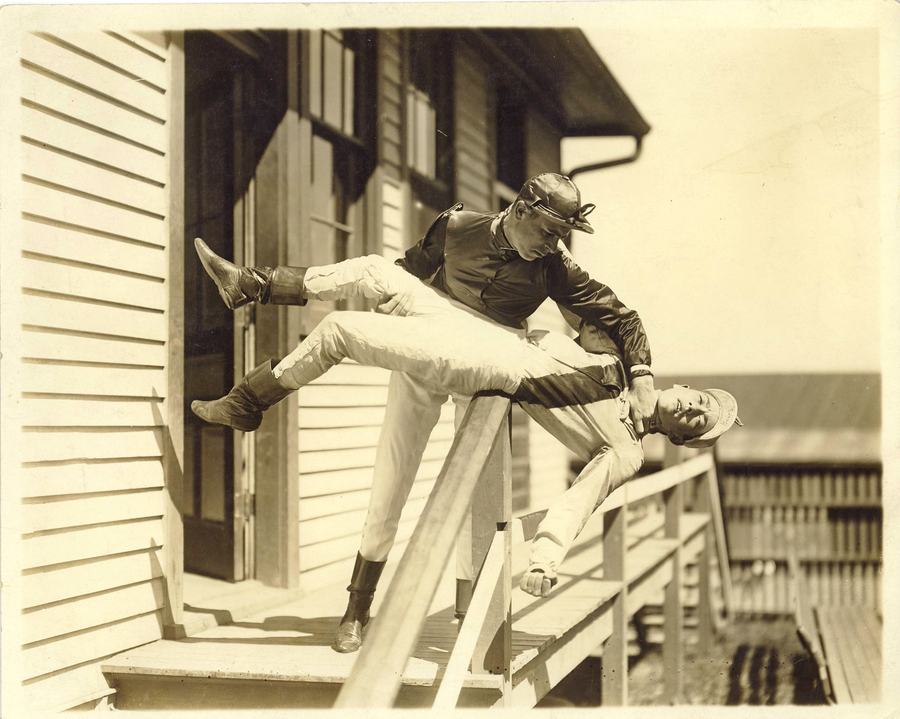
Wall Street wolves in white spats, prairie thunder on dirt tracks, and a last copper coin flipped onto the twitching flank of a scarred trotter—His Last Dollar distills the entire American mythos into a breathless 68 minutes of nitrate poetry.
Viewed today, the film feels like a time-capsule smuggled out of 1923 inside a cowboy’s saddlebag: edges frayed, emulsion scarred, yet throbbing with more pulse than most prestige miniseries daring to parade across algorithmic banners. Director David Higgins, also the scenarist, refuses to let the melodrama ossify into museum piety; instead he choreographs a three-tiered duel—between guile and gumption, between East and West, between the flicker of silent frames and the roaring appetites they depict.
Joe’s arc is less rags-to-riches than grit-to-grace. Wellington A. Playter—whose lanky gait carries the memory of every newsboy who ever dodged a trolley—plays him with a hesitation that reads as modern: a millionaire who still buttons his own cuffs, uncertain whether the applause is for the man or the wallet. In early ranch scenes, Higgins shoots Playter against vast negative space; the horizon line skews low, turning the cowboy into a cut-paper silhouette, a reminder that fortunes are only as permanent as the next dust storm.
When the story migrates to Manhattan, the visual grammar flips. Interior sets are crowded with Persian rugs, peacock fans, and gilt frames that devour light. Here, Joe’s Stetson becomes an anachronism, a black wedge signaling vulnerability amid the velvet predators. Note the moment he first unwraps a Wall Street ticker tape: the camera tilts up to his eyes, and for eight frames—just long enough for the viewer to blink—Playter lets panic perforate his grin. It’s silent-film semaphore at its most economical; no intertitle required.
Jack Pickford, forever dogged by the shadow of his megawatt sister Mary, weaponizes his boyishness here. His Tom Linson is a guttersnape made good, a social chameleon whose smile arrives half a second before his eyes, like a mask adjusting itself. Watch the way he fingers a cigar: not with the languid roll of old-money entitlement, but with the quick pinch of someone who still expects it to be confiscated. Pickford’s performance anticipates the crypto-visionaries of our decade—disrupters selling smoke, cloaked in the dialect of progress.
The screenplay gifts Linson a delectable set-piece inside the New York Stock Exchange gallery: a flurry of semaphore gestures, papers fluttering like wounded gulls, while the camera adopts a proto-Steadicam glide through the crush. Higgins overlays this with double-exposures of ticker symbols—phantom stock prices hovering like succubi. For 1923, the effect is hallucinatory, a celluloid ancestor to the data-drenched HUDs that now wallpaper every sci-fi thriller.
If Tom is the film’s id, Eleanor is its superego with a pulse. Portrayed by Betty Gray with a mix of steel and sorrow, she transcends the era’s default ingenue. Gray’s Eleanor reads balance sheets by lamplight, knows her way around a sabot round, and still finds time to pity the man who is defrauding her. Her pivotal warning scene—delivered in a single sustained medium shot—relies on eye-work alone: pupils dilating like dark suns, the glint of a tear that never falls, the subtle clench of a gloved fist. The intertitle reads merely: “Joe, they aim to break you.” Yet Gray infuses the line with operatic dread, a Cassandra in pearls.
It’s worth contrasting her with the protagonist of Lucille Love, another serial-era adventurer. Where Lucille externalized courage through acrobatics, Eleanor weaponizes information, becoming an early template for the woman who knows the ledger is sharper than any sword.
Nat G. Deverich’s Viola operates as a secondary venom, a socialite whose laughter ricochets off marble like a bullet in a bank vault. Costume designer (uncredited) drapes her in peacock feathers that quiver whenever she exhales, turning each entrance into an avian threat. Viola’s function is not mere vamp; she embodies the era’s jittery relationship with new money—applauding its arriviste energy while orchestrating its demise. In a sly visual pun, Higgins frames her beside a gilt birdcage, implying both captivity and command.
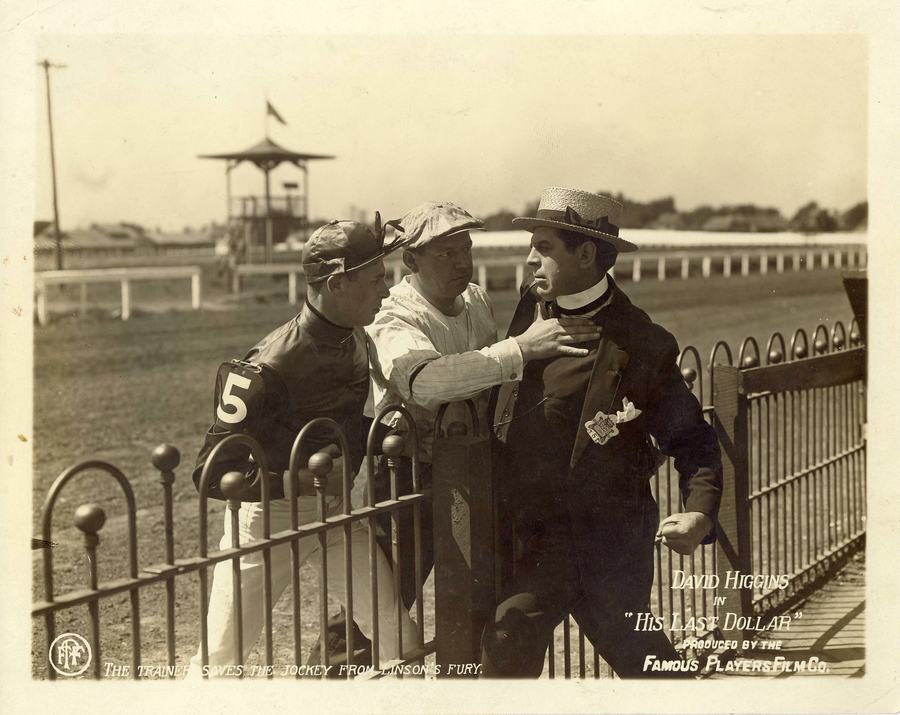
Yes, the climax hinges on a horse race—hardly revolutionary—but Higgins stages the Kentucky Futurity with such granular ferocity that the trope is reborn. Cinematographer unknown (likely shot by a committee of one-reel veterans) intercuts hooves churning soil at 16fps with crowd faces distorted by ecstasy, creating a staccato ballet that predates Seabiscuit by decades. Mongrel, a glue-factory reject with a swayback, becomes the film’s moral barometer: the embodiment of every disregarded long-shot, every newsboy’s copper coin, every woman’s whispered warning.
When Joe slaps his final dollar onto the betting window—an act photographed in chiaroscuro close-up—the gesture carries sacramental heft. The dollar is both Eucharist and ammunition; its transformation into a fistful of winnings feels less like gambling than resurrection.
Though shot in black-and-white, the film’s palette is suggested through tinting: amber for Texas dawn, cerulean for Manhattan nights, sickly green for the moments before the swindle. Modern restorations often flatten these into grayscale, but archival notes at MoMA confirm the original dye instructions. Imagine, then, the final racetrack bathed in burnt umber—money and soil conflated, the American equation stripped to its primitive pigments.
The film’s DNA splinters into later capers: The Remittance Man shares its fascination with grift in colonial garb, while As Ye Sow borrows the motif of moral reckoning arriving via agricultural metaphor. Yet His Last Dollar is leaner, more feral; it anticipates the screw-tightening fatalism of The Stain without succumbing to that film’s Gothic hysteria.
Meanwhile, continental counterparts like Les amours de la reine Élisabeth traded in regal pomp; Higgins counters with democratic dust, insisting that destiny is minted not in palaces but on racetracks where manure perfumes the air.
Surviving exhibition notes recommend a compilation of Stephen Foster melodies, punctuated by snare drum for ticker-tape sequences. Contemporary festivals often substitute generic honky-tonk, neutering the class tension. If you curate a screening, insist on live piano with lower-register dissonance during Linson’s machinations; let the unresolved tritone coil beneath the audience’s seats like a snake.
Scholars sometimes pigeonhole Eleanor as a damsel relaying a telegram of doom. Closer inspection reveals she, not Joe, engineers the narrative pivot: her intel prompts Joe to liquidate remaining assets and wager everything on Mongrel. In essence, she becomes the unseen jockey, steering destiny with a whisper rather than a whip. The film quietly awards her the moral victory while the male characters tally fiscal scores.
The script’s depiction of margin calls and phantom shares feels eerily familiar after 2008 and 2022 crypto winters. Linson’s hype of a non-existent railway is the 20th-century equivalent of a token with no blockchain. When the bubble bursts, Higgins doesn’t show boardroom panic; he shows a janitor sweeping worthless certificates, a visual shrug at the ephemerality of wealth. History, it seems, is a carousel whose painted horses rear in the same fixed orbit.
The only extant 35mm print resides in an Italian archive, plagued by vinegar syndrome along reel four. Digital scans reveal a ghost-image of the subtitle “Last Dollar” burned into the emulsion, as though the film itself became its own souvenir. Funding campaigns sputter; the niche appeal of silent rural noir pales beside safer bets like Chaplin or Saved in Mid-Air stunts. Yet to lose this film would be to misplace a Rosetta Stone of American skepticism toward easy money.
Pickford and Playter reportedly rehearsed with a metronome, calibrating gestures to 60 beats per minute to avoid the herky-jerky over-emoting that mars many silents. The result is a naturalistic gait—shoulders settle, breaths visible in the rise of lapels. Compare this to the more operatic swoons in The Fatal Wedding, where eyebrows attempt escape velocity.
Because every era needs its fable of the last coin flipped onto felt, its reminder that value is consensus hallucination. Because Betty Gray’s Eleanor deserves memetic resurrection as the patron saint of whistle-blowers. Because the thunder of Mongrel’s hooves across a nitrate strip sounds more like hope than any anthem played at a stadium.
Seek the film out, should a festival dare project it. Bring friends who still believe crypto is “inevitable.” Watch their smirk erode when the lights dim and a cowboy’s copper dollar glints like a distant star, guiding us all toward the finish line we pray exists.
IMDb —
1917
Community
Log in to comment.