DbcultAccessing Vault...
Cult Review
Senior Film Conservator
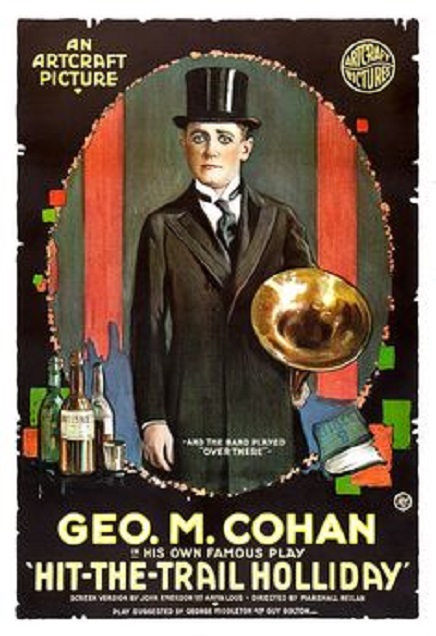
The year 1917 was a watershed moment for American cinema, a period where the primitive flickers of the nickelodeon were rapidly evolving into a sophisticated visual language. Amidst this transition, Hit-the-Trail Holliday emerged not merely as a vehicle for the incomparable George M. Cohan, but as a cultural barometer for a nation teetering on the edge of Prohibition. Directed by John Emerson and penned by the inimitable Anita Loos, the film captures a peculiar American zeitgeist where the theatricality of the pulpit began to rival the magnetism of the stage.
George M. Cohan, the man who owned Broadway, brought a specific brand of kinetic energy to the screen that few of his contemporaries could emulate. In this film, his portrayal of Billie Holliday is a masterclass in controlled charisma. Holliday is a character defined by his contradictions—a bartender who doesn't drink, a man of the world who finds himself leading a moral revolution. The screenplay, co-written by Anita Loos, sparkles with the same urbane cynicism and sharp social observation she brought to The Social Secretary. Loos had a singular talent for taking the earnestness of contemporary social movements and infusing them with a satirical edge that prevented the film from descending into mere didacticism.
Unlike the more somber explorations of vice found in films like The Bottle Imp, which treated the supernatural elements of addiction with a gothic gravity, Hit-the-Trail Holliday approaches its subject with the bounce and rhythm of a vaudeville routine. The pacing is relentless, reflecting the high-octane personality of its lead actor. Cohan doesn't just walk across a room; he vibrates with a nervous, patriotic energy that seems to anticipate the seismic shifts in American morality that were soon to follow.
The narrative arc of Holliday’s conversion is handled with a deftness that avoids the heavy-handed moralizing common in the 'dry' propaganda of the era. By positioning Holliday as a master mixologist, the film establishes his authority before he begins his crusade. This isn't a man who fears alcohol out of ignorance, but one who understands its power and chooses to reject it. This nuance is often missing in other contemporary works like The Right Direction, where moral paths are often painted in binary blacks and whites.
Holliday’s transition from the bar to the pulpit is a fascinating commentary on the intersection of celebrity and conviction. The film suggests that the same skills required to manage a rowdy saloon—quick thinking, a commanding presence, and a way with words—are the very tools needed to lead a religious revival. It’s a cynical yet honest take on the machinery of American populism. In many ways, it mirrors the adventurous spirit seen in The Americano, where the protagonist's personal drive becomes the catalyst for broader societal change.
John Emerson’s direction is characterized by a clarity of vision that was the hallmark of the Artcraft productions. The cinematography captures the contrast between the dimly lit, smoke-filled interiors of the saloons and the bright, expansive spaces of the revival meetings. This visual dichotomy serves as a metaphor for the protagonist's internal enlightenment. While it may lack the high-stakes melodrama of For the Defense or the atmospheric dread of Under galgen, the film excels in its portrayal of small-town Americana. The supporting cast, including the luminous Marguerite Clayton, provides a grounded counterpoint to Cohan’s freneticism.
One cannot ignore the technical proficiency on display. The intertitles are not merely functional but are infused with the Loos wit, providing a rhythmic cadence to the silent dialogue. The editing maintains a brisk flow, ensuring that the ideological debates never stall the narrative momentum. It is this balance of message and entertainment that makes Hit-the-Trail Holliday a standout in the 1917 catalog, far more engaging than the somewhat static presentation found in Lights of London.
As we look back through the lens of history, the film stands as a vibrant artifact of a lost world. It captures the tension of a country on the brink of a massive social experiment. While films like Lady Windermere's Fan explored the intricacies of high-society scandals, Hit-the-Trail Holliday was concerned with the soul of the common man. It shares an DNA with the rugged individualism of Smashing Through or the exotic allure of The Pool of Flame, yet it remains firmly rooted in the domestic anxieties of its time.
The performance of Richard Barthelmess, though in a smaller role, hints at the burgeoning talent that would later dominate the screen in the 1920s. The ensemble work here creates a lived-in world, from the weary brewery owners to the wide-eyed converts. It is this texture that elevates the film above the standard fare of 1917, such as the more formulaic The Spanish Jade or the procedural nature of The Doctor and the Woman.
In the final analysis, Hit-the-Trail Holliday is a triumph of persona over plot. While the story of a man changing his mind is as old as time, the way Cohan inhabits that change is what makes the film essential viewing for any serious student of silent cinema. It avoids the sentimental traps of Kitty MacKay or the rural charm of A Corner in Colleens by maintaining a sharp, almost aggressive focus on its protagonist's mission. Even the more action-oriented films of the period, like Frank Gardiner, the King of the Road, struggle to match the sheer psychological drive that Cohan brings to Holliday.
The film serves as a reminder that the early movie stars were often larger than the films they inhabited. Cohan’s Holliday is a force of nature, a whirlwind of moral certainty that sweeps through the town and the audience alike. It is a fascinating, high-energy exploration of the American spirit, captured at a moment when the world was about to change forever. For those seeking to understand the roots of American satirical cinema, this film is an indispensable milestone, offering a cocktail of wit, fervor, and theatrical brilliance that remains surprisingly potent over a century later.
IMDb 6.4
1935
Community
Log in to comment.